
Key Takeaways:
- Several Bollywood actors show publicly visible hair transformations consistent with successful hair transplant procedures
- Each celebrity's case represents a different stage of hair loss — from subtle hairline refinement (Norwood 2) to significant restoration (Norwood 4)
- The consistent factor in high-quality results: natural hairline design, appropriate density, and no visible donor scarring
- Men at any stage from Norwood 2 to 5 can achieve natural-looking results with the right technique and surgeon
- Assure Clinic's UHDHT method has delivered 20,000+ procedures with high graft survival across India and Dubai
Hair transplants are among the most searched procedures in India — and Bollywood has done more than any medical campaign to normalise them. When audiences notice that an actor looks subtly different between films — fuller temples, a lower hairline, denser crown — the conversation starts.
At Assure Clinic, we do not comment on where specific individuals had their procedures. What we can provide — as hair restoration specialists with 20,000+ procedures of experience — is a clinical reading of what publicly visible transformations reveal: the likely stage of loss, the technique consistent with the result, and what this means for anyone considering similar treatment.
Get Your Personalized Hair Transplant Cost Estimate
Takes 60 seconds. See your expected cost range based on your hair loss stage and preferred city — transparent pricing, no hidden fees.
Calculate Your Cost →Dr. Abhishek Pilani, MBBS MD Dermatology (Gold Medalist), ISHRS Member, and Founder of Assure Clinic: "Bollywood has been enormously effective at removing the stigma around hair restoration. When someone's favourite actor appears on screen with a full, natural-looking hairline and it's clear to any trained eye that restoration has occurred — it shifts the conversation from 'is this acceptable' to 'this is clearly achievable'."
Ranbir Kapoor — A Case of Early, Well-Timed Intervention

Ranbir Kapoor's hair has been a topic of public discussion for over a decade. Photographs from his early career show progressive hairline recession — a characteristic temporal withdrawal and early M-shape formation consistent with Norwood Stage 2-3.
More recent images show a hairline that appears denser, lower, and more defined than the natural progression of his loss would have produced without intervention.
What the result suggests:
The transformation is notable for its subtlety. This is not a dramatic change — it is a refined restoration that maintains a natural, slightly mature hairline appropriate for his age rather than a dramatically low or geometrically straight result. That subtlety is actually the hardest thing to achieve in hair transplant surgery.
Graft estimate (based on visible before/after): 1,500-2,000 follicular units. Classic Stage 2-3 temple refinement — the ideal window.
Clinical lesson: The best hair transplant result is one that looks like you never needed one. This requires acting early (Stage 2-3), appropriate graft density, and a surgeon who understands age-appropriate hairline design — not maximum coverage regardless of natural appearance.
Hrithik Roshan — Maintained Through Optimal Hair Health
Hrithik Roshan is often cited in this conversation because of the contrast between his father Rakesh Roshan's visible hair loss (a strong genetic signal) and Hrithik's maintained hair density. Whether through prevention, non-surgical treatment, or restoration, the result is a full, dense hairline that defies genetic expectation.
Medically, this is clinically interesting: the son of a man with significant androgenetic alopecia maintaining dense hair into his 40s speaks to one of several possibilities — early medical management (finasteride, GFC), possible surgical intervention, or particularly robust donor genetics.
Clinical lesson: Genetic predisposition to hair loss is not a foregone conclusion. Early intervention with non-surgical treatments (GFC, PRP, minoxidil) can preserve native hair for years. For those with strong family history, starting non-surgical treatment at the first signs of thinning is the most cost-effective strategy.
At Assure Clinic, patients with a family history of significant hair loss and early signs of their own loss often begin with GFC treatment to maximise the preservation window before surgical intervention becomes necessary.
Akshay Kumar — Age-Consistent Density That Tells a Story
Akshay Kumar at 56 maintains a hairline density that is noticeably inconsistent with the expected progression for someone of his age and with his family hair loss history. Comparison of photographs from the 1990s to the present shows a hairline that has, if anything, improved — rather than following the natural recession trajectory visible in his earlier career images.
What this suggests clinically: Either sustained, consistent medical management of hair loss from an early age, or — more consistent with the density improvement visible over decades — surgical restoration at one or more points combined with ongoing maintenance.
Graft estimate (based on visible before/after): If surgical, 1,500-3,000 grafts across the frontal zone and temples — consistent with a Stage 2-3 restoration at the time of procedure.
Clinical lesson: Hair restoration is not a one-time decision but a long-term strategy. The actors and public figures who maintain natural-looking results over decades typically combine transplant (for long-term restoration of thinning areas) with ongoing medical management (for native hair preservation) and non-surgical boosters (GFC post-transplant, periodic maintenance).
Salman Khan — Strategic Maintenance Over Three Decades
Salman Khan’s hair has been a topic of industry commentary for over a decade. Photographs from his earlier career show clear signs of progressive hair thinning, particularly through the mid-2010s — visible temple recession, a less defined hairline, and crown-area thinning that became apparent under bright lighting and high-definition cameras.
Recent photographs tell a different story. Compared to earlier career images, his hairline now appears more defined and temple coverage appears fuller. Whether this reflects surgical intervention, sustained non-surgical treatment, or a combination cannot be confirmed publicly — but the visible change is consistent with successful hair restoration work.
What the visible result suggests clinically: The consistent density he maintains, combined with no visible donor-area scarring in short-hair photographs, is consistent with a well-executed modern FUE-based approach — whether through a single procedure or a combination of surgical and non-surgical interventions. We have no way to verify the specifics, and Assure Clinic does not speculate about where any public figure may have received care.
Graft estimate (if a procedure did occur): 2,000-2,500 follicular units, consistent with a Norwood Stage 3 restoration addressing frontal hairline and temple areas.
Clinical lesson: Even for men who did not start hair restoration early, meaningful restoration remains possible at Stage 3 — particularly when the donor area is well-preserved. The combination of careful hairline design and appropriate graft distribution can achieve natural-looking results even when starting later than ideal.
Shah Rukh Khan — The “No Transplant” Data Point
Shah Rukh Khan is among the most frequently asked-about names in Bollywood hair transplant conversations. Based on our clinical reading of three decades of publicly available imagery: the visible evidence does not support a hair transplant.
Here is what points away from surgical restoration:
1. No density restoration event. The clinical signature of a hair transplant is a visible density INCREASE at a specific point in time — the characteristic “before-and-after” contrast. Shah Rukh Khan’s hair across decades shows the opposite pattern: a slow, continuous, age-consistent mild recession. There is no visible moment of restoration. That pattern is characteristic of natural androgenetic alopecia, not surgical correction.
2. The hairline has not returned. Comparing public appearances across his career, the hairline has gradually receded — it has never come forward. Hair transplants restore and lower a receded hairline; they do not allow one to continue receding.
3. Age-consistent temple and frontal thinning. The subtle temple recession and minor frontal thinning visible in recent photographs match what would be expected for a man his age with mild-to-moderate androgenetic alopecia — not the restored density of a transplant patient.
4. Styling disguises, it does not restore. His grooming approach works WITH his natural hair — camera angles, styling, and hair product choices that minimise the appearance of mild thinning. This is cosmetic management, not surgical restoration.
What is more consistent with the visible evidence:
- Mild-to-moderate androgenetic alopecia (approximately Norwood Stage 2-3)
- Possible long-term non-surgical management — topical minoxidil, finasteride, GFC or PRP maintenance
- Consistent expert styling and grooming discipline
- Genetic factors: not every man with hair loss progresses to significant baldness
The clinical lesson: Not every public figure with great-looking hair has had a transplant. For many men, sustained non-surgical treatment combined with appropriate styling is sufficient to maintain an age-appropriate hairline for decades. The decision to have a transplant is personal, not mandatory.
At Assure Clinic, Dr. Abhishek Pilani regularly advises men with Norwood 2-3 patterns that non-surgical treatment is often the right first step — surgery is reserved for cases where medical management has reached its ceiling.
“The best treatment is the one that matches the patient’s actual stage and goals. Not every man with early recession needs a transplant. Many do better with GFC, minoxidil, and time — and that’s a legitimate clinical outcome.”
— Dr. Abhishek Pilani, MBBS MD Dermatology (Gold Medalist), ISHRS Member
Saif Ali Khan — Temple-Focused Restoration
Saif Ali Khan provides a useful example of how a defined, limited hair transplant can transform facial framing without requiring a large-scale procedure. Earlier career photographs (late 1990s through mid-2000s) show noticeable temple recession — a classic early androgenetic pattern visible particularly in profile shots.
More recent images show restored temples and a more defined frontal hairline. The rest of the scalp appears consistent across the timeline, suggesting the restoration was targeted rather than widespread.
What the result suggests: Consistent with a temple and hairline restoration — a common, highly effective procedure for men whose hair loss is concentrated at the front third of the scalp. The targeted nature means fewer grafts, shorter recovery, and results that look completely natural because the surgeon only rebuilds what genuinely disappeared.
Graft estimate (if surgical): 1,500-2,200 grafts, focused on both temporal corners plus some frontal hairline density. Classic Stage 3 restoration territory.
Clinical lesson: Targeted restoration often outperforms broad restoration. If your hair loss is concentrated in one zone (temples only, crown only, frontal only), a focused procedure in that zone produces a better aesthetic result than distributing the same grafts thinly across a wider area.
John Abraham — The Counter-Example: Native Hair, Age-Consistent Preservation
Not every Bollywood star with great hair has had work done. John Abraham provides a useful counter-example — photographs across his career from the early 2000s to present show consistent, thick, native hair with no visible signs of androgenetic alopecia, no thinning at the crown, no temple recession.
This is what a combination of strong genetic resistance to DHT and lifelong fitness/nutrition looks like in a man now in his 50s. No restoration evident, no medical intervention required (based on what is visible), just a hair genetic profile that never entered the pattern baldness cascade.
Clinical lesson: Roughly 20-30% of men never develop significant androgenetic alopecia. If you have strong family history on both sides (father and maternal grandfather both retained hair into old age), you may be in this group. Regular monitoring — annual dated photographs — confirms preservation. For this group, fitness, sleep, and nutrition are the only interventions needed.
What this means for readers: Before you assume hair restoration is in your future, check the family evidence. Not everyone needs a transplant. If you are at Norwood Stage 1 in your late 30s with no visible progression in 2-3 years of photographs, you may simply be genetically lucky. For everyone else, early medical management buys time and protects native hair — which is still the best hair you have.
What These Cases Have in Common
Across the Bollywood transformations that hold up to scrutiny — those that still look natural 5-10 years later — several patterns emerge consistently:
| Feature | What Quality Results Share |
|---|---|
| Hairline design | Irregular, age-appropriate — not geometrically straight |
| Front edge grafts | Single-hair micro-grafts creating natural transition zone |
| Temple restoration | Natural downward angle replicated accurately |
| Density | Age-consistent — not over-dense for the person's age |
| Donor area | No visible scarring — consistent with FUE techniques |
| Result longevity | Still looks natural 5-10+ years later |
The common thread is not the clinic or the country — it is the surgical principles. Natural hairline irregularity, appropriate density graduation, accurate angle replication, and early enough intervention that the restoration doesn't have to be dramatic.
How to Spot a Hair Transplant — 5 Clinical Tells
Beyond the specific celebrity examples above, there are consistent visual markers that distinguish a well-executed hair transplant from a poor one, and both from natural hair. Knowing these markers helps you evaluate any public figure’s transformation — and, more importantly, evaluate a prospective surgeon’s before-and-after portfolio.
1. Irregular hairline edge. Natural hairlines are not straight lines. They feature subtle irregularity, stray single hairs, and micro-variation at the front edge. Transplant hairlines should replicate this. A geometrically straight line across the forehead is the single most obvious marker of a cheap or rushed transplant.
2. Single-hair grafts at the front transition zone. The first 1-2 centimetres of a natural hairline are made up almost entirely of single-hair follicular units. When a surgeon places 2-hair or 3-hair grafts at the front edge, the result looks “pluggy” — clumps of hair where individual hairs should be. Fine, single-hair front edges are a strong marker of skilled execution.
3. Natural growth angle. Hair at the hairline grows in a specific forward and slightly downward direction. Hair at the crown swirls. Hair at the temples sweeps sharply downward. A surgeon who places grafts at the wrong angle produces hair that grows in the wrong direction — immediately identifiable as transplanted. Correct angle replication is one of the most technically demanding aspects of the procedure.
4. No visible donor scar in short-hair photographs. This is the clearest distinction between modern FUE-based techniques (including Assure’s UHDHT method using UFME extraction) and older FUT/strip surgery. FUE leaves small, distributed micro-punches that heal to be effectively invisible. Strip surgery leaves a single long linear scar that becomes visible the moment the patient grows out short hair styles. Celebrity short-hair and buzzed-look photos are a good test.
5. Age-appropriate density. Natural hair has realistic density that matches the person’s age. A 30-year-old naturally has denser hair than a 55-year-old. When a transplant delivers density that is too high for the patient’s age, or too uniform across the scalp, it creates an unnaturally “young” or “doll-like” appearance. Quality restoration deliberately graduates density to look age-appropriate now and 15 years from now.
5 Red Flags of Poor-Quality Hair Transplant Work
The inverse of the above — these are the markers that a transplant was done poorly. If you see any of these in a celebrity’s before-and-after OR in a clinic’s portfolio, it is a sign the work was cheap, rushed, or performed by technicians rather than qualified doctors.
- Geometric, straight-line hairline — grafts placed along a ruler-straight edge. Never occurs naturally.
- “Pluggy” look — visible clumps of 4 or more hairs per placement, typical of older punch-graft techniques or inexperienced surgeons.
- Density mismatch — dense front with visibly sparse mid-scalp or crown behind it. Signals poor density planning and rushed execution.
- Visible linear donor scar — a single continuous line across the back of the scalp, visible with any hair style shorter than grade 3. Only occurs with FUT/strip surgery, not modern FUE techniques.
- Hair growing in wrong direction — hair at the temples standing up instead of sweeping down, or hair at the hairline pointing upward instead of forward. Angle errors during placement that cannot be corrected after the graft has settled.
“When patients ask me how to tell a good clinic from a cheap one, I tell them: look at the donor areas in short-hair photographs. If the surgeon cannot show you a buzzed-donor view, or if a linear scar is visible when they do, that is your answer. Modern FUE-based techniques like UHDHT should leave no visible scar, even at very short hair lengths.”
— Dr. Abhishek Pilani
What This Means for You
If you are experiencing hair loss and recognise yourself in any of these before photos, the clinical framework is straightforward:
Stage 2-3 (early recession, early M-shape):
- Ideal intervention window
- 1,500-2,500 grafts typically
- Non-surgical options (GFC, minoxidil) can stabilise and may be sufficient as a bridge
- Transplant results indistinguishable from natural hair when well-executed
- Ranbir Kapoor-type result achievable
Stage 3-4 (significant recession, defined M-shape or further):
- More grafts needed (2,500-4,000)
- Still excellent candidate for restoration
- Phased sessions recommended to protect graft survival
- Shami-type transformation achievable
- Post-transplant GFC strongly recommended
Stage 4-5 (advanced recession, significant crown involvement):
- Larger procedure (3,500-5,000 grafts)
- Multiple sessions across separate procedure dates
- Natural, full coverage achievable — just requires more planning and donor management
- Requires experienced surgeon for complex density and distribution decisions
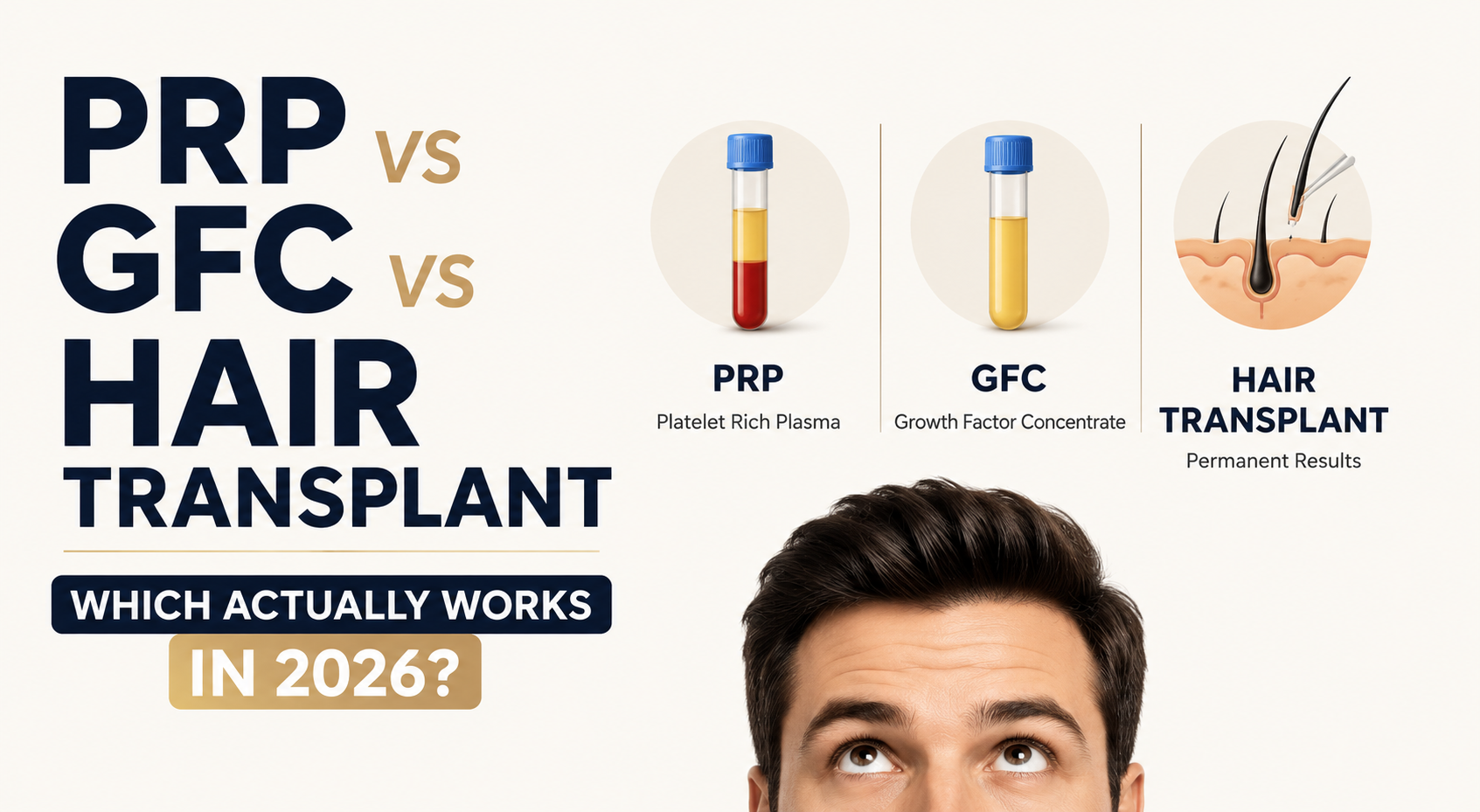
Non-surgical first? For anyone at Stage 1-2 or experiencing diffuse thinning rather than recession, Assure's GFC treatment — Growth Factor Concentrate, with 5-8x higher potency than standard PRP — is often the right first step. It does not restore a receded hairline, but for early miniaturisation it can meaningfully delay or prevent the need for surgery.
"I see patients who come in saying 'I want what Ranbir has' or 'I want what Kohli has.' My job is to translate that into a clinical plan — what stage are you at, what does your donor area look like, what is realistic for your specific hair characteristics. The goal is never the celebrity's result. The goal is the best version of your result." — Dr. Abhishek Pilani
Match Yourself to a Celebrity — Stage-by-Stage Decision Tool
If you recognise your own hair loss pattern in one of the celebrity transformations above, use this table to estimate what a comparable restoration would involve. Actual graft requirements, timeline, and outcome depend on your specific donor density, hair calibre, skin tone, and scalp anatomy — so these are starting-point estimates, not precise quotes.
| Your Norwood Stage | Closest Celebrity Example | Typical Graft Range | Recommended Technique | Timeline to Full Result |
|---|---|---|---|---|
| Norwood 2 — subtle temple recession | Ranbir-type | 1,500-2,000 grafts | Assure UHDHT, single session | 10-12 months |
| Norwood 2-3 — defined M-shape | Virat Kohli-type (full analysis) | 1,500-2,500 grafts | Assure UHDHT, single session | 10-12 months |
| Norwood 3 — temple + early frontal loss | Saif Ali Khan-type | 1,500-2,200 grafts | Assure UHDHT, single session | 12 months |
| Norwood 3-4 — significant temple and frontal recession | Shami-type (full analysis) | 2,000-3,500 grafts | Assure UHDHT, phased sessions | 12-14 months |
| Norwood 4-5 — advanced recession with crown involvement | Akshay-type (combined approach) | 3,500-5,000 grafts | Assure UHDHT phased + GFC post-op | 14 months |
| Norwood 5-6 — major restoration | Requires multi-procedure planning | 4,500-6,000+ grafts | Assure UHDHT across multiple sessions | 14-18 months |
How to use this table: Identify the stage closest to your own appearance (photographs under consistent lighting work best). Note the graft range and technique. Then book a trichoscopy consultation to confirm your exact requirements — the in-person assessment will tell you whether your donor area can support the range shown, whether you need hormonal management before surgery, and what realistic density is achievable for your specific hair characteristics.
Not sure of your Norwood stage? Take our free Norwood Stage Calculator — a 30-second visual assessment that pinpoints your stage and shows what treatment works at that level. No signup, instant result.
“Patients come in and tell me they want what a particular actor has. My job is to translate that into a clinical plan for their specific hair — what stage they are at, what their donor area can support, what is realistic for their hair calibre and skin tone. The goal is never the celebrity’s result. The goal is the best version of your result.”
— Dr. Abhishek Pilani, MBBS MD Dermatology (Gold Medalist), ISHRS Member, Founder of Assure Clinic
Related reading: Bollywood and music industry celebrities openly discuss hair restoration. Read our deep dive on Honey Singh’s reveal that he’s totally bald — and what medication-induced hair loss means for treatment decisions.
Want a Bollywood-quality result?
Use our free Baldness Calculator to check your Norwood stage in 60 seconds, then see treatment options matched to your stage.
Check My Hair Loss Stage →Considering a hair transplant?
Assure Clinic has performed 20,000+ procedures with high graft survival, led by Dr. Abhishek Pilani across 13 locations in India and Dubai.
Frequently Asked Questions
Which Bollywood actors have had hair transplants?
Several Bollywood actors show publicly visible hair transformations consistent with hair restoration procedures, including changes in hairline position, temple density, and crown coverage. We do not confirm specific procedures for individuals, as these are personal medical decisions. Our analysis is based solely on publicly visible photo comparisons.
Is it possible to get a Bollywood-level hair transplant result in India?
Yes. The quality of hair transplant results achievable in India — particularly at specialist clinics like Assure — is comparable to anywhere in the world. India has world-class hair transplant surgeons, advanced techniques (FUE, UHDHT), and a large volume of procedures that builds genuine clinical expertise.
What is the best hair transplant technique for a natural Bollywood-style result?
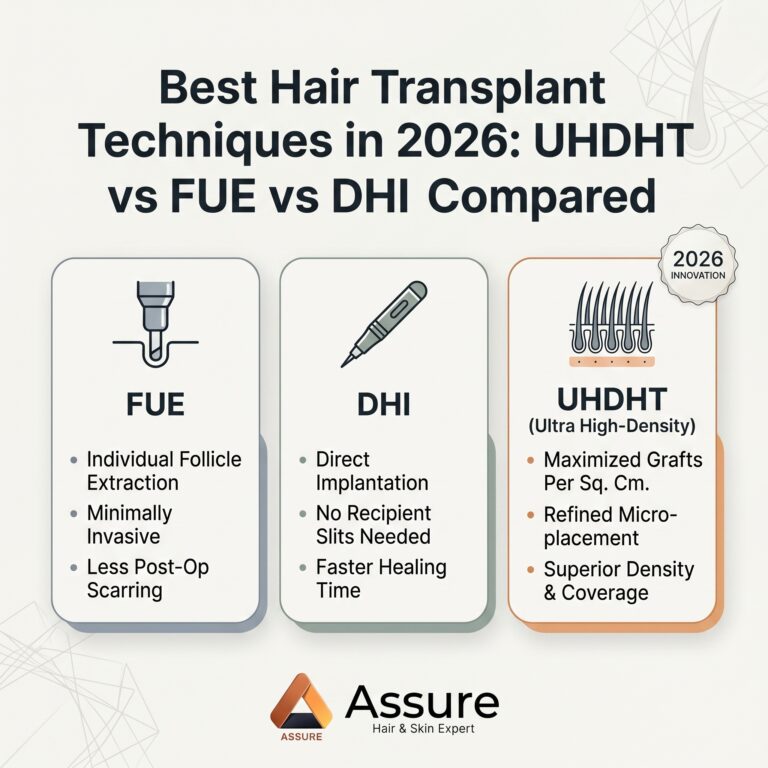
Modern FUE-based techniques, particularly Assure's UHDHT method (UFME extraction at 0.7-0.8mm + DSHI direct implantation), produce the natural-looking, scar-free results visible in the best celebrity outcomes. The technique matters, but equally important is the surgeon's hairline design skill and the doctor-led execution.
How do celebrities maintain their hair transplant results over 10+ years?
Long-term results are maintained through a combination of factors: the transplanted hair (from the DHT-resistant donor zone) is long-lasting, but surrounding native hair can continue thinning. Ongoing medical management — finasteride in appropriate candidates, GFC maintenance sessions, and monitoring — preserves native hair alongside the transplant.
How much does a hair transplant cost in India compared to abroad?
Hair transplant costs in India are significantly lower than in Europe, the US, or the Middle East for equivalent quality. At Assure Clinic, pricing is based on Full Head Results — outcome-based, transparent, with no hidden costs. Cost starts from… [book a consultation for a precise quote based on your graft requirement].
Can I achieve celebrity-level hair transplant results if I have dark, coarse Indian hair?
Yes — and in fact, Indian hair texture (typically coarser, with higher calibre per strand) often produces excellent transplant results because each graft has higher coverage per strand than fine European hair. This means achieving visual density with fewer total grafts is often more achievable for Indian patients.
What should I look for when choosing a hair transplant clinic in India?
Doctor-led procedures (not technician-led), verifiable before/after case studies, graft survival rate data, technique specifics (not just "FUE" as a generic term), and a consultation that includes trichoscopy rather than just a quote. Assure Clinic offers all of these across 13 locations with 60+ qualified doctors.
Is hair transplant permanent for celebrities — will they need another one?
Transplanted hair is long-lasting — it comes from the DHT-resistant donor zone and maintains its resistance after transplantation. What is not permanent is the patient's surrounding native hair, which can continue thinning over decades. Most patients benefit from ongoing medical management to protect native hair, and some choose additional sessions as loss progresses.
How much does a Bollywood-quality hair transplant cost in India?
Hair transplant pricing in India at quality doctor-led clinics follows outcome-based Full Head Results pricing rather than per-graft charges. The exact cost depends on the number of grafts required, the complexity of the design, and whether post-procedure GFC or medical management is included. At Assure Clinic, initial consultation with trichoscopy assessment is free, and a transparent total quote is provided once your graft requirement is confirmed. EMI options are available across all 13 locations.
How long do celebrity hair transplant results last?
The transplanted hair is long-lasting because it comes from the DHT-resistant donor zone at the back and sides of the scalp. Transplanted follicles retain this resistance long-term. However, the native hair surrounding the transplant can continue thinning if the underlying androgenetic alopecia is not medically managed. This is why most celebrities who maintain consistent results over 10-20 years combine a transplant with ongoing medication (finasteride, minoxidil) or periodic GFC sessions.
Can I really get a Bollywood-quality hair transplant at Assure Clinic?
Yes. The same clinical techniques — UHDHT (UFME extraction with 0.7-0.8mm micro-punch + DSHI direct implantation) — used to produce the high-quality results visible in Bollywood transformations are used at Assure Clinic for every patient. Every procedure is performed by a qualified doctor, never delegated to technicians. Across 20,000+ procedures at 13 locations, Assure maintains high graft survival, which is the single strongest predictor of a natural-looking final result.
Take the Next Step
The gap between before and after in the cases above is real — and it was achieved through precise surgical planning, experienced execution, and appropriate technique selection. The same tools are available at Assure Clinic.
A trichoscopy consultation with our Medical Consultants will map your current hair loss, identify your Norwood stage, assess donor density, and outline what is genuinely achievable for your specific hair characteristics.
India: +91 95861 22444 | WhatsApp: wa.me/919586122444 | Dubai: +971 547 370 350 13 locations across India + Dubai.
Disclaimer
This article is editorial commentary based on publicly available photographs and information. It does not confirm that any named individual has undergone a hair transplant or any other medical procedure — all observations are clinical inferences drawn from public images, not statements of fact. No named celebrity has endorsed Assure Clinic or is affiliated with us unless explicitly stated. This article is not medical advice; treatment decisions require an in-person consultation and trichoscopy assessment. If any named individual or their representative believes information in this article should be corrected or removed, please contact info@assureclinic.com and we will review promptly.
Last Updated: April 2026 Medically Reviewed by Dr. Abhishek Pilani, MBBS MD Dermatology (Gold Medalist), ISHRS Member, DHA Licensed