Norwood Scale: The 7 Stages of Male Pattern Baldness (2026 Guide)
The Norwood Scale is the medical system used to classify the 7 stages of male pattern baldness — from a full head of hair to complete baldness on the crown. Identify your stage in 30 seconds, see which treatments work at each stage, and understand when a hair transplant becomes the only option that delivers long-lasting results.
The Norwood Scale is the medical system used to classify the 7 stages of male pattern baldness, from a full head of hair to complete baldness on the crown. It helps you spot exactly where you are in the hair loss cycle, which stage is reversible with medication, and when a hair transplant becomes the only option that delivers long-lasting results. This guide walks you through every Norwood stage with photos, shows which treatments work at each stage, and explains how qualified doctors at Assure Clinic use the scale to plan treatment for 20,000+ patients with high graft survival.
7 Distinct Stages
From minimal temple recession to extensive crown and frontal hair loss
Since 1970s
Developed by Dr. O'Tar Norwood, the global standard for hair loss classification
Treatment Guide
Each stage has recommended treatments from PRP therapy to UHDHT transplant
What Is the Norwood Scale?
The Norwood Scale, sometimes called the Norwood-Hamilton Scale, was developed by Dr. James Hamilton in the 1950s and refined by Dr. O'Tar Norwood in 1975. It remains the gold standard for classifying male pattern baldness (androgenetic alopecia) today.
The scale works by mapping two hair loss patterns:
Receding hairline at the temples (the corners of the forehead)
Crown thinning at the top-back of the head (the vertex)
As hair loss progresses, these two zones eventually meet, leaving only a horseshoe pattern of hair around the sides and back of the head. The Norwood Scale tracks that progression through 7 distinct stages — plus a Stage 3 Vertex variant — so that treatment can be matched precisely to the extent of loss.
Why qualified doctors rely on it:
Consistent language across clinics and specialists worldwide
Matches the right treatment to the stage accurately
Predicts the likely future hair loss trajectory
Sets realistic expectations for hair transplant outcomes and graft counts
All 7 Norwood Stages Explained
Compare your hairline and crown with the reference images below to identify your stage.
Stage
Reference
Patient
Result
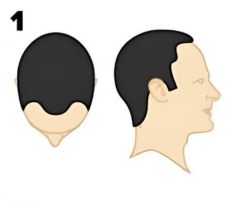
1No Hair Loss
Norwood Stage 1
Represents an adolescent or juvenile hairline and is not actually balding. The adolescent hairline generally rests on the upper brow crease. No recession is visible.
No treatment required at this stage. Preventive care with PRP or QR678 therapy can maintain hair health.
Estimated Grafts:0 (monitoring only)
Reference
✓ No treatment needed — healthy juvenile hairline
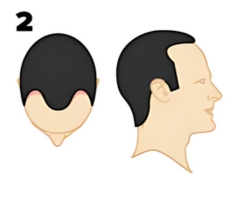
2Minimal Recession
Norwood Stage 2
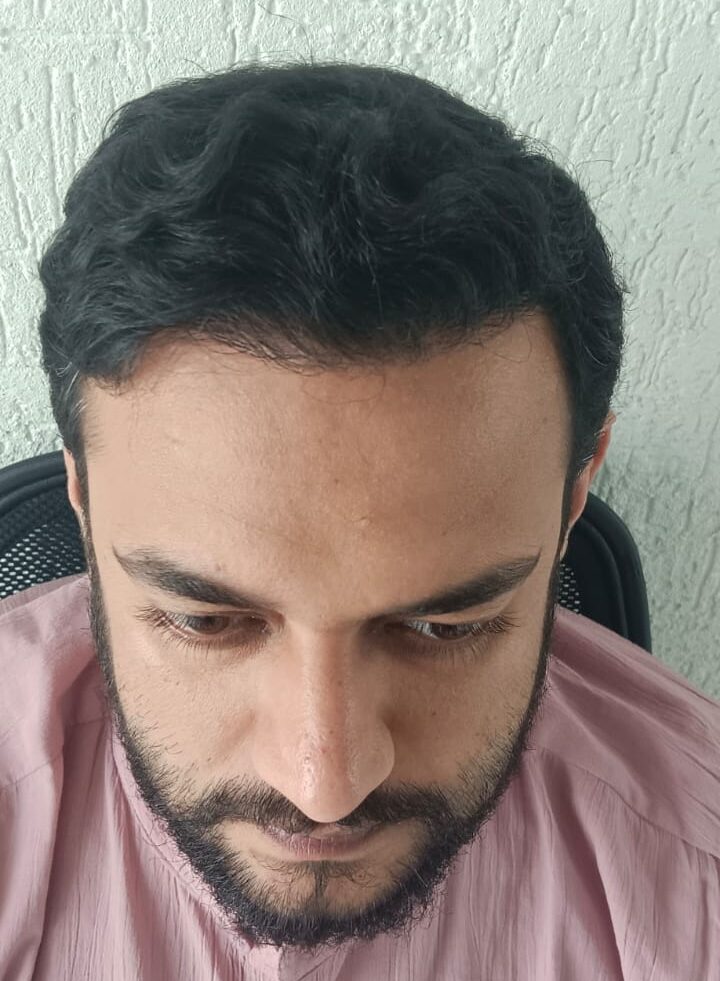
Indicates a progression to the adult or mature hairline that sits a finger's breadth (1.5 cm) above the upper brow crease, with some temporal recession. This also does not represent balding.
Early intervention with PRP therapy or QR678 can slow progression and maintain density.
Estimated Grafts:500–1,000
Reference
Patient
Result
UHDHT Result
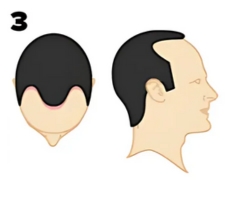
3Early Hair Loss
Norwood Stage 3
The earliest stage of clinically significant male hair loss. It is characterised by a deepening temporal recession that extends beyond the mature hairline.
Hair transplant using UHDHT technique delivers excellent results. Combined with QR678 for optimal density.
Estimated Grafts:1,000–1,500
Reference
Patient
Result
UHDHT Result
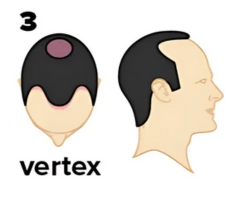
3VCrown Thinning
Norwood Stage 3 Vertex
Represents early hair loss in the crown (vertex) area while the frontal hairline may remain relatively intact. The bald spot at the crown is usually round or oval.
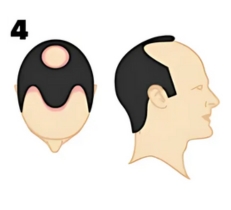
Characterised by further frontal hair loss and enlargement of vertex, but there is still a solid band of hair across the top (mid-scalp) separating front and vertex.
UHDHT hair transplant is highly effective. Our exclusive technique ensures maximum graft survival and natural density.
Estimated Grafts:1,500–2,500
Reference
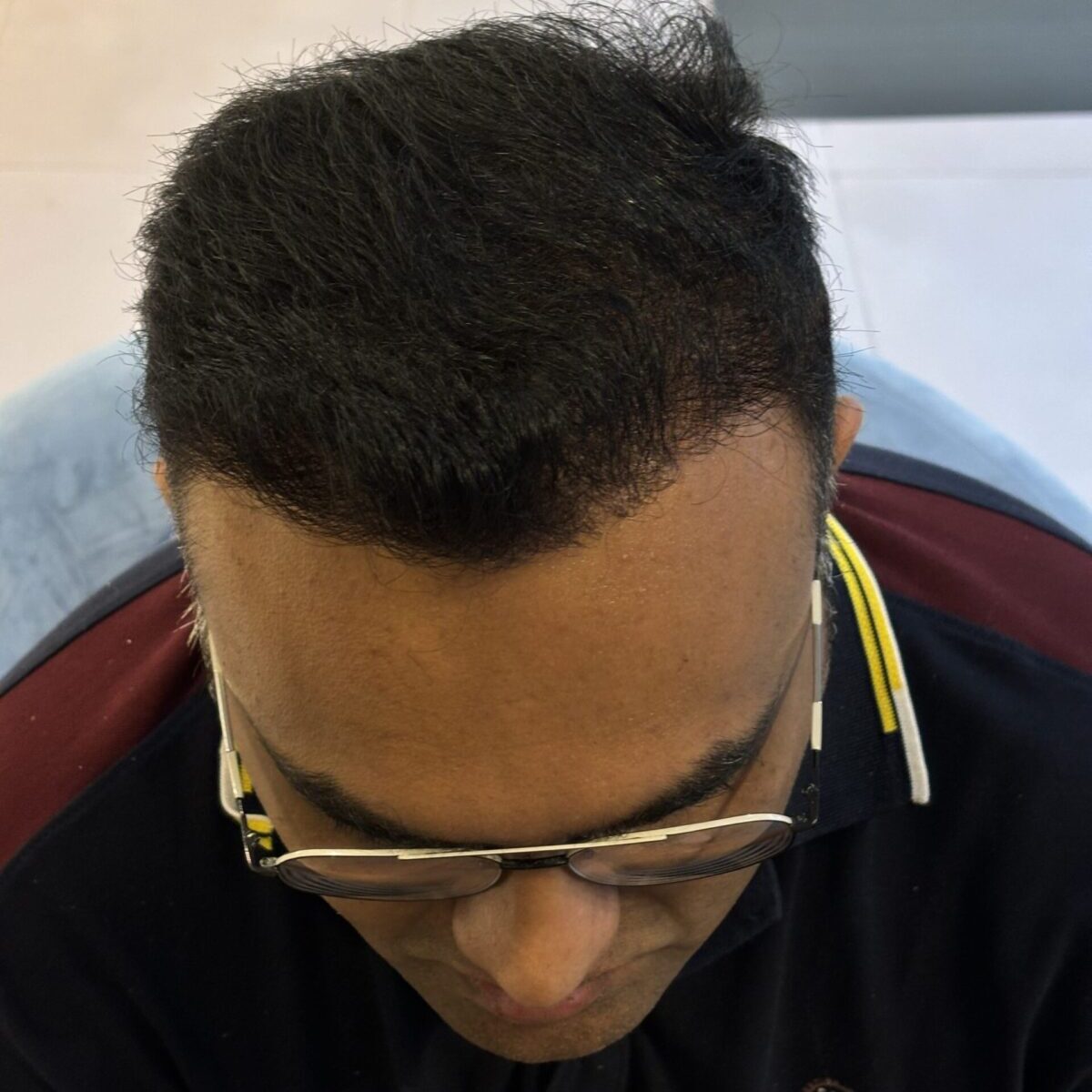
Patient
Result
UHDHT Result
5Advanced Loss
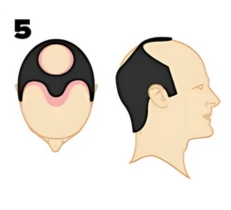
Norwood Stage 5
The bald areas in the front and crown continue to enlarge and the bridge of hair separating the two areas begins to break down.
Custom multi-session UHDHT transplant plan. Our experts design a personalised approach for comprehensive coverage.
Estimated Grafts:2,500–3,500
Reference
Patient
Result
UHDHT Result
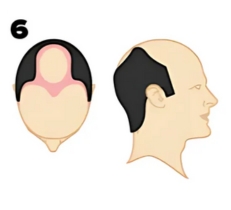
6Extensive Loss
Norwood Stage 6
Occurs when the connecting bridge of hair disappears leaving a single large bald area on the front and top of the scalp. The hair on the sides of the scalp remains relatively high.
Advanced multi-session UHDHT with strategic donor management. Our qualified doctors create a complete restoration plan.
Estimated Grafts:3,500–4,500
Reference
Patient
Result
UHDHT Result
7Complete Crown Loss
Norwood Stage 7
The most advanced stage of male pattern baldness. Only a narrow band of hair remains in a horseshoe shape around the sides and back of the head. The remaining hair is often fine and thin.
Multi-session UHDHT with strategic donor management, including body hair transplant (BHT). Scalp micropigmentation (SMP) may complement for density illusion.
Estimated Grafts:4,500–6,000+
Reference
Consult our experts for a personalised multi-session restoration plan.
How to Determine Your Norwood Stage
You can identify your approximate Norwood stage at home with this simple 4-step self-assessment:
Examine your hairline — Stand in front of a well-lit mirror. Is your hairline straight, or do you see recession at the temples? Compare with Stages 1-3 above.
Check your crown — Use a second mirror or take a photo of the top of your head. Look for thinning or a bald spot at the vertex (crown). This distinguishes Stage 3V from Stage 3.
Assess the bridge — Is there still a solid band of hair connecting your front hairline to your crown? If the bridge is thinning, you may be at Stage 4-5.
Consider family history — Look at your father and maternal grandfather. Their pattern often predicts your trajectory. If both had extensive loss, plan for proactive treatment.
For a more accurate assessment, our qualified doctors use digital scalp analysis and hair density measurements during a free consultation.
Graft counts are estimates. Exact numbers depend on donor quality, hair characteristics, and coverage goals. Book a free consultation for an accurate assessment.
Norwood Scale vs Ludwig Scale (Women)
The Norwood Scale is designed specifically for male pattern baldness, which typically presents as a receding hairline and crown thinning. Women experience hair loss differently — usually as diffuse thinning across the top of the scalp without a receding hairline.
Female hair loss is classified using the Ludwig Scale, which has 3 stages:
Ludwig Stage 1: Mild thinning on the crown, often unnoticeable
Ludwig Stage 2: Widened part line with noticeable thinning
Ludwig Stage 3: Extensive thinning across the entire top of the scalp
The most common regret we hear from patients is: "I wish I had started earlier." Here is a stage-by-stage treatment guide:
Stage 1–2: Monitor & Prevent
No transplant needed yet. Focus on PRP therapy, QR678 growth factors, and medical management (minoxidil, finasteride) to slow or halt progression. See our hair fall control guide for the full early-stage protocol. This is the window where non-surgical options work best.
Stage 3–4: The Sweet Spot for Transplant
This is the ideal window for a single-session UHDHT hair transplant. The donor area is strong, graft requirements are manageable (1,000-2,500), and results look the most natural. Most of our patients fall in this range.
Stage 5–7: Advanced Restoration
Still treatable, but requires strategic planning. Multi-session UHDHT with careful donor management is essential. Body hair transplant (BHT) may supplement limited scalp donors. Scalp micropigmentation (SMP) can add perceived density. The earlier you act, the more donor hair is available for a comprehensive result.
The bottom line: the earlier you act, the more options you have. Every year of delay means fewer follicles to work with. Book a free consultation to understand your options before it progresses further.
Hair Transplant Outcomes by Norwood Stage
At Assure Clinic, outcomes depend on your starting stage and donor area quality. Based on 20,000+ procedures with high graft survival, here is what patients at different Norwood stages can typically expect:
Stage 3–4: Near-complete frontal restoration is possible with 1,500–2,500 grafts in a single UHDHT session. This is the sweet spot — donor density is strong, graft counts are manageable, and results look the most natural.
Stage 5: 2,500–3,500 grafts across phased sessions restore strong framing of the face and reasonable crown coverage. Graft planning becomes critical because donor supply is finite.
Stage 6–7: Restoration is still possible but limited by donor supply. The realistic goal shifts to framing the face and creating the appearance of density, sometimes supplemented with body hair transplant (BHT) or scalp micropigmentation (SMP).
UFME (Ultra Fine Micro Extraction) with a 0.7–0.8 mm punch for minimal scarring in the donor area
DSHI (Direct Simultaneous Hair Implantation) for maximum graft survival at high density
All procedures are performed by qualified doctors across phased sessions — never marathon procedures that compromise graft survival. For detailed stage-wise pricing, see our hair transplant cost in India guide.
Treatment Options by Stage
Our qualified doctors recommend the most effective treatment based on your Norwood classification.
Early Stage
Norwood Stage 1–2
Preventive care to maintain existing hair density and slow any progression.
Not sure which stage you are? Take our free Baldness Calculator to identify your Norwood stage and get personalised treatment recommendations from our qualified doctors.
Book a free consultation with a Medical Consultant at Assure Clinic if you notice any of these:
Hair fall of more than 100 strands daily for 3 months or longer
Visible widening at the temples or a bald spot forming on the crown
Family history of early baldness (father, grandfathers, or uncles)
Sudden thinning at any age, especially if progressing fast
Patches of complete hair loss — may indicate alopecia areata rather than pattern baldness
The sooner you act, the more treatment options remain open. At Norwood Stage 2–3, medication and PRP therapy can often maintain or partially restore hair. By Stage 4, a hair transplant becomes the only way to regrow hair in fully bald zones. Explore our hair fall control guide for early-stage protocols, or read hair fall reasons to understand what is driving your loss.
Medical Consultants conduct your first assessment. If clinical treatment is required, you meet a qualified doctor before any procedure is planned. Call +91 95861 22444 or WhatsApp us here to get started.
Frequently Asked Questions
Common questions about the Norwood Scale and hair loss treatment.
The Norwood Scale (also known as the Hamilton-Norwood Scale) is a widely accepted classification system that measures the extent and pattern of male pattern baldness. Developed by Dr. O'Tar Norwood in the 1970s, it categorises hair loss into seven distinct stages — from Stage 1 (no significant hair loss) to Stage 7 (the most extensive pattern of hair loss). It helps hair restoration specialists assess your condition and recommend the most appropriate treatment.
You can get a preliminary idea by comparing your hairline and crown area with the reference diagrams on this page. However, for an accurate assessment, we recommend consulting with our qualified doctors at Assure Clinic. You can also take our free online Baldness Calculator assessment for a quick evaluation. A professional consultation will factor in family history, rate of progression, and donor area quality to determine your exact stage.
Hair transplant is most effective from Norwood Stage 3 onwards, where there is clinically significant hair loss. For Stages 1-2, non-surgical treatments like PRP therapy and QR678 are typically recommended to maintain existing hair. For Stages 3-6, our exclusive UHDHT (Ultra High-Density Hair Transplant) technique delivers natural-looking, high-density results with high graft survival. For advanced stages (Stage 5-7), a customised multi-session approach may be planned for optimal coverage.
UHDHT (Ultra High-Density Hair Transplant) is Assure Clinic's umbrella technique that combines our exclusive UFME (extraction) and DSHI (implantation) methods. Understanding your Norwood Stage helps our experts determine the number of grafts needed, the optimal hairline design, and the strategic placement pattern. Higher Norwood stages typically require more grafts and may benefit from multi-session UHDHT for comprehensive restoration.
We recommend consulting a qualified doctor as soon as you notice receding temples, thinning at the crown, or increased hair fall. Early intervention (Norwood Stage 2-3) offers the best outcomes because more treatment options are available, and preventive therapies can slow or halt further progression. At Assure Clinic, our free consultation includes a detailed scalp analysis, Norwood classification, and a personalised treatment plan tailored to your goals.
The number of grafts depends on your Norwood stage and desired density. Stage 2 typically needs 500-1,000 grafts, Stage 3 needs 1,000-1,500, Stage 4 needs 1,500-2,500, Stage 5 needs 2,500-3,500, Stage 6 needs 3,500-4,500, and Stage 7 may require 4,500-6,000+ grafts across multiple sessions. These are estimates — your exact graft count will be determined during a free consultation based on your donor area quality, hair characteristics, and coverage goals.
The Norwood Scale classifies male pattern baldness (receding hairline and crown thinning), while the Ludwig Scale classifies female pattern hair loss (diffuse thinning across the top of the scalp without a receding hairline). Women typically experience overall thinning rather than the distinct recession pattern seen in men. Assure Clinic treats both patterns — men with UHDHT and women with our specialised no-shave DSHI technique.
Yes, but it requires careful planning. Norwood Stage 7 patients have limited donor area, so a multi-session approach with strategic graft placement is essential. Body hair transplant (BHT) from the chest or beard may supplement scalp donors. Scalp micropigmentation (SMP) can also complement the transplant for added density illusion. At Assure Clinic, our experts create a realistic restoration plan during a free consultation.
Ready to Start Your Transformation?
Consult with our qualified doctors and get a personalised treatment plan for your hair loss stage.