
Key Takeaways:
- Virat Kohli's publicly visible hair transformation shows classic signs of a successful hair transplant — restored hairline, increased temple density, natural growth angle
- Based on visible before/after images, he showed Norwood Stage 2-3 recession before the change
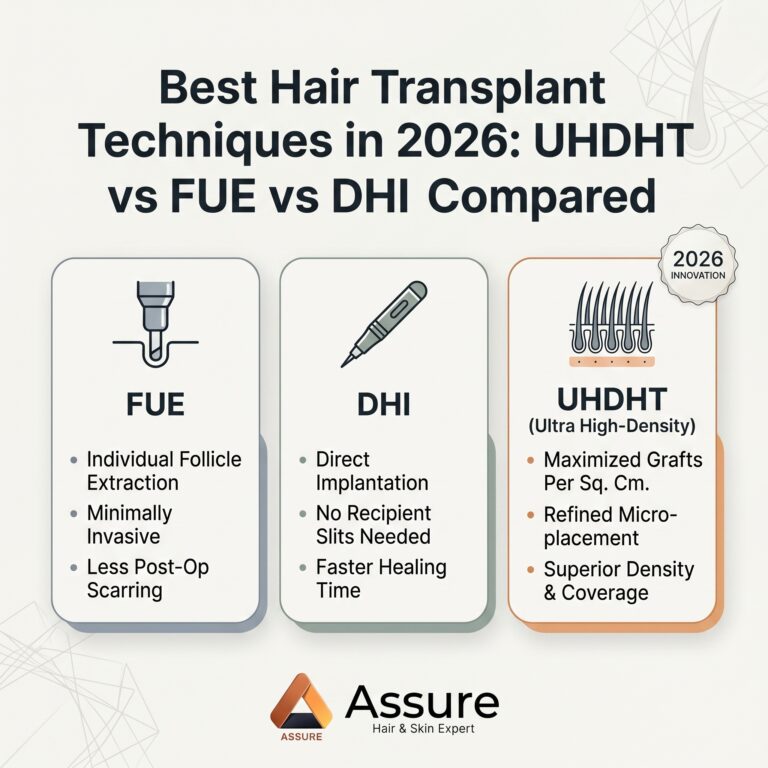
- The result is consistent with modern FUE-based transplant techniques achieving high graft survival
- Men with similar temple recession and crown thinning can achieve comparable results with the right technique
- At Assure Clinic, Dr. Abhishek Pilani has performed 20,000+ procedures with high graft survival using the UHDHT method
Few transformations in Indian cricket have been discussed as much as Virat Kohli's hair. Compare photographs from his early international career to recent years, and the difference is unmistakable: a fuller, more defined hairline, denser temples, and the kind of coverage that doesn't come from styling alone.
Hair transplants among public figures remain private choices. At Assure Clinic, we do not speculate about where anyone received their procedure. What we can do — as hair restoration specialists with 20,000+ procedures of experience — is analyse what the publicly visible transformation tells us clinically: what stage of loss was addressed, what technique is consistent with the result, and what this means for men experiencing similar changes.
Get Your Personalized Hair Transplant Cost Estimate
Takes 60 seconds. See your expected cost range based on your hair loss stage and preferred city — transparent pricing, no hidden fees.
Calculate Your Cost →Dr. Abhishek Pilani, MBBS MD Dermatology (Gold Medalist), ISHRS Member, and Founder of Assure Clinic: "The Kohli transformation is a well-observed case in the hair restoration community because it is so clearly documented over years of public life. The result is excellent — natural hairline design, appropriate density for age, and no visible signs of the unnaturally uniform density that poor-quality transplants produce."
What Virat Kohli's Hair Looked Like Before
For anyone who followed Indian cricket between 2015-2020, the progression was visible: a slightly receding temporal region, particularly at the right temple, with some crown area thinning detectable under bright stadium lighting.
Using the Norwood Scale — the standard clinical classification for male hair loss stages — Kohli's visible loss placed him at approximately Norwood Stage 2-3:
- Stage 2: Slight recession at the temples, hairline still relatively intact
- Stage 3: More defined temple recession, hairline beginning to show an M-shape
This is actually the ideal intervention window from a hair transplant perspective. At Stage 2-3, the donor hair at the back and sides of the scalp is abundant, the zone of recession is defined and predictable, and the number of grafts required (typically 1,500-2,500 for this stage) allows for natural density without depleting the donor area.
"Stage 2-3 is when I always tell patients: this is the time. You have maximum donor availability, minimum area to cover, and the results look indistinguishable from natural hair. Waiting until Stage 5-6 dramatically increases complexity and graft requirements." — Dr. Abhishek Pilani
What the Results Suggest About the Technique
Analysing the visible outcome — as seen in photographs from 2021 onwards — several characteristics are consistent with high-quality modern hair transplant techniques:
1. Natural hairline design The hairline is not a straight line. It follows the slight irregularity and micro-variation that characterises natural hairlines — single-hair grafts at the front edge, transitioning to 2-3 hair grafts behind. This is the hallmark of careful hairline design, not transplant shortcuts.
2. Appropriate density The density achieved is realistic — not the over-dense, "doll-hair" appearance that older or lower-quality techniques produce. Density matches age-appropriate expectations and doesn't look surgically uniform.
3. No visible scarring Based on publicly available images showing shorter hairstyles during the 2021-2023 IPL seasons, there is no visible linear scar in the donor area — consistent with FUE-based extraction (follicular unit extraction), not older strip/FUT methods.
4. Natural growth angle and direction Hair at the temples and hairline falls in the correct direction — slightly forward at the front, sweeping back at the sides. Matching natural growth angles is one of the most technically demanding aspects of hairline restoration, and the results here are consistent with skilled surgical execution.
| Feature | What's Visible | Clinical Interpretation |
|---|---|---|
| Hairline shape | Natural, irregular, not geometric | Careful graft placement with mixed 1 and 2-hair units |
| Temple density | Full, matching crown density | Approximately 40-50 FU/cm² — high-quality result |
| Donor area | No visible scarring in short-hair images | FUE-based extraction (0.8-1mm punch) |
| Growth angle | Natural anterior-superior direction | Experienced surgeon placing grafts at correct angle |
| Uniformity | Slightly variable — natural looking | Avoids the "pluggy" look of older techniques |
If Kohli’s transformation has you considering the same procedure, here is where to go next. Explore Assure Clinic’s UHDHT procedure, see your nearest flagship at best hair transplant in Mumbai, or check hair transplant cost.
What This Means for Men With Similar Hair Loss
If you recognise your own hairline in Kohli's before photos — temple recession starting in your 20s or 30s, early crown thinning — the clinical lesson is straightforward: this type of hair loss is eminently treatable, and the results can be excellent.
The key factors that determine whether you can achieve a comparable result:
1. Act early The Kohli transformation worked partly because intervention happened before loss became advanced. Early-stage transplants use fewer grafts, achieve higher density per area, and produce more natural results. The same procedure at Norwood Stage 5-6 requires 4,000-6,000 grafts and produces a different — though still positive — result.
2. Graft survival matters more than graft count A transplant that places more grafts but loses many of them can look thinner than one that places fewer grafts that mostly survive. Assure Clinic's UHDHT method (UFME extraction at 0.7-0.8mm + DSHI implantation) achieves high graft survival through phased sessions that ensure each graft spends minimal time outside the body.
3. The technique is doctor-led or it isn't In India, a significant percentage of hair transplants are performed by technicians, not doctors. The hairline design, graft placement angle, and density distribution decisions that produce a natural result require medical training and surgical judgement. At Assure Clinic, every procedure is performed by a qualified doctor — never delegated to a technician.
4. Hairline design is an art The difference between a natural-looking result and a transplant that "looks like a transplant" often comes down to hairline design — specifically how the surgeon places single-hair micro-grafts at the front edge to create an irregular, age-appropriate transition zone. This is the most visible 2 centimetres of any transplant.
Could You Get a Similar Result at Assure Clinic?
For men at Norwood Stage 2-3 with similar temporal recession:
The procedure: Assure's UHDHT method — using UFME (Ultra Fine Micro Extraction, 0.7-0.8mm punch) for extraction and DSHI (Direct Simultaneous Hair Implantation) for placement. This is Assure's exclusive technique for achieving high-density results with minimal trauma to grafts.
Graft estimate: 1,500-2,500 grafts for Stage 2-3 temple and hairline restoration. This is a single session procedure at Assure.
Recovery: 7-10 days visible redness and scabbing. Transplanted hairs shed at 4-6 weeks (normal). New growth visible at 3-4 months. Full result at 10-12 months.
The graft survival difference: Assure's phased, doctor-led approach and immediate implantation (DSHI) minimises the time grafts are outside the body — the primary cause of graft death in lower-quality procedures.
"If a patient comes to me at Stage 2-3 wanting the result they've seen on Kohli, I tell them: you have everything going in your favour. The donor area is full, the area to cover is small, and you're in the ideal window. The technique and execution are what determine the final result." — Dr. Abhishek Pilani
If you are considering a similar restoration, our Mumbai hair transplant clinic performs UHDHT procedures at 3 locations (Andheri, Pedder Road, Navi Mumbai) — the same method used to achieve the kind of dense, natural hairlines visible in cricket and Bollywood transformations.
Related reading: Not all celebrity hair loss is from genetics. See our explainer on Honey Singh’s medication-induced hair loss — why 7 years of bipolar medication caused complete baldness and what recovery looks like.
Curious about a Kohli-style restoration?
Use our free Baldness Calculator to check your Norwood stage in 60 seconds, then see treatment options matched to your stage.
Considering a hair transplant?
Assure Clinic has performed 20,000+ procedures with high graft survival, led by Dr. Abhishek Pilani across 13 locations in India and Dubai.
Considering treatment options?
Frequently Asked Questions
Did Virat Kohli get a hair transplant?
Virat Kohli has not publicly confirmed or denied a hair transplant. What is publicly visible — from comparison of photographs over multiple years — is a significant and sustained improvement in hairline density and temple coverage consistent with a successful hair transplant procedure. This analysis is based solely on publicly available images.
What Norwood stage was Virat Kohli at before?
Based on publicly visible photographs from approximately 2018-2020, Kohli appeared to be at Norwood Stage 2-3 — characterised by temporal recession beginning to form the early M-shape, with some crown thinning visible under bright lighting.
What hair transplant technique did Virat Kohli use?
The visible results — no linear scar in short-hair photographs, natural hairline design, appropriate density — are consistent with FUE (Follicular Unit Extraction) based techniques. This is the standard for scar-free, natural-looking transplants today. We do not have confirmed information about the specific technique or clinic.
How many grafts would a transplant like Virat Kohli's need?
For Norwood Stage 2-3 temple recession and hairline restoration, a typical graft count is 1,500-2,500 follicular units. This is a relatively modest number, which is why Stage 2-3 is the ideal window — the area to cover is small, requiring fewer grafts while achieving high density.
Can I get the same result as Virat Kohli at Assure Clinic?
If you are at a similar stage of hair loss (Norwood 2-3, temple recession), yes — Assure Clinic regularly performs hairline restoration procedures with similar outcomes. The result depends on your donor density, hair calibre, and skin tone. A trichoscopy consultation with Assure's Medical Consultants will give you a realistic assessment.
At what age did Virat Kohli get a hair transplant?
Based on publicly visible photo comparisons, any procedure would have occurred when Kohli was in his late 20s to early 30s — which is actually the optimal age range for hairline transplants. Donor hair is at peak density, the zone of loss is defined, and the result has time to fully mature.
Is hair transplant worth it for a receding hairline like Kohli's?
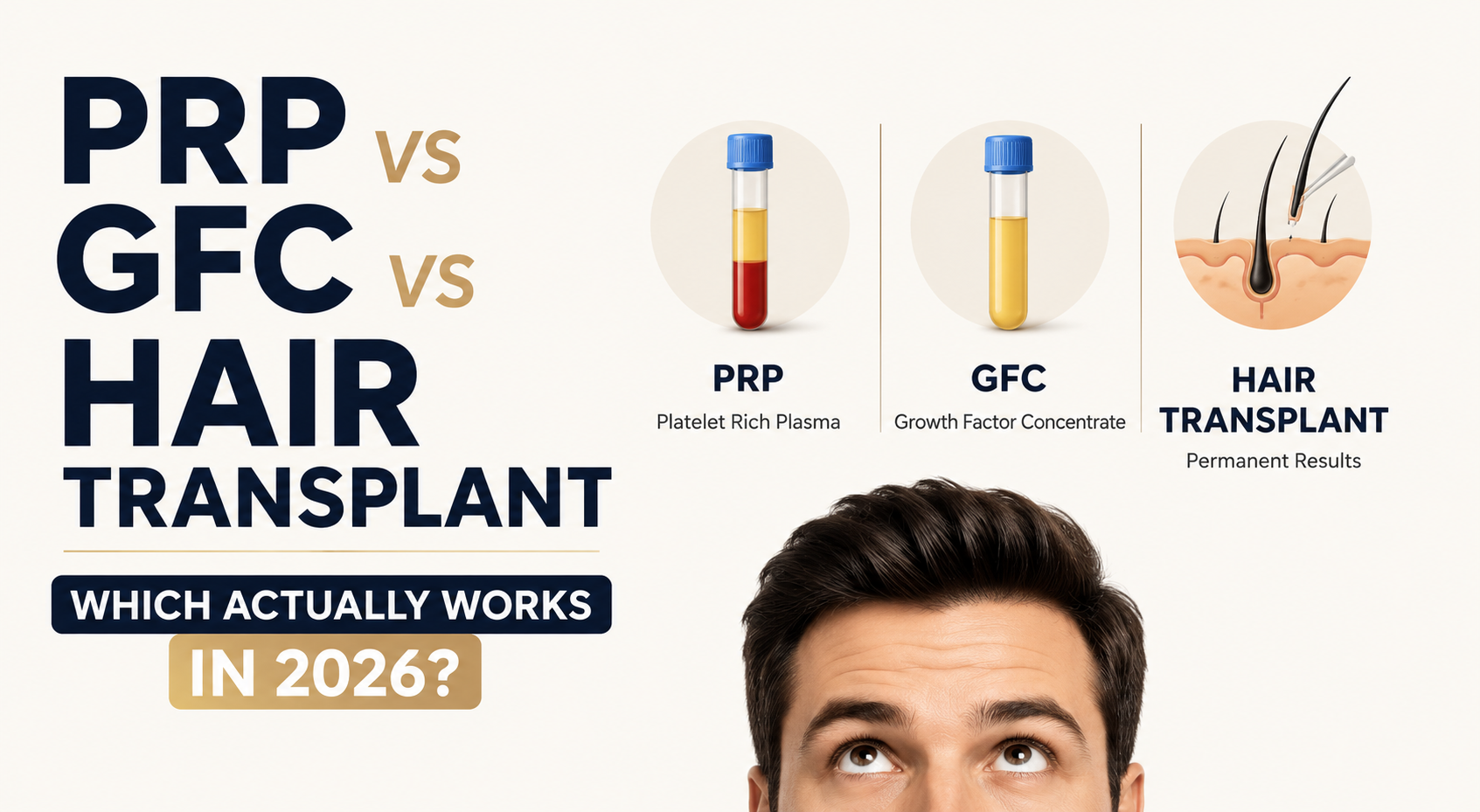
For Norwood Stage 2-3, a hair transplant is one of the highest-satisfaction procedures in cosmetic medicine. The graft requirement is manageable, results are natural, recovery is complete within 12 months, and the restoration is long-lasting. Non-surgical options (GFC, minoxidil) are valid earlier but cannot restore a hairline that has already receded.
Which hair transplant clinic in India is best for hairline restoration?
Assure Clinic, founded by Dr. Abhishek Pilani (MBBS MD Dermatology Gold Medalist, ISHRS Member), specialises in hairline restoration using the UHDHT method across 13 locations in India. With 20,000+ procedures and high graft survival, Assure is one of India's most experienced hair restoration specialists.
Book a Hairline Consultation
If you are experiencing temple recession or hairline changes similar to what you've seen in public figures, the most useful step is a trichoscopy assessment — a clinical map of your follicle density, miniaturization pattern, and donor availability.
At Assure Clinic, all consultations are conducted by experienced Medical Consultants and backed by Dr. Abhishek Pilani's protocols. We will tell you exactly what is possible for your specific hair loss pattern — and what it will cost.
India: +91 95861 22444 | WhatsApp: wa.me/919586122444 | Dubai: +971 547 370 350
Last Updated: April 2026 Medically Reviewed by Dr. Abhishek Pilani, MBBS MD Dermatology (Gold Medalist), ISHRS Member, DHA Licensed