
Key Takeaways
- Yo Yo Honey Singh revealed on the ABtalks podcast (May 2026) that he is “totally bald” and currently wears a wig, after 7 years of heavy medication for bipolar disorder caused complete hair loss.
- Medication-induced hair loss is a well-documented side effect of mood stabilizers, antipsychotics, antidepressants, and chemotherapy. This usually appears as telogen effluvium 3-4 months after starting the drug.
- For most patients, hair regrows within 6-12 months of stopping or adjusting the medication. In some cases, hair loss is permanent if the follicles have been dormant for years.
- Hair transplant becomes a viable option for permanent medication-induced hair loss, but only after the underlying medical condition is stable and any androgenetic baldness has been ruled out.
- Dr. Abhishek Pilani, founder of Assure Clinic, says patients with medication-induced hair loss need a full dermatology evaluation before any transplant decision is made.

Introduction
Introduction
In May 2026, rapper Yo Yo Honey Singh sat across from Anas Bukhash on the ABtalks podcast and said something most celebrities never admit on camera: “This is fake hair. I am totally bald.”
The 43-year-old singer explained that seven years of heavy medication for bipolar disorder caused him to gain weight to 105 kilos and lose his hair completely. The wig he has worn through his comeback, including the My Story World Tour that concluded in Bengaluru on May 16, is now part of his public story.
Get Your Personalized Hair Transplant Cost Estimate
Takes 60 seconds. See your expected cost range based on your hair loss stage and preferred city — transparent pricing, no hidden fees.
Calculate Your Cost →For thousands of viewers, the moment was emotionally striking. For millions more, it raised a question they had not seen discussed openly before: can medications really make you go bald, and if so, can the hair come back?
The answer is yes to both, with important medical conditions attached. At Assure Clinic, we treat patients with medication-induced hair loss regularly. Here is what the science says, what Honey Singh’s case can teach us, and what recovery options exist in 2026.
Dr. Abhishek Pilani, founder of Assure Clinic and an ISHRS-certified hair transplant surgeon, says: “Honey Singh’s honesty is medically significant. Drug-induced hair loss affects more people than we admit, but few patients understand that it is often treatable, and in some cases, hair transplant becomes a safe and effective option once the underlying condition is stable.”
What Honey Singh Said in His Own Words
On the ABtalks podcast, Honey Singh described his seven-year battle with bipolar disorder in detail. The relevant quotes about his hair loss:
- “I was on heavy medication for seven years.”
- “I became 105 kilos because of it, and I lost my hair completely.”
- “This is fake hair. I am totally bald. This is a wig.”
- He started recovering only after he changed doctors. The new doctor adjusted his medication dosages, and he began responding within four weeks.
He has not publicly shared which specific medications he took, but his description matches the pattern of long-term mood stabilizer and antipsychotic use commonly prescribed for bipolar disorder.
How Can Medication Cause Complete Hair Loss?
Most people associate hair loss with genetics, age, or stress. But certain medications are known to cause significant hair shedding through a process called drug-induced telogen effluvium, and in long-term, high-dosage cases, this can progress to near-total baldness.
The Science in One Paragraph
The hair growth cycle has four phases: anagen (active growth), catagen (transition), telogen (resting), and exogen (shedding). At any time, around 90% of scalp hair is in the anagen phase. Certain medications disrupt this balance by pushing a large percentage of follicles into the telogen phase prematurely. Three months later, those follicles shed all at once, leading to visible thinning. If the medication continues for years, follicles can remain dormant for so long that some never re-enter the anagen phase, resulting in permanent loss.
Medications Most Commonly Linked to Hair Loss
The American Academy of Dermatology lists drug classes that frequently cause hair loss. The ones relevant to Honey Singh’s case (bipolar disorder treatment) include:
| Drug Class | Examples | Hair Loss Risk |
|---|---|---|
| Mood Stabilizers | Lithium, Valproate (Valproic Acid), Carbamazepine | High, up to 20% of patients on lithium experience hair shedding |
| Antipsychotics | Olanzapine, Risperidone, Quetiapine, Haloperidol | Moderate, varies by drug and dose |
| Antidepressants | Fluoxetine, Sertraline, Bupropion | Mild to moderate |
| Anti-anxiety | Long-term benzodiazepines | Low to mild |
Other major categories that cause hair loss include chemotherapy drugs, beta-blockers, anticoagulants like warfarin, certain acne medications (isotretinoin), and immunosuppressants.
At Assure Clinic, drug-induced hair loss accounts for approximately 8 to 12 percent of new patient consultations annually, and the percentage has risen alongside greater awareness of mental health treatment.
How Long Does Medication-Induced Hair Loss Take to Show Up?
This is one of the most misunderstood parts of drug-induced hair loss. The shedding does NOT happen when you start the medication. It happens 3 to 4 months later.
| Timeline | What Happens |
|---|---|
| Day 1 of medication | No visible change |
| Weeks 1-12 | Hair growth cycle silently disrupted; follicles entering telogen phase |
| Months 3-4 | Sudden, dramatic shedding begins (“I am losing fistfuls of hair”) |
| Months 4-12 | Continued shedding if medication continues |
| Months 12+ | If medication continues at high dose, some follicles may not re-enter anagen, leading to permanent loss |
This delay is why many patients do not connect their hair loss to a medication they have been taking for months. By the time the shedding starts, they have forgotten that they began a new prescription.
Can the Hair Grow Back After Stopping the Medication?
In most cases, yes. The hair regrows. But the timeline and completeness depend on three factors.
Factor 1: How Long Were You on the Medication?
- Under 6 months: Hair almost always grows back fully within 6-9 months of stopping or switching the drug.
- 6 months to 2 years: Hair usually grows back within 9-18 months, but some thinning may persist in 10-20% of cases.
- More than 2 years: Partial regrowth is common, but complete regrowth becomes less likely. A percentage of follicles may remain permanently dormant.
- More than 5 years (Honey Singh’s case at 7 years): Significant permanent loss is possible, especially if the patient was also genetically predisposed to androgenetic alopecia.
Factor 2: What Dose Were You On?
Higher doses are more likely to cause permanent damage. Lithium doses above 1200 mg per day, for example, have a much higher hair loss rate than maintenance doses.
Factor 3: Are You Genetically Predisposed to Baldness?
This is the silent multiplier. If a patient has the genetic profile for androgenetic alopecia (male or female pattern baldness), medication-induced hair loss can accelerate and lock in the genetic pattern. The medication essentially “unmasks” a baldness that would have appeared more slowly later in life.
When Does Hair Transplant Become an Option?
This is the question Honey Singh’s revelation has put in front of millions of viewers. The answer requires medical nuance.
Three Conditions Must Be Met Before a Transplant
| Condition | Why It Matters |
|---|---|
| 1. The underlying medical condition is stable | A patient still on heavy medication or in active illness cannot safely undergo elective surgery. Mental health stability is just as critical as physical stability. |
| 2. The hair loss pattern is stable for at least 12 months | We need to confirm that no further loss is happening before transplanting. Transplanting too early means new bald spots may appear around the grafted area. |
| 3. The donor area is healthy | The hair on the back and sides of the scalp must have sufficient density to harvest grafts. Patients on certain medications may have damaged donor areas. |
The Assure Clinic Protocol for Medication-Induced Hair Loss Patients
At Assure Clinic, patients with a history of medication-induced hair loss go through a more rigorous evaluation than standard hair transplant candidates:
- Full medical and psychiatric history review, current medications, dosages, duration, and prescribing physician’s clearance.
- Trichoscopy, a high-magnification scalp examination to assess follicular density, miniaturization patterns, and donor area health.
- Blood panel, to rule out concurrent causes like iron deficiency, thyroid dysfunction, or vitamin deficiencies.
- 12-month stability waiting period, we do not operate on patients whose hair loss is still progressing.
- Psychiatric clearance for active mental health patients, coordinated with the patient’s psychiatrist.
Once these conditions are met, hair transplant using the UHDHT (Ultra High Density Hair Transplantation) method delivers natural, long-lasting results. Assure Clinic has performed over 20,000 procedures with high graft survival across 13 locations in India and Dubai.
Honey Singh’s Path Forward. What Would Treatment Look Like in 2026?
We have no inside knowledge of Honey Singh’s medical situation. But based on what he has publicly shared, here is what a hypothetical evaluation might look like:
Step 1: Stabilize the Underlying Condition
His recent statements suggest his bipolar disorder is now well-managed under his new doctor’s care. This is the prerequisite for any cosmetic procedure.
Step 2: Wait for Hair Loss Pattern Stability
If he has reduced his medication dosage and switched drugs, his remaining follicles may be re-entering anagen phase. A 12-month observation period would help determine whether his hair will recover on its own, partially recover, or remain permanently bald.
Step 3: Donor Area Assessment
The back and sides of the scalp typically retain hair even in severe medication-induced loss because those follicles are genetically resistant to many disruptions. If his donor area is healthy, transplant is technically possible.
Step 4: Choose the Right Technique
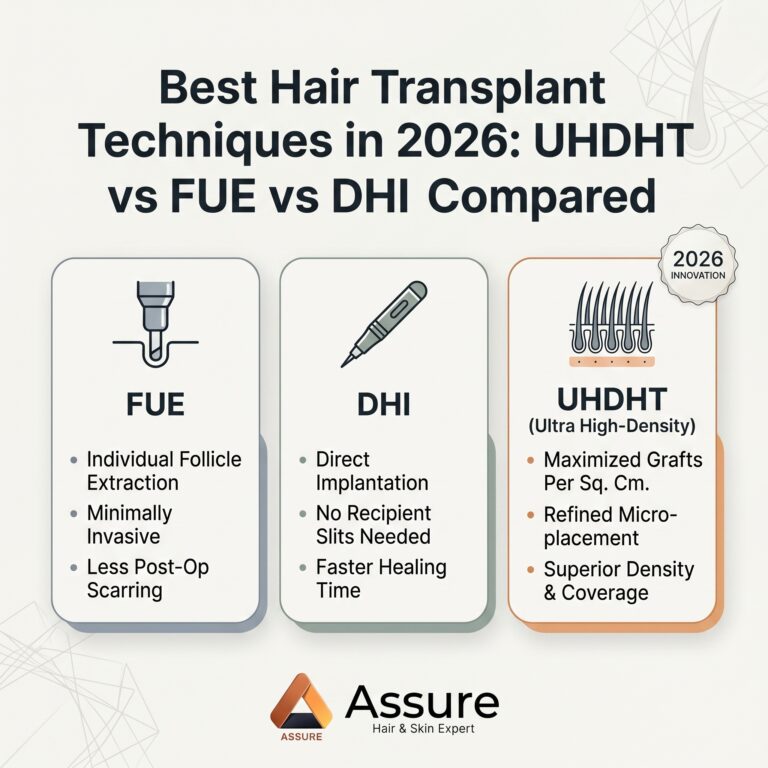
For a patient with his pattern of hair loss, the UHDHT method combining UFME (Ultra Fine Micro Extraction) and DSHI (Direct Simultaneous Hair Implantation) techniques would be the protocol of choice. This delivers 60-80 grafts per square centimetre, significantly higher density than standard FUE techniques, and is suited for restoring full coverage.
Step 5: Realistic Expectations
For a patient who has been completely bald for years, hair transplant can restore very natural-looking density but may not reach the volume he had at 25. Two sessions, spaced 8-10 months apart, would likely be needed for a Norwood Stage 6-7 pattern.
“Hair transplant is not a one-time miracle. For patients who have lost hair due to medications, it is a thoughtful, staged process. The goal is restoration of confidence and natural appearance, not the impossible illusion of never having lost hair,” explains Dr. Abhishek Pilani, founder of Assure Clinic.
Why Wigs Are a Valid Choice. And Why Many Choose Hair Transplant Instead
Honey Singh’s decision to wear a wig was a practical one. Wigs are immediate, non-surgical, and reversible. For many patients dealing with active medical treatment, a wig is the right choice.
But wigs also have limitations that drive many patients toward hair transplant once their underlying condition stabilizes:
| Factor | Wig | Hair Transplant |
|---|---|---|
| Durability | Temporary, requires daily wear | Long-lasting, your own hair |
| Daily maintenance | Putting on / removing, cleaning, regular replacement | Wash like normal hair |
| Hot climate comfort | Can be uncomfortable in Indian summers | No issue |
| Swimming, sports | Often restrictive | No restrictions |
| Cost over 10 years | Premium wigs replaced every 1-2 years can total ₹10-25 lakh | One-time investment, lifetime result |
| Confidence factor | Constant awareness of wig | Forget about it |
For patients who can medically qualify, hair transplant can end wig dependence for the long term. This is why we see so many patients who started with wigs eventually transition to surgical restoration.
What This Means for the Wider Conversation About Mental Health and Hair Loss
There is a quieter story inside Honey Singh’s revelation. Bipolar disorder is a serious illness that requires lifelong management for many patients. The medications that help save lives can have side effects, and hair loss is often one of them.
For too long, hair loss has been treated as a vanity problem. But for patients on long-term psychiatric medication, the visible loss of hair can compound the psychological burden of their illness. Some patients reduce or stop their medication against medical advice to save their hair. A decision that can be catastrophic.
The right conversation is this: stay on the medication your doctor prescribes, work with a hair restoration specialist to manage the side effects, and consider transplant only when your treatment is stable.
If you are reading this and recognising the pattern in your own life, please continue your prescribed medication and consult both your psychiatrist and a hair restoration specialist. Discontinuing medication for cosmetic reasons can be life-threatening.
Wondering if your hair loss is reversible?
Use our free Baldness Calculator to check your Norwood stage in 60 seconds, then see treatment options matched to your stage.
Considering a hair transplant?
Assure Clinic has performed 20,000+ procedures with high graft survival, led by Dr. Abhishek Pilani across 13 locations in India and Dubai.
Considering treatment options?
Frequently Asked Questions
Why does bipolar disorder medication cause hair loss?
Mood stabilizers like lithium, valproate, and antipsychotics affect the hair growth cycle by pushing follicles into the resting phase prematurely. Hair loss typically becomes visible 3-4 months after starting the medication or increasing the dose.
How long after stopping medication does hair grow back?
For most patients, regrowth begins 2-4 months after stopping or adjusting the medication, with significant improvement visible by 6-9 months. Full restoration usually takes 9-18 months. Patients who were on medication for more than 2-3 years may experience some permanent loss.
Can I get a hair transplant while still on bipolar medication?
Generally no. A hair transplant should only be considered after the underlying medical condition is stable, the hair loss pattern has been stable for at least 12 months, and the prescribing psychiatrist has provided clearance.
Is Honey Singh’s hair loss permanent?
We have no medical information on his individual case. Based on his description of 7 years of heavy medication, some permanent loss is likely. However, partial regrowth is possible if his current medication regimen has reduced the dosage or switched drug classes.
How much does a hair transplant cost in India for medication-induced hair loss?
Hair transplant pricing at Assure Clinic uses our Full Head Results model rather than per-graft pricing. The cost depends on the extent of restoration needed and the number of sessions required. Cost starts from…
Should I stop my medication to grow my hair back?
Never stop psychiatric medication without consulting your prescribing doctor. The risks of untreated bipolar disorder, depression, or anxiety far outweigh the benefit of cosmetic hair recovery. Work with both your psychiatrist and a hair restoration specialist to find a balanced approach.
Can women experience medication-induced hair loss?
Yes. Women on lithium, certain antidepressants, hormonal contraceptives, and acne medications can experience significant hair loss. The pattern in women is typically diffuse thinning across the scalp rather than the receding hairline pattern seen in men.
Will my hair grow back the same as before?
For shorter-term medication courses, hair often regrows with similar density and texture. For longer-term, high-dose courses, some patients notice the regrown hair is finer, lighter in colour, or distributed differently than their original hair.
Do I need a specialist or can a general doctor diagnose medication-induced hair loss?
A dermatologist with experience in hair disorders is recommended. They can perform trichoscopy, blood work, and differentiate medication-induced loss from genetic patterns. At Assure Clinic, every patient receives evaluation by qualified doctors trained in hair restoration.
What’s the first step if I think my medication is causing hair loss?
First, do not stop the medication. Then book a consultation with both your prescribing psychiatrist and a hair restoration specialist. The hair specialist can confirm the cause, recommend supportive treatments like PRP or topical minoxidil, and create a long-term plan that protects both your mental health and your hair.
When to Consider a Consultation
If you or someone you know is dealing with hair loss connected to long-term medication, the right time to seek expert evaluation is now, even if you are not planning a transplant. A specialist consultation can:
- Confirm whether your hair loss is medication-induced versus genetic
- Recommend supportive treatments (PRP, GFC, topical solutions) that can slow further loss
- Document your current pattern so future treatment decisions are informed
- Coordinate with your prescribing psychiatrist on options
Book a free consultation with Assure Clinic. Call +91 95861 22444 or visit any of our 13 locations across India and Dubai. Each consultation includes a trichoscopy examination, full medical history review, and personalised treatment recommendations from qualified doctors.
About Dr. Abhishek Pilani
Dr. Abhishek Pilani is the founder of Assure Clinic, a network of 13 hair transplant and dermatology clinics across India and Dubai. An ISHRS-certified hair transplant surgeon and DHA-licensed specialist, Dr. Abhishek Pilani has led over 20,000 procedures since founding the clinic in 2016. He pioneered the UHDHT (Ultra High Density Hair Transplantation) method, combining UFME extraction and DSHI implantation techniques.
Sources and References
- ABtalks Podcast with Anas Bukhash featuring Yo Yo Honey Singh, May 2026
- India TV News: ‘I am totally bald’: Yo Yo Honey Singh reveals he uses a wig after bipolar disorder treatment caused hair loss
- News9 Live: Honey Singh says he is totally bald, opens up on 7-year health battle
- Free Press Journal: ‘Lost My Hair Completely, Totally Bald’: Yo Yo Honey Singh Opens Up About Bipolar Disorder Battle
- American Academy of Dermatology Association. Hair Loss Causes and Treatments
- International Society of Hair Restoration Surgery (ISHRS). Patient Resources
- Assure Clinic internal data, 20,000+ procedures (2016-2026)