Key Takeaways:
- Mohammed Shami's visible hair transformation shows a restored frontal hairline and increased temple density consistent with modern FUE-based transplant techniques
- Based on publicly visible images from 2020-2022, Shami showed Norwood Stage 3-4 recession — a more advanced starting point than many celebrity cases
- The result demonstrates that even moderate-to-significant recession can be restored with excellent density when the procedure is well-executed
- At Assure Clinic, Dr. Abhishek Pilani uses the UHDHT method to achieve high graft survival across 20,000+ procedures
- Men at Norwood Stage 3-4 typically require 2,000-3,500 grafts for comparable restoration
Mohammed Shami's transformation is one of the more dramatic in recent Indian cricket. Photographs from his earlier career show notable frontal hairline recession — a defined temple withdrawal and hairline elevation that many men recognise in their own mirrors. Compare that to his appearance from 2023 onwards, and the difference is unmistakable: a significantly lower, denser hairline with restored temple coverage.
Hair restoration decisions are personal. Assure Clinic does not comment on where anyone had their procedure. What we can contribute — as specialists with 20,000+ procedures of experience — is a clinical reading of what the publicly visible transformation reveals about the technique, the stage of loss addressed, and what this means for men with similar hair loss patterns.
Get Your Personalized Hair Transplant Cost Estimate
Takes 60 seconds. See your expected cost range based on your hair loss stage and preferred city — transparent pricing, no hidden fees.
Calculate Your Cost →"What makes the Shami transformation notable from a clinical perspective is the starting point," says Dr. Abhishek Pilani, MBBS MD Dermatology (Gold Medalist), ISHRS Member, and Founder of Assure Clinic. "This isn't a subtle hairline refinement — it's a meaningful restoration of a more advanced recession. The result is natural, well-distributed, and the hairline design is age-appropriate. That requires skilled execution."
What Shami's Hair Looked Like Before
Mohammed Shami's earlier photographs — particularly from 2019-2022 — show a progressively receding hairline placing him at approximately Norwood Stage 3-4 on the standard hair loss classification scale:
- Norwood Stage 3: Deeper temporal recession, hairline forms a clear M-shape. Frontal density begins to reduce.
- Norwood Stage 3-4: Continued recession at temples and frontal area, with increasing crown involvement in some cases.
Stage 3-4 is a more significant intervention than a Stage 2-3 hairline refinement. It requires more grafts to cover a larger area of recession, more careful density management across the hairline zone, and experienced hairline design to create a result that looks natural rather than surgically restored.
The complexity is worth noting because the result achieved is the more impressive for it.
What the Results Reveal
The publicly visible transformation — as seen in photographs from 2023 IPL, interviews, and sporting events — shows several hallmarks of quality surgical technique:
Restored frontal hairline: The frontal hairline has been brought forward and redesigned with a natural-looking irregular edge. Single-hair grafts at the front transition zone create the micro-variation that distinguishes natural hair from a transplant "line."
Temple reconstruction: Both temporal angles show significantly improved coverage — one of the more technically demanding aspects of hair transplantation, as natural temple hair grows at a sharp downward angle that requires precise graft placement to replicate.
Density consistency: The result avoids over-density at the hairline (which looks unnatural) and under-density behind it (which makes the transplant visible). Graduating from higher density at the front to natural density behind is a hallmark of experienced surgical planning.
No visible scarring: Based on available images showing shorter hairstyles, there is no visible linear donor scar — consistent with FUE-based extraction rather than older strip surgery methods.
| Feature | What's Visible | Clinical Interpretation |
|---|---|---|
| Hairline position | Lowered, restored frontal coverage | Appropriate for age, not over-lowered |
| Temple coverage | Both temples significantly restored | Complex area — requires angle-specific placement |
| Hairline edge | Irregular, micro-varied | Single-hair grafts at front — skilled design |
| Donor area | No visible scar in short-hair images | FUE extraction (sub-1mm punch) |
| Overall density | Natural graduation front to back | Experienced density planning |
What Stage 3-4 Restoration Actually Involves
For men who recognise their own recession in Shami's before photos, it is worth understanding what Stage 3-4 restoration requires — because it is a meaningfully different procedure from a subtle Stage 2 hairline refinement.
Graft count: Stage 3-4 typically requires 2,000-3,500 follicular unit grafts to adequately cover the recession zone and restore temple density. Each follicular unit contains 1-4 hairs, so this represents 3,000-8,000 individual hair strands transplanted.
Session structure: At Assure Clinic, larger procedures like Stage 3-4 restorations are approached through Dr. Abhishek Pilani's phased session protocol — multiple shorter sessions rather than a single marathon procedure. This protects graft viability (grafts outside the body begin to deteriorate after a few hours) and maintains surgeon concentration throughout. It is the primary reason Assure achieves high graft survival.
Recovery timeline:
- Days 1-10: Redness, scabbing, mild swelling at recipient area
- Weeks 2-4: Normal appearance returns — transplanted hairs appear to grow
- Month 1-3: Transplanted hairs shed (shock loss — normal and expected)
- Month 3-6: New growth begins, sparse initially
- Month 10-14: Full result visible
The honest picture: A Shami-level result at Stage 3-4 is achievable — but requires more grafts, a skilled surgeon, and patience with the 12-month timeline to full results. "Before and after" photos at 6 months look dramatically different from the same result at 14 months.
Who Can Achieve Similar Results?
Men with similar hair loss patterns to Shami's pre-transformation — Norwood Stage 3-4, frontal recession, temple withdrawal — are excellent candidates for hair transplantation provided:
1. Donor density is adequate The back and sides of the scalp must have sufficient density to yield 2,000-3,500 grafts without creating visible thinning in the donor area. Trichoscopy assessment confirms this before any transplant is planned.
2. Hair loss is stable or being managed Transplanting into an actively progressing hair loss pattern without medical management (finasteride in appropriate candidates, or GFC treatment) means surrounding native hair may continue thinning after transplant, creating a mismatch over time.
3. The surgeon can design age-appropriate hairlines A 30-year-old and a 45-year-old with the same level of recession need different hairlines. Placing a very low, straight hairline on a man in his 40s looks unnatural as he ages. Dr. Abhishek Pilani designs hairlines that will look natural both now and 15-20 years from now.
"The work we're proudest of at Assure isn't the dramatic transformations that get noticed immediately — it's the results that, three years later, nobody can identify as transplants. That's the real benchmark." — Dr. Abhishek Pilani
Related reading: Genetic male-pattern hair loss is common, but medications can also cause complete baldness. Read about Honey Singh’s medication-induced hair loss confession and what treatment options exist in 2026.
Considering a Shami-style transplant?
Use our free Baldness Calculator to check your Norwood stage in 60 seconds, then see treatment options matched to your stage.
Considering a hair transplant?
Assure Clinic has performed 20,000+ procedures with high graft survival, led by Dr. Abhishek Pilani across 13 locations in India and Dubai.
Considering treatment options?
Frequently Asked Questions
Did Mohammed Shami get a hair transplant?
Mohammed Shami has not publicly confirmed or denied a hair transplant. Comparing photographs from his earlier career (2019-2022) to more recent images shows a significant and sustained improvement in frontal hairline and temple coverage consistent with a successful hair transplant. This analysis is based solely on publicly available images.
What Norwood stage was Shami at before his hair transformation?
Based on publicly visible photographs from approximately 2019-2022, Shami's hairline recession placed him at approximately Norwood Stage 3-4 — a defined M-shaped recession with significant temple withdrawal. This is a more advanced starting point than many celebrity hair transplant cases.
How many grafts would a transplant like Shami's require?
For Norwood Stage 3-4 with frontal and temple recession, a typical procedure requires 2,000-3,500 follicular unit grafts. This represents one of the more significant standard transplant procedures, typically covering both the frontal zone and temporal angles.
What technique is consistent with Shami's visible result?
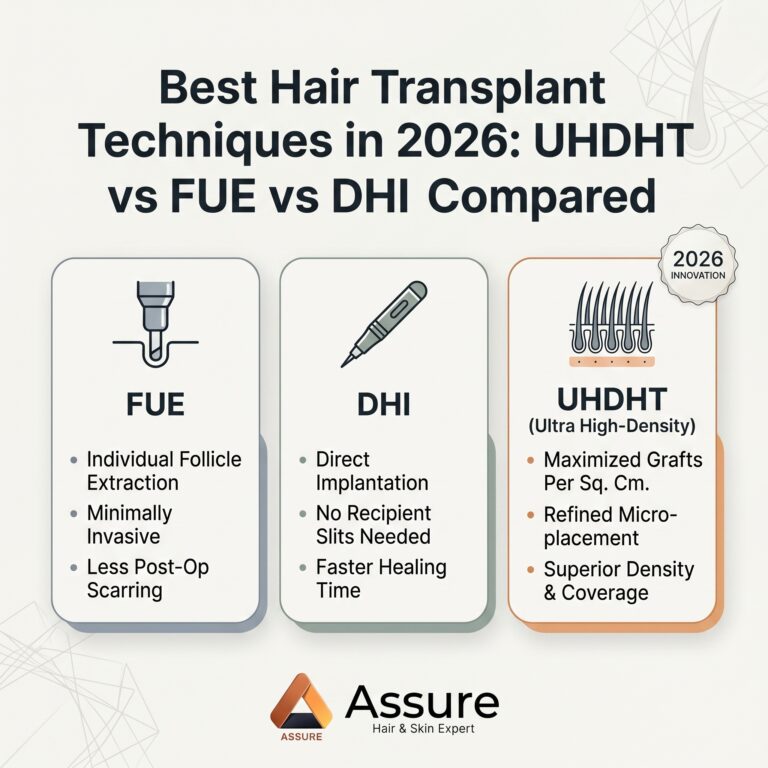
The visible result — no linear scar, natural irregular hairline design, restored temple angles — is consistent with FUE (Follicular Unit Extraction) based techniques. Modern advanced FUE protocols like Assure's UHDHT method (UFME extraction at 0.7-0.8mm) are capable of producing this quality of result.
Can I get a similar result at Assure Clinic for Stage 3-4 hair loss?
Yes. Assure Clinic regularly performs Stage 3-4 restorations using the UHDHT method. The result depends on your donor density, hair calibre, skin tone, and ongoing hair loss management. A trichoscopy consultation will determine whether you are a suitable candidate and provide a realistic graft estimate.
How long does it take to see the full result of a hair transplant like Shami's?
The full result of a Stage 3-4 restoration is visible at 12-14 months after the procedure. The shock loss phase (months 1-3 when transplanted hairs shed) is often concerning for patients who expect continuous growth — understanding the timeline in advance prevents unnecessary anxiety.
What is the recovery like for a Stage 3-4 hair transplant?
The first 10 days involve redness, scabbing, and mild swelling at the recipient area. These resolve completely. There are no permanent restrictions — most patients return to normal activity within 5-7 days. Intense physical activity (cricket, gym) is typically restricted for 2-3 weeks to protect newly placed grafts.
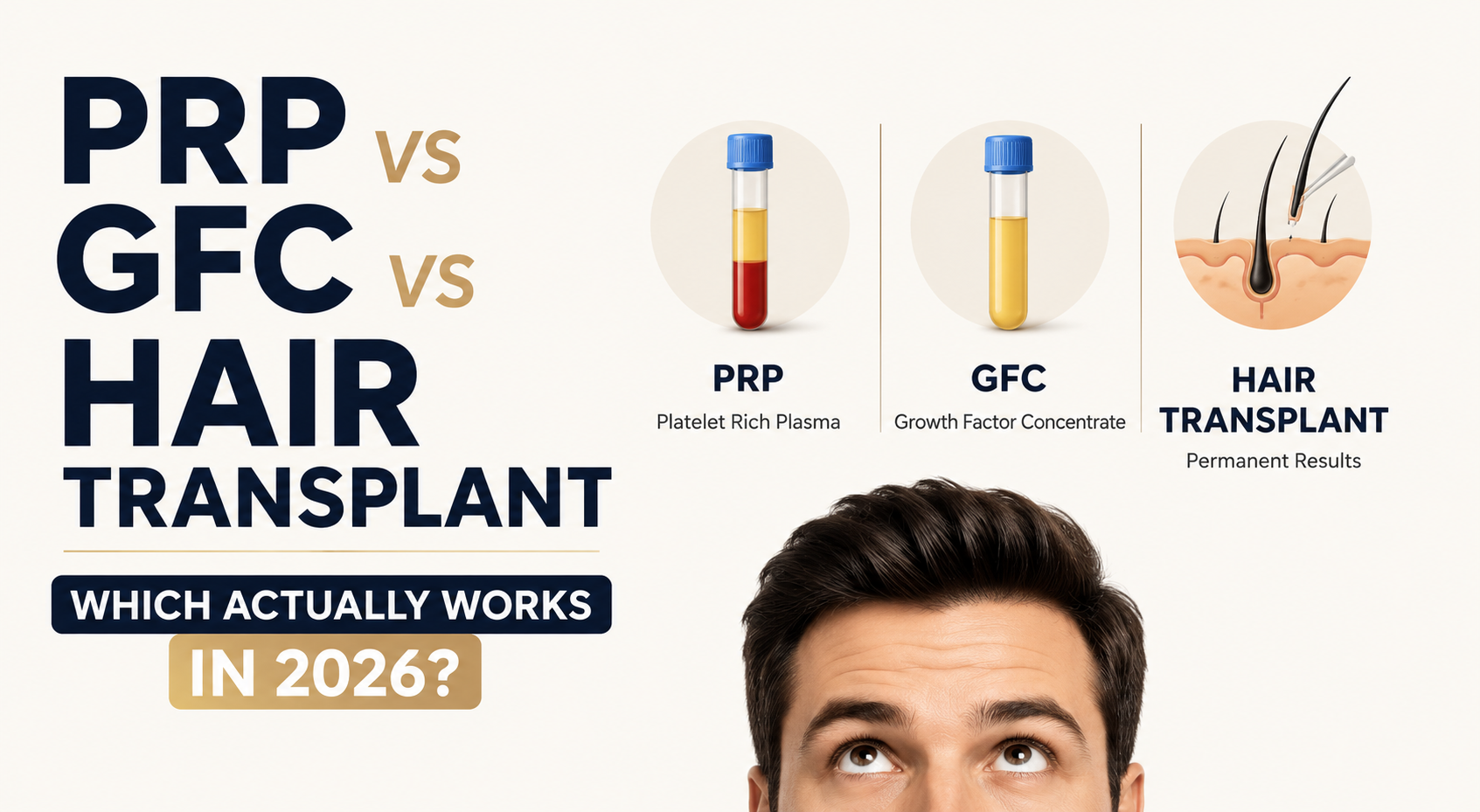
Is GFC treatment an alternative to hair transplant for this level of hair loss?
No. GFC (Growth Factor Concentrate) and similar non-surgical treatments are effective for slowing hair loss and improving density in early-stage loss (Norwood 1-2). For Stage 3-4 recession where hairline has retreated significantly, a transplant is the only treatment that restores the lost coverage. GFC is often used post-transplant to optimise graft survival and enhance results.
Book Your Consultation
If you recognise your own hairline in Shami's pre-transformation photographs, the first step is a clinical assessment — not assumptions. A trichoscopy evaluation at Assure Clinic will map your follicle density, confirm your Norwood stage, assess donor availability, and provide a realistic picture of what can be achieved.
With 20,000+ procedures and 60+ qualified doctors trained under Dr. Abhishek Pilani's protocols, Assure Clinic is equipped for Stage 3-4 restorations across all 13 locations.
India: +91 95861 22444 | WhatsApp: wa.me/919586122444 | Dubai: +971 547 370 350
Last Updated: April 2026 Medically Reviewed by Dr. Abhishek Pilani, MBBS MD Dermatology (Gold Medalist), ISHRS Member, DHA Licensed