Key Takeaways
- The most effective hair loss treatments in 2026 are hair transplantation, finasteride, minoxidil, PRP therapy, GFC therapy, and nutritional support, ranked here by long-term effectiveness.
- Hair transplant (UHDHT) is the only long-term solution and is the most effective option for advanced hair loss (Norwood stage 3 and above).
- Medications like finasteride and minoxidil genuinely work, but only while you keep using them. Stop, and the loss resumes within 6 to 12 months.
- PRP and GFC are supportive therapies that slow loss and improve density, but they do not regrow hair on fully bald areas.
- The right treatment depends entirely on your hair loss stage. Early-stage loss responds to medication; advanced loss needs a transplant.
Introduction
The best hair loss treatment is the one matched to your stage of hair loss. For early thinning, medications like finasteride and minoxidil can slow or pause the loss. For advanced or permanent loss, a hair transplant is the only solution that restores hair for good. According to the American Hair Loss Association, around 25 percent of men with male pattern baldness begin losing hair before age 21, and two-thirds show noticeable loss by age 35, which is why choosing the right treatment early matters.
This guide ranks the six most effective hair loss treatments available in 2026 by their long-term effectiveness, based on clinical evidence and the experience of treating patients at Assure Clinic. We rank honestly: medications earn their place for early-stage loss, and a hair transplant ranks first because it is the only long-term fix.
Dr. Abhishek Pilani, founder of Assure Clinic and an ISHRS-certified hair transplant surgeon, has led over 20,000 procedures across 13 clinics in India and Dubai. The rankings below reflect what actually works at each stage, not marketing.
Get Your Personalized Hair Transplant Cost Estimate
Takes 60 seconds. See your expected cost range based on your hair loss stage and preferred city — transparent pricing, no hidden fees.
Calculate Your Cost →Not sure which stage you are at? Use our free baldness calculator to check your Norwood stage in 60 seconds, then match it to the right treatment below.
Best Hair Loss Treatments 2026: Quick Comparison
| Rank | Treatment | Permanent? | Best For | Effectiveness |
|---|---|---|---|---|
| 1 | Hair Transplant (UHDHT) | Yes, permanent | Norwood 3 and above, permanent loss | Highest (high graft survival) |
| 2 | Finasteride | No, while used | Early to mid male pattern loss | High for slowing loss |
| 3 | Minoxidil | No, while used | Early thinning, both men and women | Moderate, maintains existing hair |
| 4 | PRP Therapy | No, ongoing sessions | Thinning, supportive use | Moderate, improves density |
| 5 | GFC Therapy | No, ongoing sessions | Early thinning, supportive use | Moderate, improves density |
| 6 | Diet and Supplements | No, preventive | Deficiency-related shedding | Low to moderate, preventive only |
The 6 Best Hair Loss Treatments, Ranked
1. Hair Transplant (UHDHT) — the only long-term Solution
A hair transplant moves your own DHT-resistant hair follicles from the back and sides of your scalp to thinning or bald areas, where they continue to grow long-term. It is the only treatment that restores hair on areas that have gone bald for the long term.
Honest verdict: The most effective treatment for advanced hair loss, and the only one that is long-lasting and one-time. It does not work as a preventive measure for early thinning, where medication is more appropriate. It is the right choice once hair loss has reached Norwood stage 3 or beyond, or when medications are no longer holding the loss.
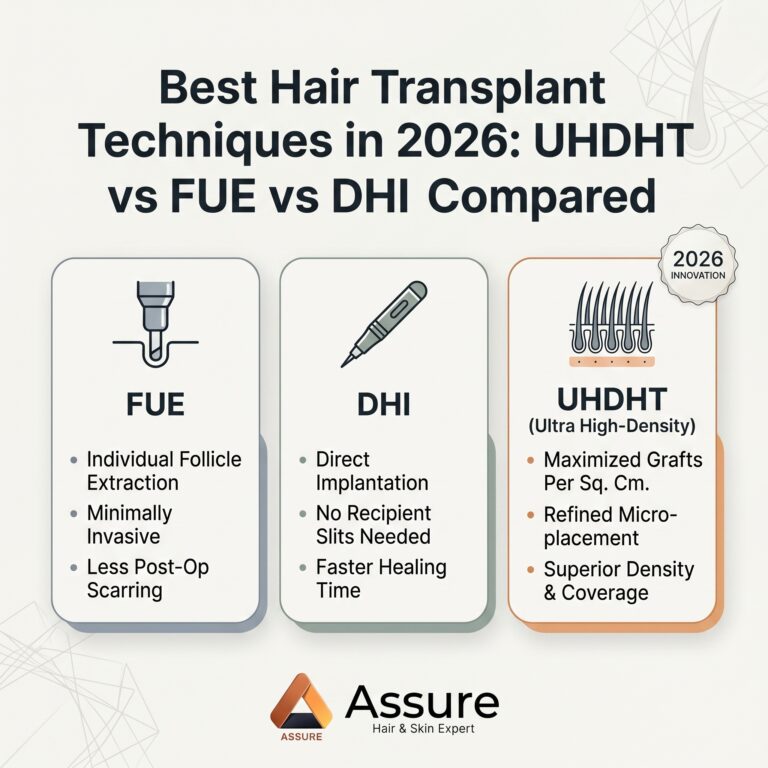
At Assure Clinic, transplants use the UHDHT (Ultra High Density Hair Transplantation) method, which combines the UFME and DSHI techniques to achieve 60 to 80 grafts per square centimetre, compared with 35 to 40 grafts in standard FUE. Across 20,000+ procedures, Assure Clinic reports high graft survival (internal data, 2016 to 2026).
“A hair transplant is the only treatment that gives a long-lasting result, but it has to be the right candidate. For early thinning, I would put a patient on medication first. For someone past Norwood stage 3, a transplant is the only thing that will actually restore the hairline,” says Dr. Abhishek Pilani, founder of Assure Clinic.
- Long-lasting: Yes, for most patients
- Best for: Norwood stage 3 and above, permanent or advanced loss
- Learn more: UHDHT hair transplant method and hair transplant cost in India
2. Finasteride — The Most Effective Medication
Finasteride is an oral prescription medication that blocks DHT, the hormone responsible for male pattern baldness. It is one of only two treatments approved specifically for hair loss with strong clinical backing.
Honest verdict: Genuinely effective at slowing and often pausing hair loss in men with early to mid-stage male pattern baldness. Clinical studies show finasteride stops further loss in around 80 to 90 percent of men and produces some regrowth in many. The catch is that it works only while you take it. Stop, and hair loss resumes within 6 to 12 months. It is a prescription medication that must be managed by qualified doctors and is not suitable for women of childbearing age.
- Long-lasting: No, effective only while used
- Best for: Early to mid-stage male pattern hair loss
3. Minoxidil — Best for Maintaining Existing Hair
Minoxidil is a topical solution or foam applied to the scalp that extends the growth phase of hair follicles and improves blood flow to the area. It is available over the counter and works for both men and women.
Honest verdict: Effective at maintaining existing hair and producing modest regrowth in early thinning, but it does not restore fully bald areas. Like finasteride, it works only while you use it, and shedding resumes within months of stopping. Results take 4 to 6 months to appear and require twice-daily application indefinitely.
- Long-lasting: No, effective only while used
- Best for: Early thinning in both men and women
4. PRP Therapy — Supportive Density Booster
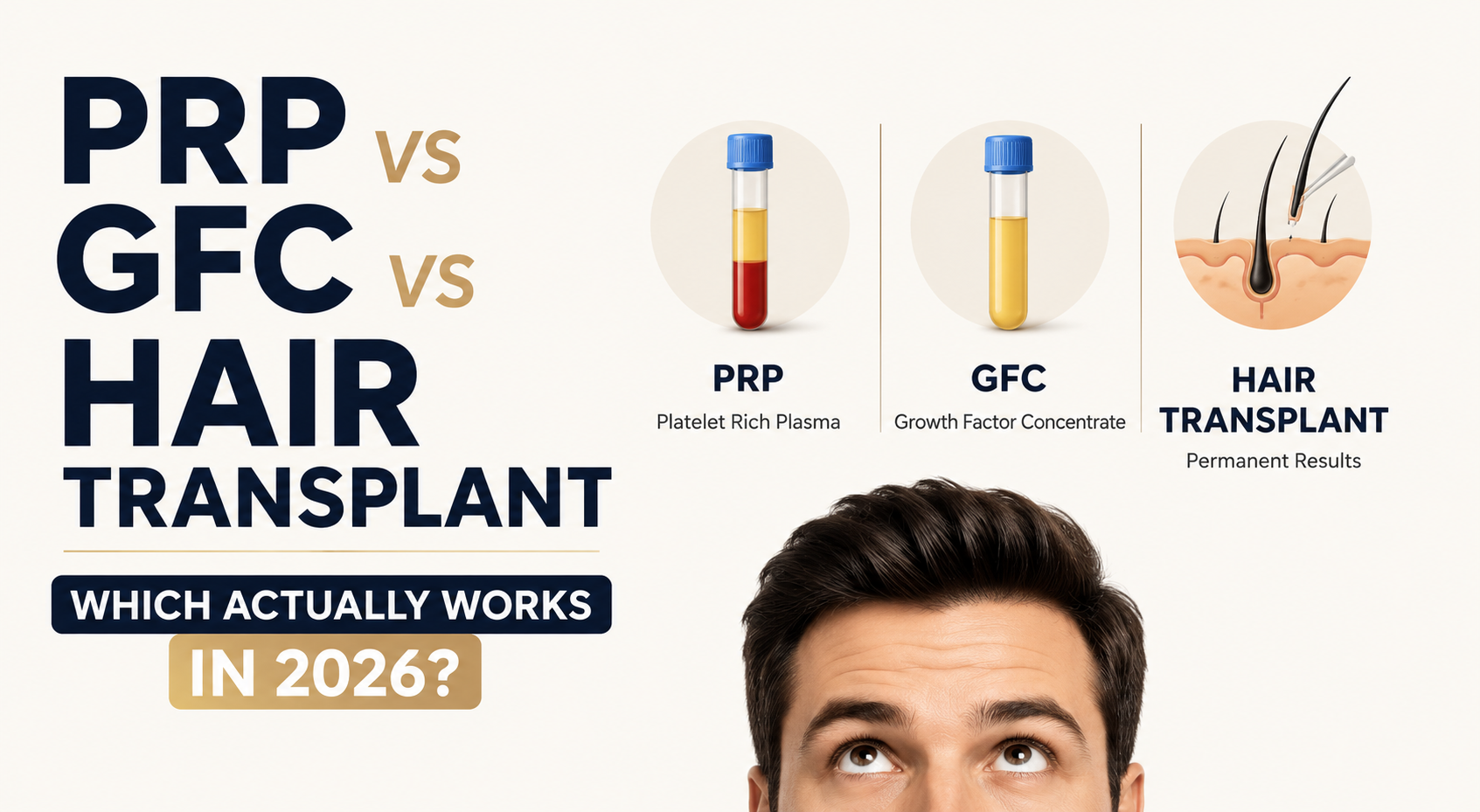
Platelet-Rich Plasma (PRP) therapy uses a concentration of your own blood platelets, injected into the scalp to stimulate hair follicles and improve density.
Honest verdict: A useful supportive treatment that slows loss and improves the density of thinning hair, especially when combined with medication. It does not regrow hair on bald areas and is not a standalone solution for advanced loss. PRP requires an initial course of sessions followed by maintenance, typically every few months.
- Long-lasting: No, requires ongoing sessions
- Best for: Thinning hair, supportive and combination use
5. GFC Therapy — Next-Generation Growth Factor Treatment
Growth Factor Concentrate (GFC) therapy is an advanced version of growth-factor treatment that uses a higher concentration of growth factors derived from your own blood to stimulate hair follicles.
Honest verdict: Similar to PRP in role, GFC is a supportive therapy that improves density and slows shedding in early thinning. Like PRP, it does not restore bald areas and works best alongside other treatments rather than alone. Learn more about GFC hair treatment.
- Long-lasting: No, requires ongoing sessions
- Best for: Early thinning, supportive use
6. Diet and Supplements — Preventive Support Only
Nutritional support includes addressing deficiencies in iron, vitamin D, vitamin B12, biotin, and protein, which can contribute to hair shedding when low.
Honest verdict: Diet and supplements help only when hair loss is caused or worsened by a nutritional deficiency. They are preventive support, not a treatment for genetic or pattern hair loss. Correcting a genuine deficiency can reduce shedding, but supplements will not reverse male or female pattern baldness.
- Long-lasting: No, preventive only
- Best for: Deficiency-related hair shedding
Why Hair Transplant Ranks First
Every treatment on this list has a place, but only one is long-lasting. Medications and supportive therapies work while you use them and stop working when you stop. A hair transplant is a one-time procedure that restores your own growing hair long-term.
| Factor | Medications (Finasteride, Minoxidil) | Supportive (PRP, GFC) | Hair Transplant (UHDHT) |
|---|---|---|---|
| Long-lasting result | No | No | Yes |
| Works on bald areas | No | No | Yes |
| One-time vs ongoing | Lifelong daily use | Ongoing sessions | One-time procedure |
| Best stage | Early | Early to mid | Advanced (Norwood 3+) |
| Cost over 10 years | Recurring | Recurring | One-time investment |
For early-stage hair loss, starting with medication is the sensible first step. But for anyone whose loss has progressed past Norwood stage 3, or whose medications are no longer holding, a hair transplant is the only treatment that delivers a long-lasting result.
When Should You Consider a Hair Transplant?
A hair transplant becomes the right choice when:
- Your hair loss has reached Norwood stage 3 or beyond. Check your stage with the norwood scale guide.
- Medications like finasteride and minoxidil are no longer holding your hairline.
- You have visible bald areas that medication cannot regrow.
- You want a long-term solution rather than lifelong daily treatment.
- Your hair loss has been stable enough to plan a lasting restoration.
Not sure if you are a candidate? Use the free baldness calculator to check your Norwood stage in 60 seconds, then book a consultation to see whether a transplant suits you.
At Assure Clinic, qualified doctors assess every patient before recommending any procedure. With 20,000+ procedures completed at high graft survival across 13 locations, the clinic matches each patient to the treatment that fits their stage, whether that is medication, supportive therapy, or a transplant. See clinic details at best hair transplant in Mumbai or find your nearest clinic on the locations page.
How to Choose the Right Treatment for Your Stage
| Your Situation | Recommended Starting Point |
|---|---|
| Early thinning, hairline just starting to recede | Minoxidil, with finasteride if male |
| Noticeable thinning, still have coverage | Finasteride plus PRP or GFC for support |
| Receding past Norwood stage 3, visible scalp | Hair transplant consultation |
| Bald areas that no longer grow hair | Hair transplant (only option) |
| Shedding linked to diet, stress, or illness | Correct the cause first, then reassess |
The honest reality is that no single treatment is best for everyone. The best hair loss treatment is the one matched to your stage, which is why a proper assessment matters before spending money on any option.
Continue your research
Frequently Asked Questions
What is the best hair loss treatment in 2026?
The best hair loss treatment depends on your stage. For early thinning, finasteride and minoxidil are the most effective medications. For advanced or permanent loss, a hair transplant using the UHDHT method is the only long-term solution, with high graft survival at Assure Clinic.
What is the only permanent hair loss treatment?
A hair transplant is the only permanent hair loss treatment. It moves your own DHT-resistant follicles to thinning or bald areas where they grow long-term. All other treatments, including finasteride, minoxidil, PRP, and GFC, work only while you continue using them. Results vary from person to person, and hair that was not transplanted can continue to thin over time.
Do hair loss medications work permanently?
No. Finasteride and minoxidil genuinely slow or pause hair loss, but only while you take them. Studies show that stopping either medication leads to resumed hair loss within 6 to 12 months, returning to where you would have been without treatment.
Is finasteride or minoxidil better?
They work differently and are often used together. Finasteride is an oral medication that blocks DHT and is more effective at stopping loss in men. Minoxidil is a topical that maintains existing hair and suits both men and women. Used together, they are more effective than either alone.
Can PRP regrow bald areas?
No. PRP therapy improves the density of thinning hair and slows shedding, but it cannot regrow hair on areas that are already bald. For bald areas, a hair transplant is the only option that restores hair.
At what stage should I get a hair transplant?
A hair transplant is generally recommended from Norwood stage 3 onward, or when medications are no longer holding your hairline. You can check your stage using a baldness calculator, then have qualified doctors confirm whether you are a suitable candidate.
How much does a hair transplant cost in India?
Hair transplant cost in India varies by the extent of restoration needed. Assure Clinic uses a Full Head Results pricing model rather than per-graft pricing, with all sessions, follow-ups, and care included. See the full breakdown on the hair transplant cost in India guide.
Which hair loss treatment is most cost-effective long term?
Over 10 years, a hair transplant is often the most cost-effective option for advanced loss, because it is a one-time procedure rather than the recurring cost of lifelong medication or repeated PRP and GFC sessions.
Can women use these hair loss treatments?
Yes, with adjustments. Minoxidil, PRP, GFC, and hair transplantation are suitable for women. Finasteride is generally not prescribed to women of childbearing age. Female pattern hair loss often responds well to a combination approach assessed by qualified doctors.
Do I need a doctor to choose a hair loss treatment?
Yes. The right treatment depends on the cause and stage of your hair loss, which should be assessed by qualified doctors. A proper diagnosis prevents wasting money on treatments that will not work for your specific type of hair loss.
Conclusion
The best hair loss treatment in 2026 is the one matched to your stage. Medications like finasteride and minoxidil are effective for early thinning but work only while used. PRP and GFC support density but do not restore bald areas. For advanced or permanent loss, a hair transplant using the UHDHT method is the only long-term solution.
The first step is knowing your stage. Check your Norwood stage with the free baldness calculator, then book a free consultation with Assure Clinic to get a treatment plan matched to your hair loss.
Book a Free Consultation: Call +91 95861 22444 or visit any of Assure Clinic’s 13 locations across India and Dubai. Every consultation includes a scalp assessment and a personalised treatment recommendation from qualified doctors.
Last Updated: June 2026 Medically Reviewed by: Dr. Abhishek Pilani, MBBS MD Dermatology (Gold Medalist), ISHRS Member, DHA-Licensed