
Key Takeaways
|
Receding hairline is one of the most common hair problems in men and in India around 58% of men between the age of 30 and 50 have male pattern hair loss (Krupa Shankar et al., 2009) so many men start noticing that their forehead is becoming bigger in their late twenties or thirties.
Most patients who come for a front hairline transplant are worried that the new hairline will look fake and people will easily make out that they have done a transplant. Usually this happens when the hairline is made too low or too straight and not because of the transplant itself so the planning of the hairline matters a lot.
In this blog, we explain what is a front hairline transplant, who should get a hair transplant for receding hairline, how a natural hairline is planned, the recovery time and how Assure Clinic can help you.
What Is a Front Hairline Transplant?
Front hairline transplant is a procedure in which the hair roots (grafts) are taken from the back or sides of your head and placed in the front to rebuild the hairline which has receded.
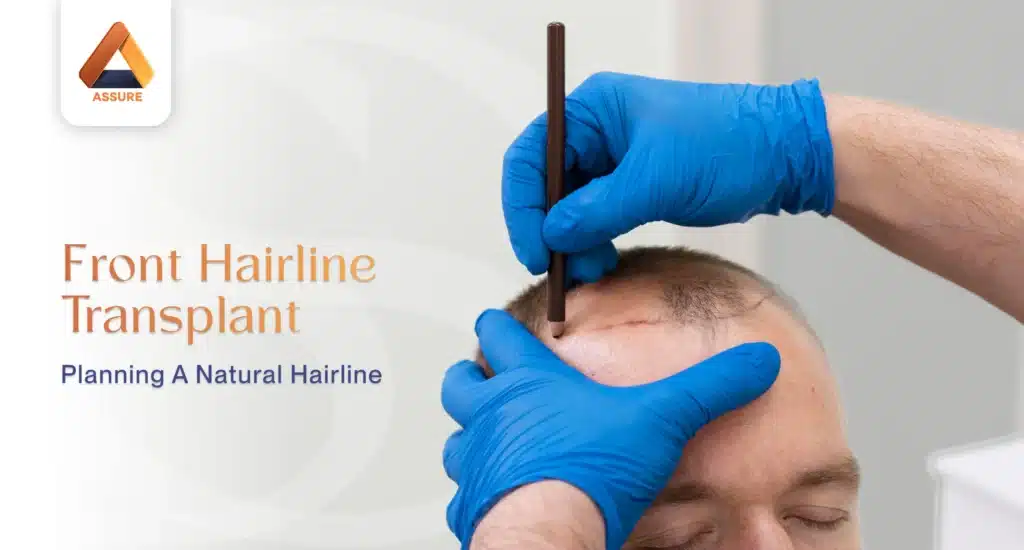
The hair at the back of the head is usually not affected by male pattern hair loss and that is why it is used as the donor area (Jimenez et al., 2021). Firstly the doctor designs and marks your new hairline on the forehead. Then the grafts are taken from the donor area and placed one by one along the marked line. Since these grafts come from an area where hair does not fall easily they continue to grow in the front as well.
The procedure is done under local anaesthesia and it may take a full day depending on the number of grafts. At Assure Clinic, the grafts are extracted with UFME (Ultra Fine Micro Extraction) and implanted with DSHI (Direct Simultaneous Hair Implantation) and the procedure is performed by our doctors.
Who Is a Good Candidate for a Hair Transplant for Receding Hairline?
Many men have a mature hairline which moves back slightly by the late twenties and then stays the same and this does not need a transplant. A hair transplant for receding hairline is usually advised when the temples and the front have become bare and the medicines are not able to bring the hair back. Following is the table that explains your Norwood stage and whether a transplant is advised or not (Norwood, 1975).
| Norwood stage | What you may notice | Is a front hairline transplant usually advised? |
| Stage 1 to 2 | Very slight change at the temples or hairline gone back by about one finger | Usually the transplant is not needed as this can be a mature hairline and doctor may just ask you to keep a watch with photos |
| Stage 2A to 3 | Your temples may go deeper making an M or V shape and forehead starts looking bigger. | First medicines are given and transplant is thought of only when temples have become bare |
| Stage 3 to 4 | Bald patches can be clearly seen at temples, front looks thin even after styling | Usually at this stage front hairline transplant is planned along with medicines so the remaining hair is saved. |
| Stage 5 and above | Front and crown both thinning, bald area big | Can still be done but in phases and front is given priority based on donor hair available. |
Also many young boys of 21 or 22 with their hairline going back start thinking that they want transplant immediately. But receding hairline does not go the same way in everyone, for some it moves fast and for some it stays same for years together. So if you are in early twenties and still losing lot of hair the doctor may tell you to wait and start medicines first, as a hairline made at this age may not match how your hair loss goes later.
How a Natural Hairline Is Planned
This planning is done before the procedure starts. And honestly it is this planning that decides how natural your hairline will look later. As per a study, natural hairline is never a sharp line rather a soft zone where single hairs are placed unevenly in front and as you go back hair becomes thicker slowly (Shapiro and Shapiro, 2013). Following are the steps which doctor usually follows.
- Firstly the doctor checks the shape of your face and the height of your forehead because the hairline that suits a round face may not suit a long or square face.
- Then the centre point of the hairline is marked which is usually around 7 to 10 cm above the eyebrows but it changes according to your face and how much hair you have lost.
- The temple corners are planned carefully because if the temples are filled completely the face of an adult can look too young and unnatural.
- The doctor plans the hairline for how you will look at the age of 40 or 50 and not only for today since the hair behind the transplanted area can keep falling.
- Your donor area is checked with trichoscopy to see how many good grafts you have so that the hairline is not made bigger than what your donor hair can cover.
- Lastly the angle and direction of each graft is decided because the hair in the front grows at a low angle and points forward so that it falls on your forehead naturally.
A natural hairline is divided into different zones and each zone gets a different type of graft. Following is the table that explains these zones and what they mean for you.
| Zone | Where it is | What it usually means for you |
| Transition zone | First 0.5 to 1 cm of your hairline | Only single hair grafts are placed here unevenly so the hairline looks soft and not like a wall of hair. |
| Defined zone | Area just behind transition zone | Mostly two hair grafts are used so that the hairline looks full from normal distance |
| Frontal tuft | Oval area in the centre of front scalp | Densest area which gives you the full look when you comb your hair |
| Temple points | Small points of hair on both sides of forehead | Made with fine grafts as they frame your face and complete your hairline. |
Also Indian men usually have a broader and flatter hairline and their temples are not so deep so a slightly fuller temple corner can also look natural in them provided there is enough donor hair (Shapiro and Shapiro, 2013).
| Worth Knowing
Many patients ask for the same hairline which they had at 18 but this is not always a good idea. Your donor area has limited grafts and once they are used they will not grow back. If the hairline is made very low then most grafts get used in the front itself and as the hair behind keeps falling you may be left with a low hairline and a thin patch behind which looks odd. Hence making the hairline at the right height saves the grafts for future and also suits your age when you grow older. |
Front Hairline Transplant Recovery and Results Timeline
Recovery after front hairline transplant is quick and within few days most people are able to go back to desk work. Nevertheless the final result takes time since the transplanted hair falls first and then grows back again. Following is the table that explains what you may notice after the transplant.
| Time after the transplant | What you may notice |
| First 3 to 7 days | Small scabs, redness in the front and little swelling on forehead for few days |
| 2 to 6 weeks | Transplanted hair starts falling which is called shock loss. It is normal as the roots are safe under the skin. |
| 3 to 4 months | Thin new hair starts coming along the hairline |
| 6 to 8 months | Hairline looks fuller and you may notice the hair getting thicker. |
| 12 to 18 months | Final result can be seen as the new hair becomes mature and thick |
Following are some general tips for recovery but your doctor may change them as per your condition.
- Sleep with head raised on two pillows for first few nights, this helps swelling to go down faster.
- Do not touch, scratch or pick the scabs and wash your hair only the way clinic has told.
- Avoid heavy exercise, swimming and direct sun till the time your doctor says.
- Avoid smoking and alcohol in first few weeks because it slows down the healing.
- Do go for all follow up visits so that doctor can check how the grafts are growing.
Why Medicines Still Matter After a Front Hairline Transplant
Front hairline transplant gives you new hair in the front but the male pattern hair loss in your existing hair does not stop with it, so the hair behind and around your new hairline can still become thin. A study was done on around 80 men in which the ones who took finasteride from one month before transplant till eleven months after it had better hair counts and looked fuller in photos than the ones who took placebo (Leavitt et al., 2005). This study was small and done only for one year and it was funded by the company which makes this medicine but it matches with what doctors usually see in practice.
Hence your doctor may suggest medicines like finasteride or minoxidil along with the transplant. These medicines can have side effects and are not suitable for everyone so take them only after doctor has checked you and never start or stop them on your own.
Questions to Ask Before Your Front Hairline Transplant
You should ask your doctor some questions before you go for front hairline transplant so that you know how your hairline will be planned. Following are some questions which you can carry to your consultation.
- Is my hairline receding or is it a normal mature hairline?
- What is my Norwood stage and is my hair loss still active?
- Where will my new hairline be placed and how will it look when I am older?
- How many grafts do I have in my donor area and how many will be used for the front?
- Who will design the hairline and who will do the procedure?
- Will I need medicines along with the transplant and for how long?
- What will my new hairline look like month by month as the hair grows?
If you are not ready for a transplant yet then the right hairstyle for a receding hairline can also make your hairline look better for the time being.
How Assure Clinic Plans Your Front Hairline Transplant
Receding hairline is a long-term problem and it cannot be solved only by adding grafts in the front. Front hairline transplant is just one part of hair restoration which also includes finding the reason for your hair fall, saving the hair you still have and planning for the future.
| Expert Hair Insight
“In my experience, most patients ask us for a lower hairline but what they actually want is a hairline that nobody notices. At Assure Clinic, we check the patient’s face, Norwood stage, scalp with trichoscopy and donor hair before drawing even a single line on the forehead. Our doctors design the hairline and place the grafts and for bigger areas we plan the work in phases and not in one long session. If you have a receding hairline, get it checked first because sometimes medicines are enough and the transplant can wait.” Dr. Abhishek Pilani, MBBS, MD (Dermatology, Venereology & Leprosy) Co-Founder and Chief Hair Transplant Surgeon, Assure Clinic | Reg. No. 2011020289 (MMC) |
Hair transplant planning at Assure Clinic
At Assure Clinic hairline transplant is done with UHDHT method where grafts are taken out with UFME and placed with DSHI, so each graft is put into the scalp soon after it is taken out. In the consultation your scalp is checked with trichoscopy, your Norwood stage is found out and your hairline design is discussed with you. The cost is as per Full Head Results pricing and not per graft and there are EMI options as well.
If your hairline is receding and you want to know whether front hairline transplant is right for you or not then you can visit your nearest Assure Clinic today as we have 13 clinics across India and Dubai.
Frequently Asked Questions
What is a front hairline transplant?
It is a procedure where the hair roots from back of your head are placed in the front for rebuilding a receding or thin hairline.
Is a hair transplant for receding hairline permanent?
Transplanted hair usually stays for many years as it is taken from the area where hair does not fall easily. But the original hair around it can still become thin so doctor may give medicines for protecting it.
Will my front hairline transplant look natural?
Yes it can look natural if the hairline is planned as per your face and age with single hair grafts in front and the line kept slightly uneven and not straight.
How many grafts are needed for a front hairline transplant?
This depends on how much your hairline has gone back and how much thickness you want. For only temple corners lesser grafts are needed than for the whole front so after checking your scalp the doctor can tell you the number.
At what age can I get a hair transplant for receding hairline?
No fixed age is there but doctors are careful in early twenties as the hair loss pattern is still not clear. Once hair loss is stable most men become better candidates.
Can my new hairline be made very low?
Usually no. Very low hairline uses up many grafts and as you grow older it may not suit you so doctor places it at a height matching your face and donor hair.
When will I see results after a front hairline transplant?
Usually new hair starts coming in 3 to 4 months and by 6 to 8 months hairline looks fuller while the final result can take 12 to 18 months.
Is it normal for transplanted hair to fall after a few weeks?
Yes it is normal. It is called shock loss and as the roots are safe under the skin new hair grows back in next few months.
Do I need medicines after a hair transplant for receding hairline?
Most patients do as the transplant does not stop hair fall in your existing hair. Whether finasteride or minoxidil suits you or not will be decided by your doctor so never start or stop them on your own.
Is a front hairline transplant painful?
It is done under local anaesthesia so mostly only the first few injections are felt. For few days after the procedure mild pain and swelling is common which settles with proper care.
References
Jimenez F, Alam M, Vogel JE, Avram M. (2021). Hair transplantation: Basic overview. Journal of the American Academy of Dermatology, 85(4), 803-814.
Krupa Shankar D, Chakravarthi M, Shilpakar R. (2009). Male androgenetic alopecia: population-based study in 1,005 subjects. International Journal of Trichology, 1(2).
Leavitt M, Perez-Meza D, Rao N, Barusco M, Kaufman K, Ziering C. (2005). Effects of finasteride (1 mg) on hair transplant. Dermatologic Surgery, 31(10), 1268-1276.
Norwood OT. (1975). Male pattern baldness: classification and incidence. Southern Medical Journal, 68(11).
Shapiro R, Shapiro P. (2013). Hairline design and frontal hairline restoration. Facial Plastic Surgery Clinics of North America, 21(3), 351-362.