
Eyebrow Transplant Essentials To Know
|
Eyebrows frame the face and shape the way we look and express ourselves and when they are thin or missing many people find that daily pencilling, powders or tattoos are a tiring answer. An eyebrow transplant is the surgical option and a systematic review of 354 patients from 18 countries found burns to be the most common reason people needed one (Klingbeil and Fertig, 2018).
The eyebrow is a small area but it needs a lot of precision. The doctor has to understand the anatomy of the brow, design its shape, and handle the extraction and implantation with great care so that the new hairs look natural. (Gupta et al., 2017) A well-done eyebrow transplant is difficult to tell apart from natural brows and a poorly planned one is easy to figure out.
The following guide explains the eyebrow transplant procedure step by step, what the results look like and when, whether an eyebrow transplant is permanent, the side effects, who it suits and what it costs.
What Is an Eyebrow Transplant?
An eyebrow transplant or an eyebrow hair transplant is a procedure in which hair follicles are taken from a donor area and placed into the eyebrow area. The donor area is usually the back of the scalp or the area behind the ear because the hair there is fine enough to match brow hair when it is used as single-hair grafts.
Follicular unit extraction or FUE is now the most commonly used way of taking the grafts as it avoids a linear scar on the scalp (Gupta et al., 2017). Follicular unit transplantation using a strip of scalp is also used by some surgeons. The choice depends on the surgeon’s preference and on the patient.
Why Do Eyebrows Thin or Go Missing?
Eyebrow loss has many causes and finding the cause is the first step because it decides whether a transplant is advisable at all. Secondary causes should be ruled out or corrected before a transplant is considered and loss of the outer third of the eyebrow may be linked to a thyroid problem (Klingbeil and Fertig, 2018). The following table lists the common causes.
| Cause of eyebrow loss | Can a transplant help? |
| Over-plucking, threading or laser hair removal | Often considered once the cause has stopped |
| Burns, injuries or surgical scars | May be considered once the scar has matured, though graft survival in scar tissue can be lower |
| Alopecia areata | Usually not advised while it is active, and only in long-stable cases with a dermatologist’s clearance |
| Thyroid or other medical causes | The cause needs to be treated first |
| Absent or sparse eyebrows from birth | Can be considered after assessment |
Eyebrow Transplant Procedure Step by Step
The eyebrow transplant procedure is done in the clinic with local anaesthesia and follows a set order.
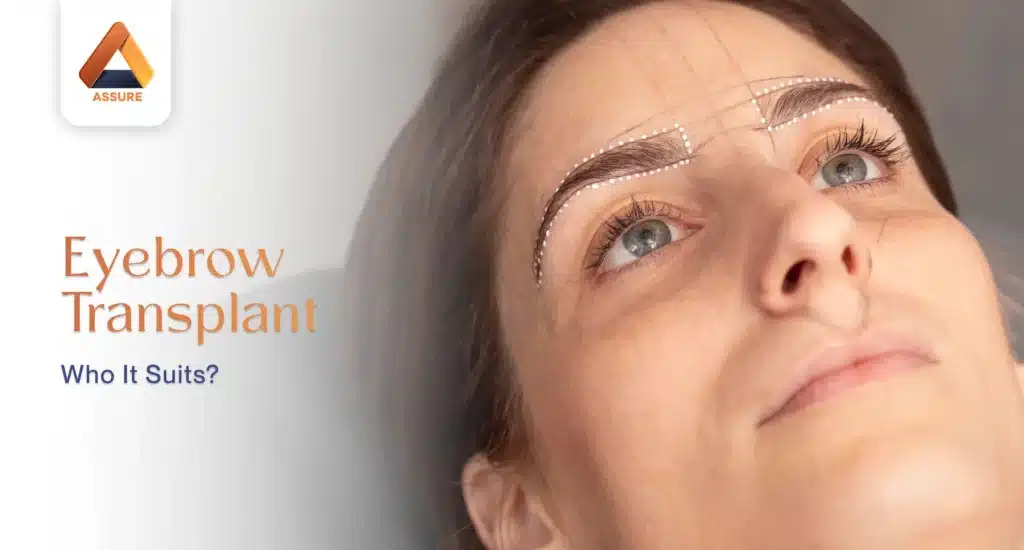
- Consultation and design wherein the doctor examines the brow area, asks about the cause of the loss and discusses the shape you want. A template is marked so that both brows are balanced and suit your face.
- Donor preparation during which the donor area is trimmed and numbed, and single-hair grafts are taken one by one.
- Recipient sites step includes creating tiny sites in the brow area at a very fine angle and in the direction in which natural eyebrow hair grows. The angle matters more than the number of grafts, because eyebrow hairs lie flat and fan outward.
- Implantation is when the single-hair grafts are placed one at a time with the finer hairs at the front of the brow and the denser ones behind as planned by the doctor.
- Aftercare is the part of the process where you are given instructions on washing, medicines and what to avoid in the first days.
The procedure usually takes a few hours depending on the number of grafts. Because of the local anaesthesia, pain during the procedure is minimal, and mild swelling and tenderness for 2 to 3 days are common afterwards.
Eyebrow Transplant Results and Timeline
Patients often expect to see the final brow as soon as the swelling settles but eyebrow transplant results take months. The transplanted hairs go through a shedding and regrowth cycle and the final result is usually seen at about 8 to 12 months. The following table shows what generally happens.
| Time after procedure | What you can expect |
| First week | Redness, small scabs and mild swelling, which settle with the care advised by the doctor |
| First few weeks | The transplanted hairs usually shed, which is expected and does not mean the procedure has failed |
| Around 3 to 4 months | New hair starts to appear |
| 8 to 12 months | The result is mostly visible and the density and shape can be judged |
Transplanted eyebrow hair does not adopt the short growth cycle of natural brow hair. It grows like scalp hair so it needs trimming. A touch-up session may be needed to refine the density or the shape. Case series have reported natural-looking results with a high level of patient satisfaction when single follicular units are used by an experienced surgeon (Jiang et al., 2020). However, results vary from person to person.
Is Eyebrow Transplant Permanent?
For most people, an eyebrow transplant is permanent because the transplanted hair keeps the growth characteristics of the donor area. That is why the hair keeps growing and needs trimming. However, permanent does not mean guaranteed. Some grafts may not survive, brows can change with age and if the original cause of the loss is still active as in alopecia areata, the transplanted hair can be affected as well. A touch-up is sometimes planned if the density is not what was hoped for.
Eyebrow Transplant Side Effects and Risks
Serious complications are uncommon and reviews of the published cases describe low complication rates when the standard techniques are followed (Klingbeil and Fertig, 2018). Still it is important for you to know what to expect.
| Category | Possible Side Effects or Concerns |
| Common and short-lived | Redness, swelling, tenderness, small scabs and sometimes slight bruising, which settle in a few days. |
| Donor area | Tiny marks where the grafts were taken, which are covered by the surrounding hair. |
| Less common | Ingrown hairs or small pimples around the grafts, infection, and some grafts not growing. |
| Planning-related | An uneven shape or an unnatural angle or direction, which is the main reason to choose an experienced doctor. |
Call the clinic if you have increasing pain, spreading redness, pus, fever or swelling that is getting worse and not better.
Am I Suitable For Eyebrow Transplant?
An eyebrow transplant may suit adults who have thin, patchy or missing eyebrows and who have a healthy donor area. The doctor may consider it in these situations.
- Eyebrows damaged by over-plucking, threading or laser hair removal, once the habit has stopped
- Eyebrow loss from burns, injuries or surgical scars, after the scar has matured
- Sparse or absent eyebrows from birth
- Patients who have realistic expectations and can follow the aftercare and trimming advice
It may not suit you right now if the cause of the eyebrow loss is still active or untreated. This includes active alopecia areata and thyroid or other medical conditions that have not been corrected. It is also not the right choice for someone who expects perfectly symmetrical brows, because natural brows are never exactly alike.
| Expert Hair Insight
“In the eyebrow the artistry matters as much as the surgery. The angle and direction of each hair decide whether the brow looks natural, and the first thing we check is why the eyebrow was lost.” Dr. Abhishek Pilani, MMC 2011020289, Co-Founder and Chief Hair Transplant Surgeon, Assure Clinic |
Eyebrow Transplant Cost in India
The cost of an eyebrow transplant depends on the number of grafts, the area to be covered, the complexity of the design and whether a touch-up is expected. As per Assure Clinic’s eyebrow guidance most plans need about 100 to 400 grafts per eyebrow and the cost works out to roughly ₹15,000 to ₹50,000 or more per eyebrow. These are indicative figures. The final cost is given after the doctor assesses your brows and the donor area.
When you compare quotations, ask who will perform the design, extraction and the implantation and whether a touch-up session is included or charged separately.
Eyebrow Transplant Consultation at Assure Clinic
Assure Clinic is a hair transplant and skin clinic with centres across India and in Dubai. Each patient is assessed by a doctor, who explains the cause of the eyebrow loss, the technique, the number of grafts and the cost before any procedure is planned. Results vary from person to person and depend on the cause of the loss, hair type, donor area, general health and aftercare. To find out whether an eyebrow transplant suits you, consult Assure Clinic for an assessment.
Disclaimer: This article is for general information. It is not medical advice or a price quotation. Costs, techniques and results differ from person to person. Please consult a qualified doctor about your own eyebrow loss.
Frequently Asked Questions
What is an eyebrow transplant?
An eyebrow transplant is a procedure in which hair follicles from the back of the scalp are placed into the eyebrow area to restore thin or missing brows.
How is the eyebrow transplant procedure done?
The doctor designs the brow, numbs the area, takes single-hair grafts from the donor area and places them at the natural angle and direction of eyebrow growth. It takes a few hours depending on the number of grafts.
How much does an eyebrow hair transplant cost?
It depends on the number of grafts and the design. As per Assure Clinic’s eyebrow guidance, it works out to roughly ₹15,000 to ₹50,000 or more per eyebrow, and the doctor confirms the cost after assessment.
Is an eyebrow transplant permanent?
In most people, yes. The transplanted hair keeps the growth of the donor area, so it continues to grow for years. Some grafts may not grow, and a touch-up is sometimes needed.
What are the eyebrow transplant side effects?
Swelling, redness, tenderness and small scabs for a few days are common. Ingrown hairs, infection and an uneven result are less common.
How long do eyebrow transplant results take?
The transplanted hairs shed in the first few weeks and new growth starts after a few months. The final result is usually seen at 8 to 12 months.
Does a transplanted eyebrow need trimming?
Yes. Transplanted eyebrow hair grows like scalp hair, so it needs trimming, sometimes every 1 to 2 weeks.
Is an eyebrow transplant painful?
Local anaesthesia is used, so pain during the procedure is minimal. Mild swelling and tenderness for 2 to 3 days are common afterwards.
Who is suitable for an eyebrow transplant?
Adults with thin or missing brows from over-plucking, laser removal, burns, scars or birth, once the cause is stable, may be suitable. A doctor confirms this after assessment.
Can an eyebrow transplant be done for alopecia areata?
Usually not while the condition is active. In long-stable cases it may be considered after clearance from a dermatologist, with a risk that the grafts may be affected.
Is an eyebrow transplant better than microblading?
They do different things. Microblading is a semi-permanent tattoo that fades over time and needs repeat sessions, while an eyebrow transplant places real hair follicles that keep growing and need trimming. A transplant needs a healthy donor area and a few days of recovery, so a doctor can help you decide which option fits your brows.
References
Gupta J, et al. The science and art of eyebrow transplantation by follicular unit extraction. J Cutan Aesthet Surg. 2017;10(2):66-71.
Jiang W, et al. Clinical outcomes and technical tips for eyebrow restoration using single-follicular-unit hair transplantation. A case series review. J Cosmet Dermatol. 2020. doi:10.1111/jocd.13242.
Klingbeil KD, Fertig R. Eyebrow and eyelash hair transplantation: a systematic review. J Clin Aesthet Dermatol. 2018;11(6):21-30.