
GFC Treatment Essentials To Know
|
GFC hair treatment is one of the most searched non-surgical options for thinning hair and it is often described as an advanced form of PRP. Many people want to know whether it works, how many sessions are needed and what the treatment costs. The honest answer is that it can help in the right patient at the right stage and that published research on GFC is smaller than the research on PRP itself. (Evans et al., 2022; Kieling et al., 2024)
This matters because a treatment that is advised at the wrong stage wastes both time and money. GFC works on follicles that are still alive but weakened and it cannot restore a scalp where the follicles are already gone. Knowing where you stand on the Norwood scale or the Ludwig scale helps you judge whether GFC is the right step or whether a transplant should be discussed instead.
The following guide explains what GFC hair treatment is, how it differs from PRP, how many sessions are usually advised, what GFC treatment cost depends on, who it suits and what results to expect.
Thinking about GFC for thinning hair?
What Is GFC Hair Treatment?
GFC stands for growth factor concentrate. GFC treatment for hair is a non-surgical, injection-based procedure in which a small amount of your own blood is processed to obtain a concentrate of growth factors which is then injected into the scalp. Platelets carry proteins such as PDGF, VEGF, EGF and TGF-beta that signal the body to repair tissue and improve blood supply and the aim of GFC is to deliver these signals to hair follicles that have started to shrink.
Because the material comes from your own blood, a reaction to the product itself is unlikely. GFC is used mainly for androgenetic alopecia, which is also called pattern hair loss, and for diffuse thinning where active follicles remain.
How Does GFC Differ from PRP?
PRP or platelet-rich plasma is made by spinning your blood so that the platelets are concentrated and the injection still contains plasma and some other blood cells. GFC involves an additional processing step with an activator kit and the growth factors are separated from the other blood components before injection. The table lists the differences as they are described in the protocol followed at Assure Clinic.
| Feature | GFC | PRP |
| What is injected | Growth factors separated from other blood components | Platelet concentrate along with plasma and some other blood cells |
| Processing | An additional activation step with a GFC kit | Centrifugation alone, and the method differs between clinics |
| Usual sessions | 3 to 4, about 4 weeks apart | 3 to 6, depending on the protocol |
| Maintenance | Every 4 to 6 months depending on response | Periodic sessions depending on response |
| Regrows bald areas | No | No |
| Source of material | Your own blood | Your own blood |
It is important to look at the evidence honestly. Meta-analyses of randomised trials show that PRP increases hair density in androgenetic alopecia, although the studies are very different from each other and the quality of evidence is low (Evans et al., 2022; Kieling et al., 2024). Studies on growth factor concentrates are fewer and smaller and research on newer concentrate techniques is still developing (Zhou et al., 2025) so a claim that GFC is better than PRP should be read with care.
How Is GFC Treatment Done?
The procedure follows a few steps and is carried out in the clinic by a doctor.
- A small amount of blood, usually 8 to 16 ml is drawn from your arm in the same way as a blood test.
- The blood is processed in a centrifuge with a GFC kit which separates and concentrates the growth factors. This takes about 30 to 40 minutes.
- The scalp is cleaned and a numbing cream is applied and a regional nerve block may be offered if you are sensitive to pain.
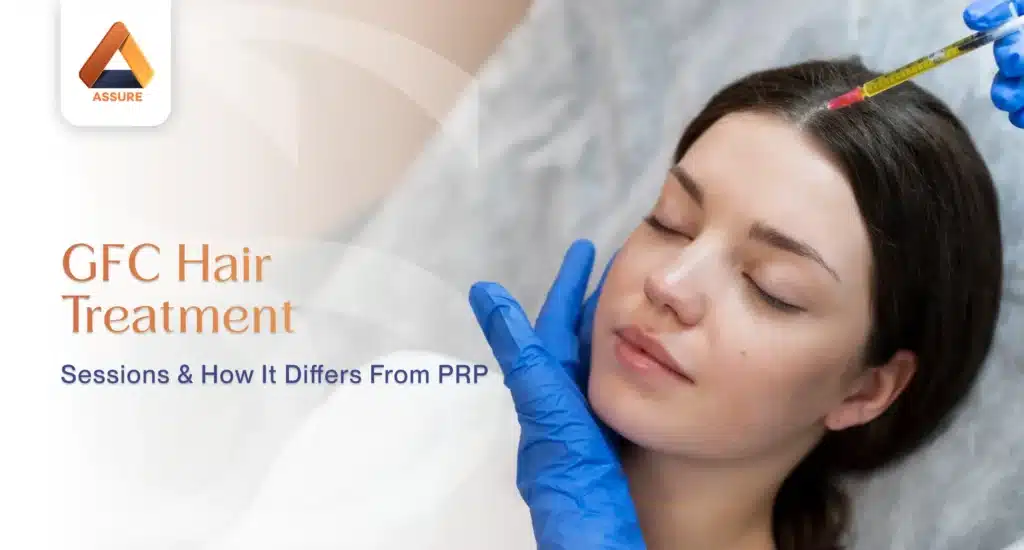
- The concentrate is injected across the thinning areas with very fine needles in a grid pattern and the depth and spacing are planned according to your scalp and the pattern of your hair loss.
The whole session takes about 75 to 90 minutes. Most patients find the injections mildly uncomfortable. Some tenderness, swelling or redness on the scalp for 24 to 48 hours is common and settles by itself.
How Many GFC Sessions Do You Need?
The standard protocol at Assure Clinic is 3 to 4 sessions spaced about 4 weeks apart which forms one treatment cycle. After that the maintenance sessions every 4 to 6 months are usually advised depending on how your hair responds. The exact number is decided by the doctor after assessing your scalp so it can be fewer or more in your case.
Results do not appear after a single session. Early changes such as less hair fall may be noticed from around 8 to 12 weeks and the fuller effect builds up over the following months. Results vary from person to person, and GFC slows and supports active hair loss. It is not a permanent solution.
What Does GFC Treatment Cost Depend On?
GFC treatment cost is not the same for every patient because the plan is different for every scalp. At Assure Clinic the cost is quoted after a scalp assessment and not as a fixed price.
| What changes the cost | Why it matters |
| Number of sessions | A full cycle is usually 3 to 4 sessions, and maintenance sessions come later |
| Area of the scalp treated | A larger area of thinning needs more concentrate and more injection time |
| Standalone or combined treatment | The cost changes if GFC is combined with PRP, laser or medicines |
| City and clinic | Operating costs and facilities differ between clinics |
| The kit used | A genuine GFC kit costs more than a basic PRP tube |
When you compare quotations, ask what is injected and how it is prepared because some clinics use the name GFC for concentrated PRP. Ask also whether the quote includes the scalp assessment, the doctor-supervised procedure, the follow-up at each session and the post-treatment instructions and whether maintenance sessions are charged separately. EMI is also available at Assure Clinic locations.
Is GFC Hair Treatment Suitable For Me?
GFC is generally suitable for people who still have active hair that is thinning. The doctor may consider it in the following situations.
- Early to moderate pattern hair loss such as Norwood stage 1 to 3 in men and Ludwig stage 1 to 2 in women
- Diffuse thinning at the crown or temples where follicles are weakened and not lost
- Active shedding, because follicles that are still working respond better than dormant ones
- Support after a hair transplant usually advised 1 to 3 months after the procedure
- Patients who prefer a non-surgical option or are unable to undergo surgery
GFC is less suitable when the follicles are absent or permanently damaged. This includes complete baldness at Norwood 6 and 7 and scarring alopecia. Patients on blood thinners need medical clearance before injections. A scalp assessment with trichoscopy helps the doctor decide whether GFC is appropriate or whether a transplant should be discussed instead.
GFC Along With Medicines and Other Hair Treatments
GFC is usually one part of a plan and not the whole plan. Medicines such as finasteride and minoxidil are commonly recommended as the base treatment for androgenetic alopecia (Kanti et al., 2018) and GFC or PRP is added as a supportive step.
When the area has already gone bald, no injection will bring the hair back and the discussion moves to a transplant.
| Expert Hair Insight
“GFC and PRP are support treatments for hair that is thinning but still alive. When an area is already bald I tell the patient clearly that an injection will not bring hair back and we talk about a transplant instead.” Dr. Abhishek Pilani, MMC 2011020289, |
Are There Any Side Effects of GFC?
Side effects are usually mild and short-lived. These include swelling, redness, soreness and sometimes small bruises at the injection points which settle in 24 to 48 hours. Infection is uncommon when the procedure is done under sterile clinical conditions. Tell your doctor about any blood-thinning medicine, bleeding problem or active scalp infection before the session and follow the instructions given on medicines and hair washing afterwards.
GFC Hair Treatment at Assure Clinic
Assure Clinic is a hair transplant and skin clinic with centres across India and in Dubai. A scalp assessment with trichoscopy is done before any treatment is recommended and the doctor explains the options, the number of sessions and the cost. GFC is advised only when it suits your stage of hair loss for which a proper doctor consultation is important. Consult a dermatologist at Assure Clinic to have your hair loss assessed and to discuss whether GFC suits you.
Want to know if GFC suits your hair loss and what it will cost?
Disclaimer: This article is for general information. It is not medical advice or a price quotation. Costs, sessions and results differ from person to person. Please consult a qualified doctor about your own hair loss.
Frequently Asked Questions
What is GFC hair treatment?
GFC hair treatment uses growth factor concentrate prepared from your own blood, which is injected into the scalp to support thinning hair that still has active follicles.
How much does GFC treatment cost?
The cost depends on the number of sessions, the area treated and whether it is combined with other treatments. At Assure Clinic it is quoted after a scalp assessment.
How many GFC sessions are needed?
The usual protocol is 3 to 4 sessions about 4 weeks apart, followed by maintenance every 4 to 6 months. Your doctor decides the number after assessing your scalp.
What is the difference between GFC and PRP?
PRP concentrates platelets along with plasma. GFC takes an extra step to separate the growth factors from the other blood components before injection.
Is GFC better than PRP?
Not proven for everyone. Research on PRP is larger and shows an increase in hair density, while studies on GFC are fewer and smaller. A doctor can tell which suits your stage of hair loss.
Can GFC regrow hair on bald areas?
No. GFC supports follicles that are still active and cannot restore hair where the follicles are already gone. A hair transplant is considered for bald areas.
Is GFC treatment painful?
Most patients find it mildly uncomfortable. A numbing cream is applied before the injections, and some tenderness for 24 to 48 hours is common.
How long do GFC results last?
There is no fixed duration because results differ between patients and are not permanent. Maintenance sessions are usually advised every 4 to 6 months depending on response.
Can GFC be done after a hair transplant?
Yes. It is often used 1 to 3 months after a transplant to support the surrounding hair and the healing of the scalp, as decided by your doctor.
Who should not take GFC treatment?
People with complete baldness, scarring alopecia or an active scalp infection are usually not suitable, and those on blood thinners need medical clearance first.
References
Evans AG, et al. Platelet-rich plasma as a therapy for androgenic alopecia: a systematic review and meta-analysis. J Dermatolog Treat. 2022;33(1):498-511.
Kanti V, et al. Evidence based (S3) guideline for the treatment of androgenetic alopecia in women and in men. J Eur Acad Dermatol Venereol. 2018;32(1):11-22.
Kieling L, et al. Is autologous platelet-rich plasma capable of increasing hair density in patients with androgenic alopecia? A systematic review and meta-analysis of randomized clinical trials. An Bras Dermatol. 2024;99(6):847-862.
Zhou D, et al. Advances in research on concentrated growth factor applications for androgenetic alopecia treatment: a review. Med Sci Monit. 2025;31:e948054.