
Hair Transplant Essentials to Know
|
Hair loss does not begin at the same age for everyone. Some men notice their hairline moving back in their early twenties while others see thinning only in their forties, and an Indian study found male pattern hair loss in about 58% of men aged 30 to 50 (Krupa Shankar et al., 2009). This is why the question of the right age for a transplant comes up at so many different stages of life.
Most patients who ask about the right age are worried about one of two things. Young men feel that if they wait their hairline will go back too much and older men feel that a transplant will not work for them or will look odd at their age. Usually neither of these is true because whether you can get a transplant depends more on how your hair is falling than on your age itself.
In this blog, we explain the hair transplant age limit, the best age for hair transplant, why doctors are careful in early twenties, transplant after 50 and how Assure Clinic can help you.
Check My Hair Loss Stage
What Is the Hair Transplant Age Limit?
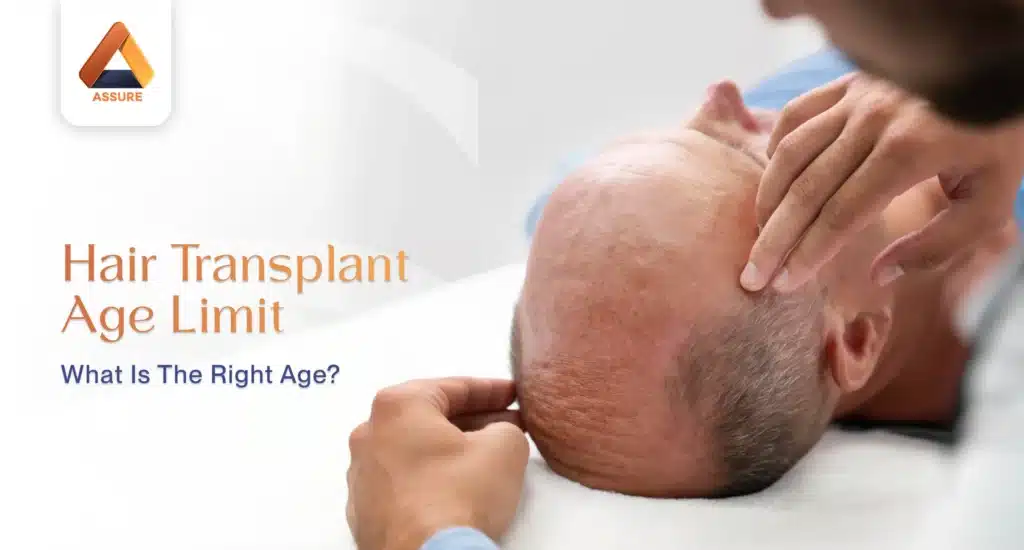
No fixed upper age limit is there for hair transplant in adults and men in their fifties and sixties also get it done. At the lower end, it is done only after 18 and doctors are usually careful before the mid-twenties as the hair loss pattern is still changing.
The hair at the back of the head is usually not affected by male pattern hair loss and that is why it is used as the donor area (Jimenez et al., 2021). These roots keep growing even after they are shifted to the front, so the result depends more on how many good roots you have at the back and how much hair you are still losing in the front. Your old photos help the doctor here as they show how fast your hairline has gone back in the last few years. Your sugar, blood pressure and the medicines you take are also noted before deciding whether you are the right candidate for a hair transplant.
What Is the Best Age for Hair Transplant?
In many men hair loss moves fast in the early twenties and then slows down by the late twenties or thirties. In one study only 16% of men between 18 and 29 years had moderate to extensive hair loss while in men between 40 and 49 years it was 53% (Rhodes et al., 1998). So the best age for hair transplant for most men comes somewhere between late twenties and forties, as by this time the pattern becomes clear and doctor can plan keeping your future hair loss also in mind. Following is the table that explains what usually happens at different ages and whether a transplant is advised or not.
| Age | What you may notice | Is a hair transplant usually advised? |
| 18 to 24 | Hairline going back fast and more hair on the pillow or in the shower | Usually not, doctor may start medicines first and ask you to keep a watch with photos |
| 25 to 35 | In many men hair loss slows down and the Norwood stage becomes clear. | Can be planned if the hair loss has been stable for some time |
| 35 to 50 | Front and crown thinning, pattern mostly settled | Most common age for transplant and it is usually planned along with medicines. |
| 50 and above | Bald area can be big and donor hair may be thinner | Can still be done after a health check and front is given priority based on donor hair available. |
Many people above the age of 50 think that they have become too old for a transplant. But by this age the hair loss has mostly settled so the doctor can clearly see how much area needs to be covered. So if the health is fine and the donor hair is good the transplant can still give a good result.
Why Doctors Are Careful With Transplant in Early Twenties
In early twenties the hairline can keep going back for many more years and nobody can say for sure where it will stop. If the hairline is made at 22 and the hair behind it keeps falling then by 30 there can be a transplanted front with a thin patch behind it, and more grafts will be needed to fill that. Following are the main reasons why doctors usually ask young patients to wait.
- Pattern is not clear yet and sometimes it moves faster than expected.
- Donor area has limited grafts so using many of them early leaves lesser for later.
- Many boys bring their school photo and ask for the same low hairline which may not suit them at 40.
- Second or third sitting may be needed later if the hair loss continues.
So at this age doctor may first give medicines as per your stage and ask you to click photos every few months from the same angle so that it is easy to compare. Once the loss slows down the transplant can be planned much better.
Hair Transplant After 40, 50 and 60
By 40 or 50 the hair loss has mostly settled so the doctor can clearly see how much area is to be covered and how much donor hair is there to cover it. Many men at this age think it is too late but a transplant can still be done if the health is fine.
However few things are checked extra at this age. Donor hair may be little thinner, sugar, BP and blood thinners need checking before the procedure and healing can be bit slow. Hairline is also kept little higher so it suits the face. And grey hair actually helps in some men as it does not show the scalp that much.
Things That Matter More Than Age
Following are some points which matter more than your age while deciding hair transplant and these are general points so your doctor may change them as per your condition.
- How stable your hair loss is in last one or two years.
- Your Norwood stage and how much area needs to be covered.
- How thick and healthy your donor area is.
- General health like sugar, blood pressure and any medicines you take.
- Whether you are ready to take medicines after transplant if needed.
- What you are expecting from the result.
| Worth Knowing
Many people think the earlier they do transplant the better it is but this is not always true. Your donor area has only limited grafts and once they are used they will not grow back. For example if most grafts are used at 22 to make a low hairline and by 32 the crown also starts thinning, then there may not be enough grafts left for it. Hence the right time is when your hair loss is stable and not just when you first notice it. |
Why Medicines Still Matter at Any Age
Many patients feel once transplant is done nothing else is needed, but hair transplant does not stop male pattern hair loss in the hair which you already have.
| Research also supports this. In a placebo-controlled trial, men who took finasteride from one month before their transplant until eleven months after it ended up with higher hair counts (Leavitt et al., 2005). It was a small one-year study funded by the drug’s maker, but it is why your doctor may suggest finasteride or minoxidil along with transplant. Never start or stop them on your own. |
| Expert Hair Insight
“In my experience, young patients usually want transplant immediately and older patients usually think they have missed the chance, but both get surprised after consultation. At Assure Clinic we check the scalp with trichoscopy, find the Norwood stage and see the donor hair and only then we tell whether it is the right time or medicines should be started first. Our doctors themselves design and place the grafts. If you are not sure about your age, get your hair checked first rather than deciding by yourself.” Dr. Abhishek Pilani, MBBS, MD (Dermatology, Venereology & Leprosy) Co-Founder and Chief Hair Transplant Surgeon, Assure Clinic | Reg. No. 2011020289 (MMC) |
Hair transplant planning at Assure Clinic
At Assure Clinic hairline transplant is done with UHDHT method where grafts are taken out with UFME and placed with DSHI, so each graft goes in the scalp soon after it is taken out. In the consultation your scalp is checked with trichoscopy, your Norwood stage is found out and the doctor tells you whether to go ahead now or start medicines first. The cost is as per Full Head Results pricing and not per graft and there are EMI options as well.
Frequently Asked Questions
What is the hair transplant age limit?
There is no fixed upper age limit for hair transplant in adults. The doctor checks how your hair loss is going, your donor area and your health and then decides whether you can go ahead.
What is the best age for hair transplant?
For most men it’s somewhere in between late twenties and forties. By this age the Norwood stage is usually apparent so the doctor can plan the hairline for how you will look later as well.
Can I get a hair transplant at 20 or 21?
Usually no. At this age the hairline is still going back in most men so the doctor may first give medicines and check again after few months.
Can I get a hair transplant at 50 or 60?
Yes it can be done if your health allows it. Sugar, blood pressure and blood thinners are checked before the procedure and healing may take little more time.
Does age affect hair transplant results?
Not much. Thickness of your donor hair, how stable your hair loss is and following aftercare properly matter more than age.
Will I need another transplant later if I do it young?
It is possible if hair keeps falling behind the transplanted area, which is why the doctor plans the hairline keeping future loss in mind and may give medicines.
Is hair transplant permanent at any age?
Transplanted hair usually stays for many years as it is taken from the back of the head where hair does not fall easily. But your own hair around it can still become thin.
References
Jimenez, F., et al. (2021). Hair transplantation: Basic overview. Journal of the American Academy of Dermatology, 85(4), 803-814.
Krupa Shankar, D., et al. (2009). Male androgenetic alopecia: Population-based study in 1,005 subjects. International Journal of Trichology, 1(2), 131-133.
Leavitt, M., et al. (2005). Effects of finasteride (1 mg) on hair transplant. Dermatologic Surgery, 31(10), 1268-1276.
Rhodes, T., et al. (1998). Prevalence of male pattern hair loss in 18-49 year old men. Dermatologic Surgery, 24(12), 1330-1332.