Hair transplant technology has changed more in the last three years than in the previous two decades combined. If you researched your options even 18 months ago, the landscape today looks dramatically different.
New extraction tools, exclusive implantation methods, AI-assisted planning, and regenerative therapies have reshaped what a modern hair transplant can deliver. But not every “breakthrough” lives up to its marketing. Some clinics still use decade-old techniques while branding them as cutting edge.
This guide separates genuine innovation from hype. We cover the techniques backed by clinical results, the technology that actually improves outcomes, and the questions you should be asking before you choose a clinic in 2026.
Get Your Personalized Hair Transplant Cost Estimate
Takes 60 seconds. See your expected cost range based on your hair loss stage and preferred city — transparent pricing, no hidden fees.
Calculate Your Cost →Whether you are evaluating your first procedure or considering a second session for added density, this is the most complete overview of where hair transplant technology stands right now.
How Hair Transplant Technology Has Evolved: A Brief History
Understanding where we are today requires a quick look at the path that got us here.
The Strip Era (FUT)
Follicular Unit Transplantation, commonly called the strip method, dominated from the 1990s through the early 2010s. The surgeon removed a strip of scalp from the back of the head, dissected it under a microscope into individual follicular units, and implanted them into the recipient area.
FUT delivered reasonable results in skilled hands, but it left a permanent linear scar across the donor zone. Recovery was painful, and patients could never wear their hair short in the back without revealing the scar. This technique is now considered outdated for most candidates.
The FUE Revolution
Follicular Unit Extraction changed the game by removing individual follicular units directly from the scalp using a circular punch tool. No strip, no linear scar, and a faster recovery. FUE became the global standard by the mid-2010s.
However, standard FUE has limitations. Typical punch sizes range from 0.9mm to 1.2mm, which means larger extraction wounds, a higher risk of transection (damaging the graft during extraction), and visible micro-scarring in the donor area at higher graft counts.
DHI: A Step Forward in Implantation
Direct Hair Implantation introduced the Choi implanter pen, which allowed the surgeon to implant grafts directly without pre-making recipient sites. This gave better control over angle and direction, and it reduced the time grafts spent outside the body.
DHI was a genuine improvement for certain cases, particularly hairline work. But the Choi pen was not designed for ultra-fine grafts, and it required frequent reloading, which extended procedure times.
2024 to 2026: The UFME and DSHI Era
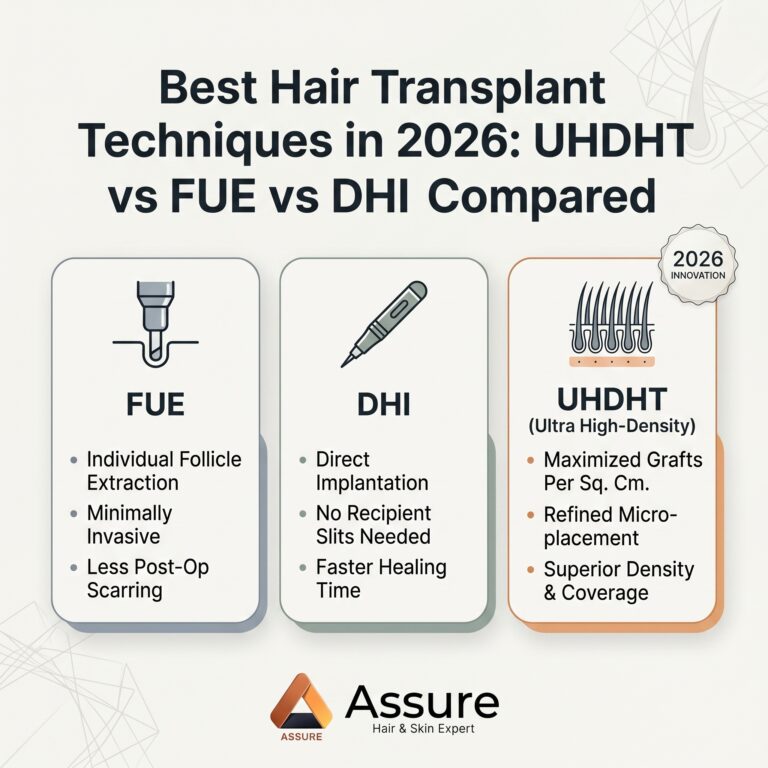
The most significant advances have arrived in the last two years. Ultra-High Density Hair Transplant (UHDHT) combines two exclusive techniques, UFME for extraction and DSHI for implantation, to achieve graft densities and survival rates that were not possible with standard FUE or DHI.
This is where 2026 technology genuinely separates itself from everything that came before.
UFME: The Ultra-Fine Extraction Breakthrough
Ultra-Fine Micro Extraction (UFME) is a exclusive extraction technique that represents the most meaningful upgrade to follicle harvesting since FUE was first introduced.
What makes UFME different from standard FUE?
The core innovation is the punch size. UFME uses a custom-engineered micro-punch measuring just 0.6 to 0.8mm in diameter, compared to the 0.9 to 1.2mm punches used in conventional FUE. That difference may sound small on paper, but its impact on outcomes is substantial.
Key benefits of UFME extraction:
- Minimal donor scarring. The smaller punch creates extraction sites so small they become virtually invisible within days, not weeks. Patients can wear their hair at a grade 1 or 2 buzz cut without visible scarring in the donor area.
- Higher graft survival. The precision of the micro-punch reduces transection rates, meaning fewer grafts are damaged during extraction. This contributes directly to high graft survival achieved with the UHDHT method.
- Greater donor preservation. Because each extraction site is smaller, more follicular units remain available for future sessions. This is critical for younger patients who may need additional density later.
- Faster healing. Smaller wounds close faster. Most UFME patients see complete donor healing within 5 to 7 days, compared to 10 to 14 days with standard FUE.
According to Dr. Abhishek Pilani, MBBS, MD Dermatology (Gold Medalist), ISHRS Member, and DHA Licensed practitioner: “The shift from 1mm punches to 0.6mm punches is not an incremental improvement. It fundamentally changes the donor management equation. We can now extract more grafts per square centimeter while leaving the donor zone looking untouched.”
UFME is not simply “smaller FUE.” The instrument design, the extraction motion, and the depth calibration are all engineered specifically for the 0.6 to 0.8mm range. Standard FUE punches cannot achieve comparable results at this size because they were not designed for it.
DSHI: Direct Simultaneous Hair Implantation
If UFME revolutionized extraction, Direct Simultaneous Hair Implantation (DSHI) did the same for the implantation side of the procedure.
How DSHI differs from standard DHI
Standard DHI uses the Choi implanter pen: the technician loads a single graft into the pen, hands it to the surgeon, and the surgeon implants it by pressing the plunger. This one-at-a-time loading cycle means grafts spend more time outside the body, and the procedure takes longer.
DSHI is a exclusive technique that enables simultaneous channel creation and graft placement in a single motion. The key differences include:
- Reduced out-of-body time. Grafts are implanted within seconds of extraction. Every minute a graft spends outside the body reduces its viability. DSHI minimizes this window dramatically.
- Higher density placement. DSHI allows implantation at densities of 60 to 80 grafts per square centimeter, compared to 35 to 45 with standard DHI. This means fuller results in fewer sessions.
- Precise angle and depth control. The DSHI instrument gives the qualified doctor direct control over implantation angle (matching natural hair growth patterns) and depth (ensuring the graft sits at the correct position in the dermis).
- Simultaneous workflow. Because extraction and implantation happen in parallel during UHDHT procedures, the total procedure time is shorter and graft viability is maximized.
According to Dr. Abhishek Pilani: “With DSHI, we are not just placing grafts faster. We are placing them with a level of directional precision that was physically impossible with the Choi pen. The result is hair that grows at the exact angle and orientation of native hair, which is what makes a transplant look natural rather than ‘planted.'”
UHDHT: Combining UFME + DSHI for Ultra-High Density Results
Ultra-High Density Hair Transplant (UHDHT) is the overarching method that combines UFME extraction with DSHI implantation into a single, integrated procedure protocol.
Think of it this way: UFME is how grafts are taken out, DSHI is how they are put in, and UHDHT is the complete system that coordinates both for maximum density and survival.
What UHDHT delivers that individual techniques cannot:
- High graft survival across 20,000+ completed procedures
- Ultra-high density: 60 to 80 grafts per cm², enabling full coverage in fewer sessions
- Minimal downtime: Most patients return to desk work within 3 to 5 days
- Natural results: The combination of precise extraction angles (UFME) and precise implantation angles (DSHI) produces results that are indistinguishable from natural hair growth
- Full head results pricing: Assure Clinic prices UHDHT as a complete full head result rather than charging per graft, which eliminates the incentive to under-graft
UHDHT procedures at Assure Clinic are performed by a team of over 60 qualified doctors across 13 clinic locations, with every procedure supervised by senior surgeons trained in both UFME and DSHI protocols.
Full Technique Comparison: FUE vs DHI vs UFME vs DSHI
One of the most common questions from patients researching their options is how these techniques actually compare side by side. This table provides a direct, factual comparison.
| Feature | Standard FUE | Standard DHI | UFME (Extraction) | DSHI (Implantation) |
|---|---|---|---|---|
| Type | Extraction method | Implantation method | Exclusive extraction technique | Exclusive implantation technique |
| Punch/Tool Size | 0.9 – 1.2mm | Choi pen (0.9 – 1.0mm) | 0.6 – 0.8mm micro-punch | Proprietary DSHI instrument |
| Scarring | Visible dot scars at high counts | Minimal (implant side) | Near-invisible micro-dots | Minimal channel scarring |
| Healing Time | 10 – 14 days | 7 – 10 days | 5 – 7 days | 5 – 7 days |
| Graft Survival Rate | Varies by clinic | Varies by clinic | High | High |
| Density Achievable | 30 – 40 grafts/cm² | 35 – 45 grafts/cm² | Supports 60 – 80/cm² (with DSHI) | 60 – 80 grafts/cm² |
| Out-of-Body Time | Higher (batch process) | Moderate (sequential) | Minimal (simultaneous workflow) | Minimal (immediate placement) |
| Pricing Model | Per graft | Per graft | Full head results | Full head results |
| Who Performs | Technicians common | Technicians common | Qualified doctors only | Qualified doctors only |
| Best For | Basic coverage | Hairline refinement | High-density full procedures | High-density full procedures |
Key takeaway: UFME and DSHI are not just newer versions of FUE and DHI. They are purpose-built, exclusive techniques designed to work together under the UHDHT method. The density, survival rate, and healing advantages are the direct result of engineering both sides of the procedure as a unified system.
For a deeper comparison of extraction and implantation approaches, see our detailed guide: FUE vs DHI Hair Transplant.
AI and Imaging in Hair Transplant Planning
The procedure itself is only as good as the plan behind it. In 2026, artificial intelligence and advanced imaging have transformed the pre-operative planning phase.
Digital Trichoscopy and Donor Mapping
Before any extraction begins, qualified doctors now use high-resolution digital trichoscopy to analyze the donor area at the individual follicle level. This technology captures:
- Follicular unit density per square centimeter across the entire donor zone
- Hair shaft diameter and caliber variations
- The ratio of single-hair to multi-hair follicular units
- Scalp laxity and skin thickness measurements
This data feeds into planning software that creates a precise extraction map, ensuring grafts are harvested evenly across the donor area to prevent visible thinning or patchiness.
AI-Assisted Design and Simulation
AI tools in 2026 allow patients to see projected outcomes before a single graft is extracted. These systems analyze:
- Face shape, forehead proportions, and existing hairline remnants
- The patient’s age and likely future hair loss progression
- Donor supply relative to current and anticipated recipient needs
The result is a personalized treatment plan that accounts not just for today’s coverage goals but for how the patient’s hair loss pattern is likely to evolve over the next 10 to 20 years. This long-term planning is one of the most underappreciated advances in modern transplant medicine.
Try our Baldness Calculator to get an initial assessment of your hair loss stage and see how many grafts might be needed for your pattern.
What AI cannot replace
It is worth noting what AI does not do in 2026. AI does not perform the extraction. AI does not implant grafts. The artistic judgment of hairline design, the tactile skill of working with different hair textures, and the real-time decision-making during surgery remain firmly in the hands of qualified doctors. AI is a planning tool, not a replacement for surgical expertise.
PRP and GFC: Advances in Non-Surgical Hair Restoration
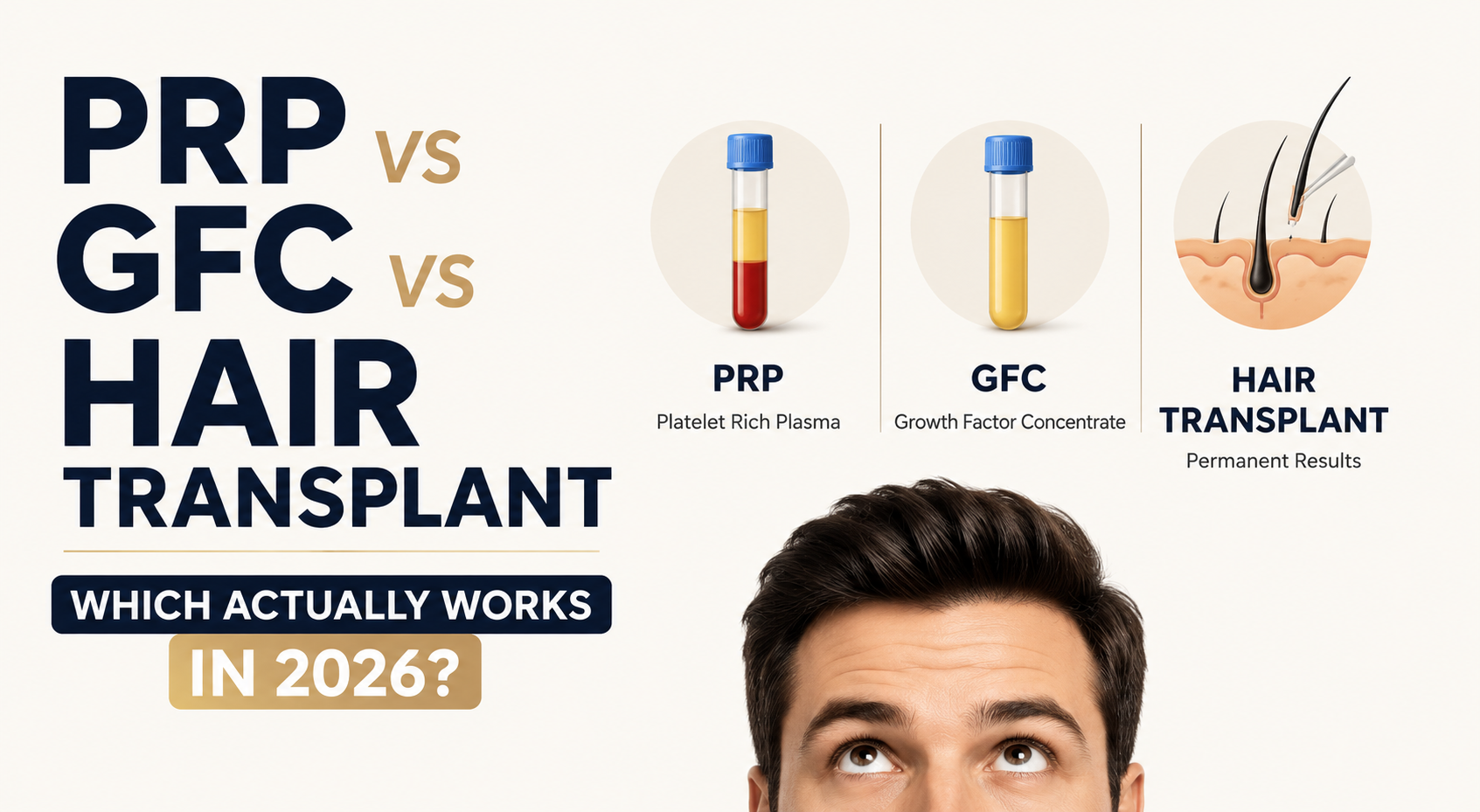
Not every patient needs a transplant, and not every transplant patient should skip adjunct therapies. Platelet-Rich Plasma (PRP) and Growth Factor Concentrate (GFC) have both matured significantly as clinical treatments.
PRP in 2026
PRP therapy involves drawing the patient’s blood, processing it to concentrate the platelet-rich fraction, and injecting it into the scalp. The growth factors in platelets stimulate dormant follicles and improve the health of miniaturizing hair.
What has changed recently is standardization. Earlier PRP treatments varied wildly in concentration and protocol, leading to inconsistent results. In 2026, double-spin protocols and standardized platelet concentration thresholds have made PRP results more predictable and reproducible.
PRP is most effective for:
– Early-stage thinning (Norwood 2 to 3) where follicles are miniaturizing but not yet dead
– Post-transplant recovery, where PRP accelerates graft healing and early growth
– Maintenance therapy to slow ongoing miniaturization in non-transplanted areas
GFC: The Next Step Beyond PRP
Growth Factor Concentrate is a more refined version of the same principle. GFC isolates specific growth factors from the blood rather than relying on the full platelet concentrate. The result is a higher concentration of the active molecules that drive follicle stimulation, with fewer inflammatory components.
GFC is gaining traction in 2026 as a standalone treatment for patients who are not yet candidates for transplantation, and as a complement to UHDHT procedures during the post-operative phase.
Comparison: PRP vs GFC
| Feature | PRP | GFC |
|---|---|---|
| Source | Patient’s blood (platelet-rich plasma) | Patient’s blood (isolated growth factors) |
| Concentration | Variable (protocol-dependent) | Higher, more consistent |
| Inflammatory Response | Moderate (contains white blood cells) | Lower (purer growth factor isolation) |
| Sessions Needed | 3 – 4 initial, then maintenance every 4 – 6 months | 2 – 3 initial, then maintenance every 6 months |
| Best For | Early thinning, post-transplant healing | Targeted follicle stimulation, sensitive scalps |
| Can Replace Transplant? | No (slows loss, does not regrow bald areas) | No (slows loss, does not regrow bald areas) |
Neither PRP nor GFC can regrow hair in areas that are completely bald. They are tools for preservation and optimization, not replacement for surgical restoration. Any clinic claiming otherwise should be approached with skepticism.
Stem Cell Therapy for Hair Loss: Where We Are in 2026
Stem cell therapy is the most asked-about emerging treatment in hair restoration, and also the most misunderstood.
What is clinically available now
In 2026, the most established stem cell approach in hair restoration is autologous stem cell therapy, where stem cells are derived from the patient’s own tissue (typically a small skin or fat sample). These cells are processed and injected into the scalp to stimulate dormant follicles.
Clinical trials have shown promising results for early-stage hair loss, particularly in improving hair density in areas of active miniaturization. However, the evidence base remains smaller and less mature than for PRP or surgical transplantation.
What is not yet available
Hair follicle cloning and unlimited donor multiplication remain in the laboratory phase. Despite decades of research, no clinic anywhere in the world can clone hair follicles at scale for clinical use. Companies and research labs are making progress, but regulatory approval for commercial use is likely still several years away.
The honest assessment
Stem cell therapy in 2026 is a legitimate adjunct treatment for certain patients with early hair loss. It is not a replacement for hair transplantation in patients with established baldness. Any clinic marketing stem cells as a “cure” for baldness or a substitute for surgical restoration is overstating the current evidence.
The most effective protocol for advanced hair loss in 2026 remains UHDHT (surgical restoration) combined with PRP or GFC (maintenance and optimization), with stem cell therapy as an optional additional layer for suitable candidates.
Phased Sessions vs Marathon Sessions: Why Shorter Is Better
A critical question that patients often overlook is how the procedure is structured in terms of session length and graft count per sitting.
The marathon session problem
Some clinics promote mega-sessions of 5,000 to 8,000 grafts in a single sitting lasting 10 to 14 hours. On paper, getting everything done in one day sounds efficient. In practice, it creates serious risks:
- Graft viability drops with time. Grafts extracted in hour 2 that are not implanted until hour 10 have spent 8 hours outside the body. Even with advanced holding solutions, survival rates decline measurably after 4 to 6 hours.
- Surgeon fatigue. A 12-hour procedure taxes even the most experienced team. Precision in hour 11 is not the same as precision in hour 2.
- Patient stress. Extended time under local anesthesia, restricted movement, and physical discomfort can trigger physiological stress responses that impair healing.
- Higher complication rates. Scalp swelling, recipient area trauma, and post-operative edema are all more common with ultra-long sessions.
The phased session advantage
The UHDHT protocol at Assure Clinic uses phased sessions, typically 3 to 5 hours each, with procedures spaced appropriately based on healing progress. This approach ensures:
- Grafts are never outside the body longer than necessary (thanks to the simultaneous UFME + DSHI workflow)
- The surgical team maintains peak precision throughout each session
- The patient’s scalp has time to heal optimally between sessions
- Graft survival stays high rather than dropping, as it can with marathon sessions
According to Dr. Abhishek Pilani: “A hair transplant is a microsurgical procedure, not an endurance test. We would rather complete a procedure in two focused sessions with high graft survival than one exhausting marathon where more grafts are lost. The math is simple: fewer surviving grafts means thinner results, regardless of how many were implanted.”
For more on what the recovery process looks like, see our complete guide: What to Expect After a Hair Transplant: Recovery Timeline Day by Day.
What to Look for in a Modern Hair Transplant Clinic: 2026 Checklist
The technology is only as good as the clinic delivering it. Here is a practical checklist for evaluating any hair transplant clinic in 2026.
Surgical team credentials
– Are procedures performed by qualified doctors, or are technicians doing the extraction and implantation?
– What are the lead surgeon’s qualifications? Look for recognized medical degrees, dermatology specialization, and membership in professional bodies like ISHRS (International Society of Hair Restoration Surgery).
– How many procedures has the team completed? A track record of 20,000+ procedures indicates a mature, high-volume practice.
Technology and technique
– What extraction method does the clinic use? Ask about punch size. If they are using punches larger than 0.9mm, they are not offering the latest extraction technology.
– What implantation method is used? Standard forceps, Choi pen, or a more advanced technique like DSHI?
– Does the clinic use digital trichoscopy and computerized donor mapping for pre-operative planning?
Transparency and pricing
– Does the clinic offer full head results pricing, or do they charge per graft? Per-graft pricing creates an incentive to under-graft patients to keep costs down, or over-count grafts to inflate the bill.
– Can they show documented before-and-after results from patients with a similar hair loss pattern to yours?
– What does the cost actually include? Ask about medications, follow-up PRP sessions, and revision policies.
Post-operative support
– What is the follow-up schedule? A good clinic monitors your progress at regular intervals for at least 12 months.
– Is PRP or GFC included or recommended as part of the post-operative protocol?
– What happens if results are below expectations? Ask about the clinic’s revision policy before the first procedure.
Red flags to watch for
– Clinics that promise “guaranteed results” (biology does not come with guarantees)
– Technician-led procedures marketed as “doctor-supervised”
– Per-graft pricing with no clear documentation of actual graft counts
– Robotic transplant systems marketed as superior (robotic systems use larger punches, cannot match the precision of experienced hands using micro-punches, and add significant cost with no proven outcome advantage)
– Clinics that cannot explain the difference between their extraction and implantation methods
Learn more about Assure Clinic’s surgical team and approach.
Is a Hair Transplant Permanent? The Science Behind Lasting Results
One of the most common concerns patients have is whether transplanted hair will actually last. The short answer is yes, but the full picture deserves explanation.
Hair transplants work because of a principle called donor dominance. Follicles taken from the permanent zone at the back and sides of the scalp retain their genetic programming even after being moved to a balding area. They continue to grow long-term because they were never programmed to miniaturize.
However, a hair transplant does not stop ongoing hair loss in non-transplanted areas. This is why long-term planning (addressing future loss patterns, not just current bald areas) and adjunct therapies like PRP are so important.
With UHDHT’s high graft survival, patients can expect the vast majority of transplanted follicles to produce hair for the long term. The combination of precise extraction (UFME), immediate implantation (DSHI), and evidence-based post-operative care maximizes this outcome.
For the full scientific breakdown, read: Is Hair Transplant Permanent? Real Science, Real Answers.
Frequently Asked Questions
What is the most advanced hair transplant technique in 2026?
UHDHT (Ultra-High Density Hair Transplant) is currently the most advanced method available. It combines UFME for extraction and DSHI for implantation, both of which are exclusive techniques. Together, they achieve graft densities of 60 to 80 per square centimeter with high graft survival, which exceeds the capabilities of standard FUE or DHI.
How is UFME different from regular FUE?
UFME uses a 0.6 to 0.8mm micro-punch compared to the 0.9 to 1.2mm punch used in standard FUE. This smaller size reduces donor scarring, improves graft survival by lowering transection rates, and allows faster healing (5 to 7 days versus 10 to 14 days). UFME is a exclusive technique that requires specialized instruments not used in conventional FUE.
What is DSHI and how does it differ from DHI?
DSHI (Direct Simultaneous Hair Implantation) is a exclusive implantation technique that enables simultaneous channel creation and graft placement in one motion. Standard DHI uses the Choi pen, which loads and implants one graft at a time. DSHI achieves higher density placement (60 to 80 grafts per cm² versus 35 to 45 with DHI) and better angle control.
How much does a hair transplant cost in 2026?
Assure Clinic uses full head results pricing rather than per-graft pricing. This means you pay for the complete outcome, not an individual graft count. Costs vary based on the extent of hair loss and the number of sessions required. For detailed pricing information, visit our hair transplant cost page.
Are robotic hair transplants better than manual techniques?
No. Robotic systems use punches of 1.0mm or larger and cannot match the precision of UFME’s 0.6 to 0.8mm micro-punch. Robotic systems add significant cost and are limited in their ability to handle varying hair textures, angles, and scalp curvatures. Experienced qualified doctors using UFME and DSHI consistently outperform robotic systems in graft survival, density, and natural appearance.
How long does recovery take after a UHDHT procedure?
Most patients return to desk work within 3 to 5 days. Donor area healing is typically complete within 5 to 7 days. The recipient area shows visible hair growth starting at 3 to 4 months, with full results visible at 12 to 15 months. Detailed recovery milestones are covered in our recovery timeline guide.
Can PRP or GFC replace a hair transplant?
No. PRP and GFC are effective at slowing hair loss and stimulating miniaturizing follicles, but they cannot regrow hair in areas that are completely bald. They are best used as complementary treatments alongside UHDHT or as standalone maintenance therapy for early-stage thinning.
What is stem cell therapy for hair loss?
Stem cell therapy involves using the patient’s own stem cells to stimulate dormant hair follicles. In 2026, it is a legitimate adjunct treatment for early hair loss but is not a replacement for surgical hair transplantation. Hair follicle cloning remains in the research phase and is not commercially available.
How many grafts can be transplanted in one session?
With the UHDHT phased session approach, typically 2,000 to 3,500 grafts are transplanted per session in focused 3 to 5 hour procedures. This keeps graft out-of-body time minimal and survival high. Marathon sessions of 5,000+ grafts compromise graft viability and surgeon precision.
How do I know if I am a good candidate for a hair transplant?
Good candidates have sufficient donor hair density, realistic expectations, and stable or manageable hair loss. A digital trichoscopy assessment can determine your donor capacity and suitability. Contact Assure Clinic at +91 95861 22444 for a free consultation, or use our Baldness Calculator for an initial self-assessment.
Last Updated: April 2026
Medical review by Dr. Abhishek Pilani, MBBS, MD Dermatology (Gold Medalist), ISHRS Member, DHA Licensed. With over 20,000 procedures performed across 13 Assure Clinic locations, Dr. Pilani specializes in Ultra-High Density Hair Transplant (UHDHT) using exclusive UFME and DSHI techniques.