
Medically reviewed by Dr. Abhishek Pilani, MBBS, MD Dermatology, Co-Founder and Chief Hair Transplant Surgeon, Assure Clinic | Registration No.: MMC 2011020289
Hair Transplant Essentials To Know
|
A hair transplant is a considered investment in personal appearance, and the cost deserves the same degree of scrutiny as the procedure itself. Yet many people begin their research with a single figure which is the price per graft. While this provides an initial benchmark, it offers little insight into the expertise, surgical planning and degree of restoration that determine the overall expenditure.
In India, hair transplant pricing in 2026 varies with the extent of hair loss, the availability of suitable donor follicles, the technique selected and the clinical team’s approach to achieving natural-looking density. (Rose, 2015; Rassman et al., 2002) The distinction between an attractive quotation and a well-planned procedure often lies in these finer details.
The following guide examines prevailing per-graft rates, estimated costs across common graft counts, the number of grafts typically required at different stages of hair loss and expenses that may fall outside the initial fee. All prices are indicative. A personalised estimate requires a thorough examination of your scalp and donor area, followed by a treatment plan tailored to your restoration goals.
Learn More
What Does a Hair Graft Actually Represent?
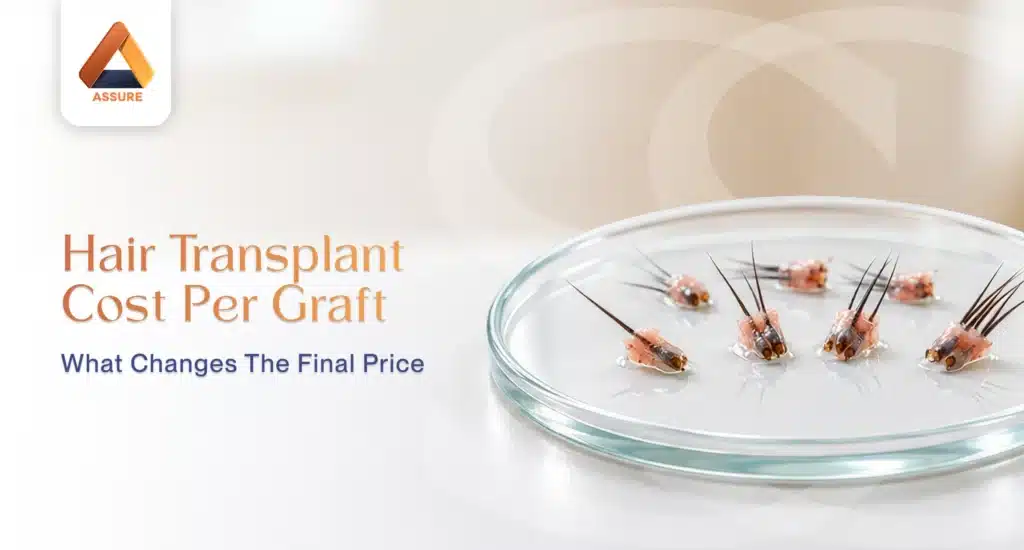
A graft is the basic unit used to plan and price a hair transplant. Each follicular unit contains between one and four hairs, usually growing together through a single opening in the scalp. These units are harvested from the donor area, typically at the back and sides of the head, and implanted into areas affected by thinning or hair loss.
The distinction matters when assessing the hair transplant cost per graft. A single-hair graft and a four-hair graft each count as one unit, yet they contribute differently to the overall hair count and the appearance of density. The number of grafts alone, therefore, offers an incomplete picture of what a procedure can achieve.
Consider two patients who each receive 2,000 grafts. Their results may differ considerably depending on the number of hairs within each graft, the distribution across the scalp, the survival of implanted follicles and the patient’s existing hair. This is also why the 2000 grafts hair transplant cost should be considered alongside the treatment plan, not as a standalone measure of value.
When comparing the hair transplant cost in India, look beyond the quoted rate. The more meaningful assessment considers how the available donor hair will be used, how the grafts will be distributed and whether the proposed plan suits the pattern of hair loss.
Hair Transplant Cost per Graft in India in 2026
Hair transplant pricing in India varies considerably by technique, clinic and the level of surgical expertise involved. In 2026, FUE generally falls at the lower end of the per-graft scale, while DHI commands a higher rate because of its implantation method and the precision required at each stage. These figures are indicative Assure Clinic equivalents, not a standard tariff across clinics.
| Technique | Indicative cost per graft | Method of implantation | What shapes the price |
| FUE (Follicular Unit Extraction) | ₹100 – ₹150 | Individual follicular units are extracted and implanted into prepared recipient sites. | Surgical expertise, graft handling and procedure volume |
| DHI (Direct Hair Implantation) | ₹150 – ₹200 | Extracted grafts are placed using a specialised implanter pen. | Implantation technique, handling time and clinical expertise |
FUT (Follicular Unit Transplantation) follows a different approach. A strip of scalp is removed from the donor area and dissected into follicular units, leaving a linear scar. Clinics commonly price FUT as a package, which makes a direct per-graft comparison less straightforward.
The differences between these procedures extend beyond their quoted rates. The FUE hair transplant technique uses individual extraction, while DHI hair transplantation employs a dedicated implantation pen.
A quotation substantially below the prevailing range warrants a closer examination of its inclusions. Ask whether the fee covers the surgeon, clinical team, medication, post-operative reviews and any additional sessions that may be recommended. The rate matters, but the expertise behind the procedure and the terms of the quotation deserve equal scrutiny.
Hair Transplant Cost for 1,000 to 5,000 Grafts in India
The number of grafts required has a direct bearing on the cost of a hair transplant, but the relationship is not always as straightforward as the statistics suggest. A receding hairline may require a relatively modest number of grafts, while restoring density across the frontal scalp and crown can call for a considerably larger session. The treatment plan must account for the area to be covered, the available donor hair and the density that can realistically be achieved. (Rose, 2015)
For someone considering 2,000 grafts, the estimated procedure cost ranges from ₹2,00,000 to ₹3,00,000 with FUE and ₹3,00,000 to ₹4,00,000 with DHI, based on the indicative rates discussed above. The final outlay may also include medication, follow-up appointments, taxes and additional treatments, depending on the clinic’s pricing structure.
The estimates below show how the cost changes with graft count.
| Number of grafts | Estimated FUE cost | Estimated DHI cost |
| 1,000 | ₹200,000 – ₹300,000 | ₹3,00,000 – ₹4,00,000 |
| 1,500 | ₹2,50,000 – ₹3,75,000 | ₹3,75,000 – ₹5,00,000 |
| 2,000 | ₹3,00,000 – ₹4,50,000 | ₹4,50,000 – ₹6,00,000 |
| 2,500 | ₹4,00,000 – ₹6,00,000 | ₹6,00,000 – ₹8,00,000 |
| 3,000 | ₹5,00,000 – ₹7,50,000 | ₹7,50,000 – ₹10,00,000 |
| 4,000 | ₹7,00,000–₹10,50,000 | ₹10,50,000–₹14,00,000 |
| 5,000 | ₹2,00,000–₹3,00,000 | ₹3,00,000–₹4,00,000 |
These figures are calculated by multiplying the estimated per-graft rates by the number of grafts. They illustrate the broad pricing range in India, not the fee payable at a particular clinic. A larger graft count does not automatically translate into better coverage, either. The distribution of grafts, the number of hairs within each follicular unit and the characteristics of the donor area all influence the final appearance.
Before settling on a budget, ask for an itemised quotation based on your proposed treatment plan. The distinction between the estimated surgical fee and the total cost of care is an important distinction to be considered before you proceed.
How Many Grafts Do You Need at Each Stage of Hair Loss?
The number of grafts required is determined by the extent of hair loss, the areas that need coverage and the strength of the donor supply. Two people with a similar-looking hairline may require different graft counts, depending on their hair calibre, existing density and the result they wish to achieve.
Doctors commonly use the Norwood scale to assess male pattern baldness. It ranges from Stage 1, with little or no visible recession, to Stage 7, where hair loss has advanced across most of the top of the scalp (Norwood, 1975). Each stage offers a broad indication of the work involved, although the final graft count must be established through an individual assessment.
| Norwood stage | Typical graft requirement | Indicative FUE–DHI cost range |
| 2–3: Receding temples and early thinning | 1,500–2,000 | ₹2,00,000–₹4,00,000 |
| 3–4: More pronounced recession and crown thinning | 2,000–3,000 | ₹2,00,000–₹6,00,000 |
| 5–6: Extensive baldness with a narrowing bridge of hair | 3,000–5,000 | ₹3,00,000–₹10,00,000 |
| 7: Advanced hair loss across the top of the scalp | 5,000–7,000 or more | ₹5,00,000–₹15,00,000 |
Cost ranges are indicative calculations based on the FUE and DHI equivalents outlined earlier. Actual graft requirements and quotations may differ.
At advanced stages, the availability of donor hair becomes a defining consideration. The hair at the back and sides of the scalp is finite, and extracting too much can compromise the appearance of the donor area. A carefully planned procedure may therefore prioritise the frontal hairline and mid-scalp, where restoration can make the greatest visual difference, instead of attempting uniform coverage across every bald area.
Check Your Norwood Stage
What Determines the Final Cost of a Hair Transplant?
Two patients undergoing a transplant for 2,000 grafts can receive markedly different quotations. The difference is rarely explained by graft count alone. Surgical technique, donor hair quality, the surgeon’s involvement and the scope of care included in the fee all contribute to the final figure.
Choice of technique
FUE, DHI and other hair restoration methods differ in their extraction and implantation procedures, equipment requirements and time involved. These differences influence the fee, although a higher-priced technique does not automatically deliver a superior result. The choice should reflect your scalp characteristics and restoration plan.
Extent of hair loss and donor supply
The area requiring coverage determines the approximate graft requirement, while donor density, hair calibre and scalp characteristics influence how many grafts can be harvested safely. Excessive extraction can leave the donor area visibly depleted, a concern that requires careful planning (Rose, 2015). Trichoscopy can help the doctor assess follicular density and the condition of the donor scalp before finalising the plan.
The surgeon’s role
Hairline design, graft extraction, recipient-site creation and implantation each require technical judgement. Before proceeding, establish who will perform these stages and how closely the surgeon will supervise the procedure. The division of responsibilities should be clear before you commit to a quotation.
Per-graft pricing versus a fixed fee
A per-graft model ties the surgical charge to the number of grafts used. A fixed-fee package covers a defined procedure for an agreed amount. Neither model tells the full story until you know what is included. Compare the total payable for your treatment plan, along with any exclusions, before judging one quotation against another.
Clinic location and facilities
Operating costs vary between cities and clinics. Staffing, surgical facilities, equipment and the standard of clinical support can all influence pricing. These factors deserve consideration alongside the headline fee, particularly when comparing clinics in different locations.
Number of sessions
Extensive hair loss may require restoration over more than one session, depending on donor availability, the proposed coverage and the clinical plan. If further sessions are anticipated, ask whether they are included in the original fee or charged separately. This distinction can materially change the total expenditure over time.
How Does Assure Clinic Price a Hair Transplant?
At Assure Clinic the cost is not worked out per graft. The doctor begins with a trichoscopy scan, reviews your hair loss grade and donor hair, and discusses how much coverage you want. The price is set after that assessment. As listed on the clinic website, the cost ranges from ₹2 lakh to ₹15 lakh, and where you fall within it depends on the extent of hair loss and what the plan requires.
The price covers the consultation, trichoscopy, hair mapping, the procedure with all planned sessions, local anaesthesia, medicines, an aftercare kit and follow up visits over 12 months. PRP and QR678 are separate treatments and are priced separately.
Which Costs Tend to Sit Outside a Hair Transplant Quote?
A quote can look complete and still leave a few items for later. The table lists the usual ones with rough amounts, so you know what to ask about.
| Possible extra | Rough amount | Worth asking |
| PRP sessions | ₹5,000 to ₹15,000 a session, often 3 to 6 | Is it part of the plan, and is it needed in my case? |
| Medicines and aftercare | ₹3,000 to ₹8,000 | Which medicines, and for how long? |
| Follow up visits | ₹500 to ₹2,000 a visit | Are they charged, and for how many months? |
| Second session | Varies | Is it charged separately? |
| Taxes | Varies | Is the quote inclusive of tax? |
| Travel and stay | About ₹10,000 to ₹30,000 | Can the clinic help plan the visit? |
| Expert Hair Insight
“Grafts are a limited resource. The number we plan for a patient is based on how much donor hair the scalp can spare and how much coverage is realistic, and the cost follows from that plan.”
|
Does Insurance Cover a Hair Transplant, and Can You Pay in EMI?
Standard health insurance does not cover a hair transplant because the procedure is treated as cosmetic. Reconstruction after a burn or an accident can be handled differently, and your insurer can confirm how your policy reads. Many clinics arrange EMI through banks and finance partners. Before you accept one, look at the tenure, the interest rate and any processing fee, since the monthly figure alone hides the total you will repay.
Hair Transplant Consultation at Assure Clinic
Assure Clinic is a hair transplant and skin clinic with centres across India and in Dubai. Each patient is assessed with a scalp scan, and the doctor explains the technique, the number of grafts and the cost before any procedure is planned. Results vary from person to person and depend on hair type, donor area, general health and aftercare.
Request a Consultation
Disclaimer: This article is for general information. It is not medical advice or a price quotation. Costs, techniques and results differ from person to person. Please consult a qualified doctor about your own hair loss.
Frequently Asked Questions
What is the hair transplant cost per graft in India?
Assure Clinic does not price per graft but expressed per graft its plans work out to about ₹100 to ₹150 for FUE and ₹150 to ₹200 for DHI in 2026. The actual figure depends on the technique, the hair loss and the plan.
How much does a 2000 graft hair transplant cost?
At those figures it comes to about ₹2 lakh to ₹4 lakh before extras, with FUE at the lower end and DHI at the higher end. Your own figure depends on your plan.
How much does a 3000 graft hair transplant cost?
Roughly ₹3 lakh to ₹4.5 lakh with FUE and ₹4.5 lakh to ₹6 lakh with DHI, before taxes and separately priced treatments like PRP.
What is the hair transplant cost in India overall?
It depends on the graft count, the technique, the clinic and the city. At Assure Clinic the cost ranges from ₹2 lakh to ₹15 lakh, depending on the hair loss and the plan. A doctor can give an exact figure after examining you.
Does Assure Clinic charge per graft?
No. The cost is set after the doctor assesses your scalp, hair loss grade and donor hair, and it is not worked out per graft.
Why is DHI usually priced higher than FUE?
Placing each graft with an implanter pen takes more time and training, and that is generally reflected in the rate.
Are there costs beyond the quoted price?
Sometimes. Medicines, PRP, follow up visits, a second session and taxes may sit outside the first quote, so ask for a written list of inclusions and exclusions.
Does health insurance cover a hair transplant?
Usually not, because it is classed as cosmetic. Reconstruction after a burn or injury may be treated differently.
Can I pay for a hair transplant in EMI?
Many clinics offer EMI through banks and finance partners. Check the tenure, the interest and any fees before you decide.
Are the results of a hair transplant permanent?
Hair taken from the donor area is generally long lasting once it has been transplanted. Hair around it that was not transplanted can keep thinning, so some people need medicines or a later session. A doctor can explain what to expect in your case.
References
Norwood OT. Male pattern baldness: classification and incidence. South Med J. 1975;68(11):1359-1365.
Rose PT. Hair restoration surgery: challenges and solutions. Clin Cosmet Investig Dermatol. 2015;8:361-370.
Rassman WR, et al. Follicular unit extraction: minimally invasive surgery for hair transplantation. Dermatol Surg. 2002;28(8):720-728.
Kanti V, et al. Evidence based (S3) guideline for the treatment of androgenetic alopecia in women and in men. J Eur Acad Dermatol Venereol. 2018;32(1):11-22.