
Medically reviewed by Dr. Abhishek Pilani, MBBS, MD Dermatology, Co-Founder and Chief Hair Transplant Surgeon, Assure Clinic | Registration No.: MMC 2011020289
Hair Transplant Essentials To Know
|
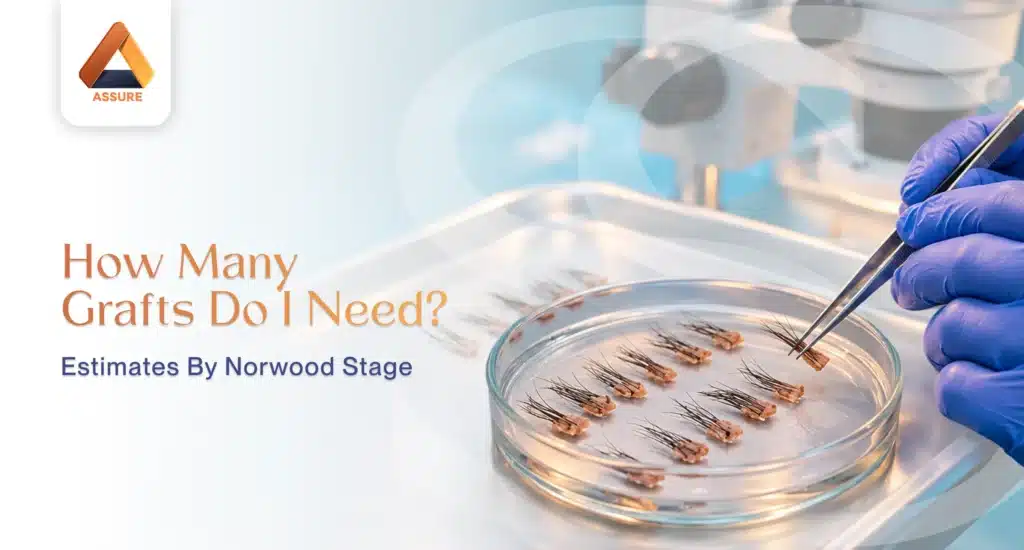
‘How many grafts do I need’ is usually the first question people ask once they start looking at the cost of a hair transplant because the graft number sits behind almost every quotation. Yet the number is an outcome of planning and not a starting point. It follows the stage of hair loss, the area to be covered, the density that is planned and the donor hair that the scalp can spare. (Norwood, 1975; Rose, 2015)
A figure read from a chart or a graft calculator is therefore only a first estimate. Two people at the same Norwood stage can need different numbers because of differences in hair thickness, hair colour, curl and donor density and the distinction between a sensible plan and an oversized one often lies in these details.
The following guide sets out graft estimates by Norwood stage, how much area 2000 grafts cover, what a graft calculator can and cannot tell you and what else changes the final number. All figures are indicative and a personalised number needs an examination of your scalp and donor area by a doctor.
CTA NOT TO PUBLISH
How Many Grafts Do I Need for My Hair Loss?
There is no single answer because the number depends on three things, which are the area you want to cover, the density planned in that area and the donor hair available. In simple terms, grafts needed are roughly the area to be covered multiplied by the density planned. A frontal area of 50 square centimetres planned at 40 grafts per square centimetre, for example, needs about 2,000 grafts.
This is also why the answer to ‘how many grafts do I need’ changes from person to person even at the same stage of hair loss. The stage gives a broad indication of the work involved and the final count is set after the doctor has looked at your scalp.
Graft Needs by Norwood Stage
Doctors commonly use the Norwood scale to describe male pattern baldness. It ranges from Stage 1, with little or no visible recession, to Stage 7, where hair loss has advanced across most of the top of the scalp (Norwood, 1975). The stages are easier to place once you see them side by side in this Norwood scale guide for hair loss, which also explains how hair loss usually progresses.
The table below gives the typical graft requirement for each stage. Taking about two hairs per graft on average, it also shows the approximate number of hairs.
| Norwood stage | What it looks like | Typical graft requirement | Approximate hairs |
| 2–3 | Receding temples and early thinning | 1,500–2,000 | 3,000–4,000 |
| 3–4 | More pronounced recession and crown thinning | 2,000–3,000 | 4,000–6,000 |
| 5–6 | Extensive baldness with a narrowing bridge of hair | 3,000–5,000 | 6,000–10,000 |
| 7 | Advanced hair loss across the top of the scalp | 5,000–7,000 or more | 10,000–14,000 or more |
These ranges are not targets to be reached. At the advanced stages the donor supply becomes the deciding factor, and a doctor may plan fewer grafts than the chart suggests so that the donor area is not left visibly thin. Medicines such as finasteride and minoxidil are also commonly advised alongside a transplant to protect the hair that has not been transplanted (Kanti et al., 2018).
CTA NOT TO PUBLISH
Not sure where you fall on the Norwood scale? Check your stage before you speak to a doctor.
Use the Baldness Calculator
How Much Area Does 2000 Grafts Cover?
The area that 2000 grafts cover is simply the number of grafts divided by the density planned per square centimetre. A lower density spreads the grafts over a larger area while a higher density gives a fuller look over a smaller area. The table shows how the same 2000 grafts behave at different densities.
| Density planned (grafts per sq cm) | Area covered by 2,000 grafts |
| 30 | About 67 sq cm |
| 40 | About 50 sq cm |
| 50 | About 40 sq cm |
| 60 | About 33 sq cm |
| 80 | About 25 sq cm |
These are illustrations of the arithmetic and not a promise of coverage. As described on the clinic website, the UHDHT method at Assure Clinic is planned at 60 to 80 grafts per square centimetre, which means 2000 grafts would cover roughly 25 to 33 square centimetres. On average a graft holds about two hairs, so 2000 grafts contain roughly 4,000 to 4,400 hairs.
In practice 2000 grafts are usually enough for early recession or a thinning front of the scalp, and not enough for extensive loss across the mid scalp and crown. The doctor chooses the density according to the donor supply and the area where restoration makes the greatest visual difference, which is usually the hairline and the mid scalp.
Can a Graft Calculator Tell You How Many Grafts You Need?
A graft calculator or baldness calculator asks for your Norwood stage and sometimes your age and the area affected, and gives a range similar to the table above. It is useful for getting an idea before you speak to a clinic, and Assure Clinic’s baldness calculator can help you place your stage.
What a graft calculator cannot do is examine you. It cannot measure the density of your donor hair, the thickness of each hair, the curl, the contrast of hair colour against your skin or the way your hair loss is likely to progress. A trichoscopy scan helps the doctor assess follicular density and the condition of the donor scalp, and the graft number is finalised only after that.
What Else Changes the Number of Grafts?
Hair thickness, colour and curl
Thick, coarse or wavy hair gives more visual coverage per graft than fine, straight hair. A person with fine hair that contrasts strongly with the scalp may need more grafts than another person at the same stage to get a similar look. The number of hairs within each graft also changes the overall hair count.
Donor supply
The hair at the back and sides of the scalp is finite, and extracting too much can leave the donor area visibly depleted (Rose, 2015).
Density you want
A fuller density needs more grafts per square centimetre and therefore more donor hair. A natural look does not always need the highest possible density, and the doctor balances the density you want with what the donor area can safely give.
Future hair loss
Pattern baldness usually progresses, so a plan for a younger patient should keep donor hair in reserve for later. A transplant done only for the present area of loss can look uneven if the hair around it keeps thinning, which is why medicines are often advised along with the procedure.
Number of sessions
Extensive hair loss may be restored over more than one session, depending on the donor supply and the coverage planned. At Norwood 6 and 7 the doctor may recommend two sessions spaced several months apart.
What If the Donor Hair Is Not Enough for Every Bald Area?
When the donor supply is not enough to cover everything, a carefully planned procedure gives priority to the frontal hairline and the mid scalp instead of attempting uniform coverage across every bald area. The crown can be addressed later, if needed, once the first result has settled. Honest planning at this stage matters more than a big number on the quotation.
| Expert Hair Insight
“Patients usually come to us with a number in mind. What we plan is an area and a density that the donor hair can safely support, and the graft number is the result of that plan.”
|
How Does the Number of Grafts Affect the Cost?
A larger hair transplant plan generally costs more but the relation is not a straight line. At Assure Clinic the cost is not worked out per graft. It is set after assessment and ranges from ₹2 lakh to ₹15 lakh, depending on the hair loss and the plan.
Hair Transplant Consultation at Assure Clinic
Assure Clinic is a hair transplant and skin clinic with centres across India and in Dubai. Each patient is assessed with a scalp scan, and the doctor explains the technique, the number of grafts and the cost before any procedure is planned. Results vary from person to person and depend on hair type, donor area, general health and aftercare.
CTA NOT TO PUBLISH
Want to know how many grafts your hair loss and donor area need?
Request a Consultation
Disclaimer: This article is for general information. It is not medical advice or a price quotation. Graft numbers, costs and results differ from person to person. Please consult a qualified doctor about your own hair loss.
Frequently Asked Questions
How many grafts do I need?
It depends on your Norwood stage, the area to be covered, the density planned and your donor supply. Early stages often need 1,500 to 2,000 grafts and advanced stages 5,000 to 7,000 or more. A doctor confirms the number after examining your scalp.
How many grafts do I need for a receding hairline?
A receding hairline with early thinning at the temples often needs about 1,500 to 2,000 grafts. The number is higher if the recession is deeper or the mid scalp is also thinning.
How much area does 2000 grafts cover?
About 50 square centimetres at a planned density of 40 grafts per square centimetre. A higher density covers a smaller area and a lower density covers a larger one.
Is 2000 grafts enough?
For early recession or a thinning front of the scalp it may be enough. For crown loss or more advanced stages it is usually not, and the doctor may plan more grafts or more than one session.
How many hairs are in 2000 grafts?
On average a graft holds about two hairs, so 2000 grafts contain roughly 4,000 to 4,400 hairs. The exact number depends on how many single, double and triple hair grafts are used.
How accurate is a graft calculator?
It gives a rough range from your Norwood stage and a few inputs. It cannot assess your donor density or hair thickness, so treat it as a starting point before a consultation.
Does a higher graft count mean a better result?
No. The placement, density and angle of the grafts and the donor supply also decide the result, so the number should follow the plan.
Can I need more than one session?
Yes. Extensive hair loss may need two sessions spaced several months apart, depending on the donor supply and the coverage planned.
Can a hair transplant cover the whole bald area?
Not always. When the donor hair is limited, the plan may give priority to the front hairline and the mid scalp.
Does the number of grafts change the cost?
In most clinics a larger plan costs more. At Assure Clinic the cost is set after assessment and ranges from ₹2 lakh to ₹15 lakh, depending on the hair loss and the plan.
References
Kanti V, et al. Evidence based (S3) guideline for the treatment of androgenetic alopecia in women and in men. J Eur Acad Dermatol Venereol. 2018;32(1):11-22.
Norwood OT. Male pattern baldness: classification and incidence. South Med J. 1975;68(11):1359-1365.
Rose PT. Hair restoration surgery: challenges and solutions. Clin Cosmet Investig Dermatol. 2015;8:361-370.