
Key Takeaways
|
A population study from India found male pattern hair loss in about 58% of men aged 30 to 50 (Krupa Shankar et al., 2009). In most men the first change shows up at the temples, where the corners of the forehead slowly move back and the M shape becomes deeper with time.
Most men then start hiding the temples with their hair or a cap and start thinking that a temple hair transplant is the only way out. But deep temples do not always need a transplant. In some men it is just a mature hairline which settles by itself, and in others it is an early receding hairline that medicines can slow down. So whether you need surgery depends on your age, your hair loss stage and how much donor hair you have at the back.
In this blog, we explain what is temple hair transplant, causes of temple hair loss, temple hair loss treatment before surgery, who it suits, how temples are planned, what to expect after it and how Assure Clinic can help you.
Are your temples going back every year?Check My Hair Loss Stage
What Is a Temple Hair Transplant?
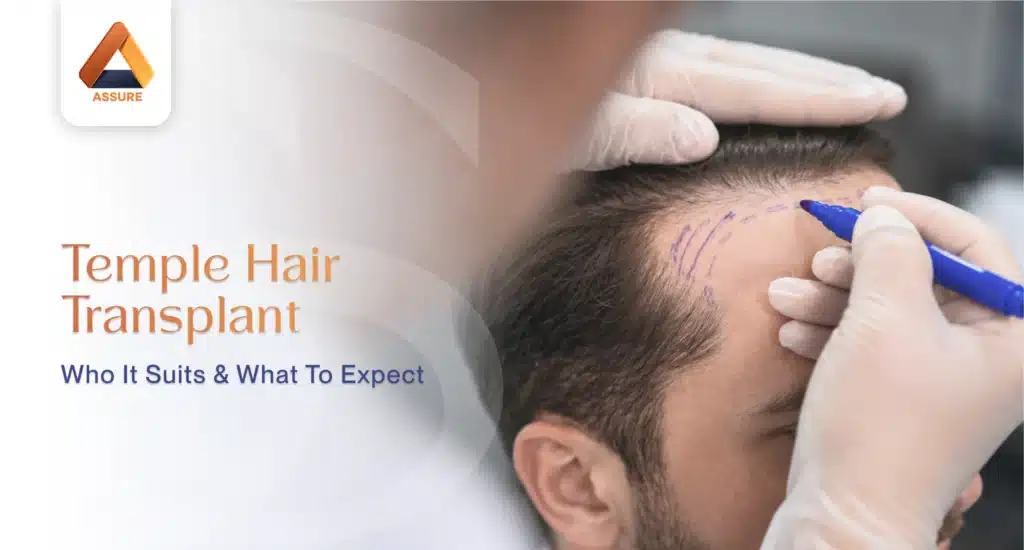
Many people get confused between temple hair transplant and front hairline transplant. The main difference is that the temple hair transplant is just done at the corners. The hair roots (grafts) from back of your head is shifted to the temples, that is the corners on both sides of forehead from where front hairline turns back towards ear.
Most patients ask why hair is taken from back only and the reason is that back of the head is generally safe from male pattern hair loss and hence it is used as donor area (Jimenez et al., 2021). Firstly the doctor marks how much of the corner needs filling and post that grafts are taken out one by one and put in the temples at a very flat angle so that new hair sits close to the skin same like natural temple hair.
In the majority of men temple hair transplant is done along with front hairline transplant as temples and front both go back together. Only in few cases where front is still fine and just corners have gone deep, the temples alone done.
What Causes Temple Hair Loss?
Many men directly blame stress or shampoo for their temples going back but majority of the time it is male pattern hair loss in which hair first goes from temples and then from front and crown (Norwood, 1975). There also might be other causes as well that is why the doctor checks the cause first.
Following is the table that explains the common causes:
| Cause | What you may notice |
| Male pattern hair loss | Temples going back slowly in M shape, usually runs in family |
| Mature hairline | Hairline shifts back around one finger by late twenties and then stops. |
| Tight hairstyles | Thinning at temples in those who tie hair tight daily or wear tight cap or helmet |
| Scarring hair loss | Shiny smooth skin at hairline, at times eyebrows also thin out. Dermatologist check is a must first. |
| Stress, illness or low iron | Hair fall from all over the head and not just temples |
So in case your temples are going back slowly and your father or brother also has same kind of hairline then mostly it is male pattern hair loss. But in case the skin is looking shiny or there is itching or redness, kindly show it to a doctor first and do not jump to transplant.
Temple Hair Loss Treatment Before a Transplant
Every temple does not require surgery. When the hair at temples has thinned out but is still present then temple hair loss treatment with medicines may facilitate in slowing it down and at times make it a little thicker. Following is the table that explains the usual options.
| Treatment | What it usually does | When it is used |
| Minoxidil | Thin hair grows thicker and hair fall slows down | Early thinning and also after transplant |
| Finasteride | Brings down DHT, the hormone which shrinks the hair roots | Active male pattern hair loss, strictly on prescription |
| PRP | Growth factors from your own blood are injected in the scalp | At times added with medicines |
| Temple hair transplant | New roots placed where hair is already gone | Temples bare and hair loss stable |
A study was done for one year on men having hair loss in front and middle of the scalp and the ones who took finasteride had more hair count than the ones on placebo, and in the second year also the benefit continued (Leyden et al., 1999). But medicines work on thin hair and not on bare skin, so once the temples turn smooth and empty transplant is mostly the only way to get hair back there. Also these medicines have side effects and do not suit everyone so take them only after the doctor checks you.
Who Is a Good Candidate for a Temple Hair Transplant?
Temple hair transplant is suitable for you when the temples have turned bare, the hair loss has become stable and there is enough of healthy and thick hair at back of your head. To know where you stand you can check the receding hairline stages and Norwood scale, usually by Norwood 3 the temples turn bare.
Following are some situations where doctor may ask you to wait but these are general points so your doctor may change them as per your condition.
- You are only in early twenties and hair is still falling fast.
- Your hairline has gone back just a little, it may be a mature hairline only.
- Hair is going because of tight hairstyles, scarring or some illness and not male pattern.
- Back of the head itself is thin or it was used in an earlier transplant.
- You do not want to take medicines even when doctor says they are needed to save your other hair.
How Temples Are Planned in a Hair Transplant
Temples need extra care than rest of the scalp because over here the hair grows very flat and points down and back towards the ear, so the grafts are also put at a very low angle in the same direction (Shapiro and Shapiro, 2013). Following are the steps which doctor usually follows.
- Firstly the doctor sees your face shape, forehead height and up to what extent the corners have gone deep.
- Then the front hairline is marked and temples are joined with it, many patients only think about temples but both has to look like one line.
- The corner is not filled fully as adult men naturally have a small curve there and a fully filled corner gives a teenager look which does not suit.
- At the edge only single hair grafts are put and few thicker ones behind so that it does not look see-through.
- Small temple points near the sideburns are also checked, most people do not even notice them but if they have become thin they are made again as they frame the face.
- Lastly doctor checks how many grafts are there at the back so that some are saved for future.
Your ethnic hair pattern matters as well. Indian men tend to have a broader, flatter hairline with less deep temples, so the temple corners can be kept a little fuller and still look natural, as long as the donor hair can support it (Shapiro and Shapiro, 2013).
| Worth Knowing
Many men come with their old college photos and ask to fill the temples fully so that forehead looks straight from one side to other. But in adult men a small corner at temples is normal and filling it fully makes the face look unnatural. For example if most of your grafts are used just to make the temples fully straight at 25 and by 35 the crown also starts thinning, then there may not be enough grafts left for it. Hence it is better to fill temples enough to frame your face and save some grafts for future. |
What to Expect After a Temple Hair Transplant
Now coming to the procedure day, it is done under local anaesthesia so you are awake throughout and mostly go home on same day itself. Within few days most people join back their desk work, nevertheless the final result takes time since transplanted hair falls first and then grows again. Following is the table that explains what you may notice.
| Time after the transplant | What you may notice |
| First 3 to 7 days | Small scabs at temples, little redness and swelling on forehead which sometimes comes down near eyes also, do not panic it settles |
| 2 to 6 weeks | Transplanted hair falls and many people think the transplant has failed but it is called shock loss and roots stay safe under the skin. |
| 3 to 4 months | Fine new hair starts coming at corners |
| 6 to 8 months | Temples look fuller |
| 12 to 18 months | Final result as hair becomes thick and settles in its direction |
Following are some general tips for recovery but your doctor may change them as per your condition.
- Sleep with head raised for first few nights, many people use two pillows, this helps swelling to settle faster.
- Do not scratch or pick the scabs even if it itches and wash hair only the way you have been advised to.
- Avoid wearing caps, helmets, doing heavy exercise and coming under direct sun till the time doctor says.
- Avoid smoking and alcohol in first few weeks as it slows down healing.
- Do go for all follow up visits even if everything looks fine so that doctor can check how grafts are growing.
Many patients feel that once transplant is done they do not need anything else but temple hair transplant does not stop male pattern hair loss in the hair which you already have.
In a small one-year trial, men who started finasteride a month before their transplant and continued it for eleven months after had higher hair counts than men on placebo (Leavitt et al., 2005). The trial was funded by the medicine’s manufacturer, so it is not the final word, but it is one reason your doctor may advise finasteride or minoxidil after transplant. Never start or stop them on your own.
How Assure Clinic Plans Your Temple Hair Transplant
Most people walk in thinking only about the corners but temple hair loss is usually just the start of a long pattern, so putting grafts at corners alone does not solve it. The transplant is one part and along with it the cause has to be found, the hair you still have has to be saved and some donor hair has to be kept for later.
| Expert Hair Insight
“In my experience, many patients want their temples filled fully but once they understand how it will look at 40 most of them agree for a softer corner that suits their age. At Assure Clinic we first check if the temple hair loss is male pattern or something else, then we see the Norwood stage, scalp under trichoscopy and donor hair and only then temples are planned with the front hairline. Our doctors themselves design and place the grafts. If your temples are only thinning then medicines may be enough for now.” Dr. Abhishek Pilani, MBBS, MD (Dermatology, Venereology & Leprosy) Co-Founder and Chief Hair Transplant Surgeon, Assure Clinic | Reg. No. 2011020289 (MMC) |
Hair transplant planning at Assure Clinic
At Assure Clinic hairline transplant including temples is done with UHDHT method where grafts are taken out with UFME and placed with DSHI, so each graft goes in the scalp soon after it is taken out. In consultation your scalp is checked with trichoscopy and your Norwood stage is found out. Cost is as per Full Head Results pricing and not per graft and there are EMI options as well.
If your temples are going back and you want to know whether temple hair transplant is right for you or not then you can visit your nearest Assure Clinic as there are 13 clinics across India and Dubai.
Book a Consultation
Frequently Asked Questions
What is a temple hair transplant?
It is a procedure where hair roots from back of your head are placed in the bare corners on both sides of forehead.
Can I get a hair transplant only for the temples?
Yes it can be done if front hairline is still good and only corners have gone back. But in most men doctor plans temples with front so both look like one line, else it can look patchy.
How many grafts are needed for a temple hair transplant?
It depends on how deep temples have gone and whether front is also being done. Only corners need much lesser grafts than full hairline so after checking scalp doctor can tell the exact number.
Is a temple hair transplant permanent?
Transplanted hair usually stays for many years as it comes from back of head. But hair around it can still become thin so medicines may be needed.
What is the best temple hair loss treatment?
No one treatment is best for everyone and this is the question most people ask first. When temples are only thinning medicines like minoxidil or finasteride may help but when skin has become bare temple hair transplant is mostly needed.
Can temple hair grow back on its own?
Usually no. Many people try oils and home remedies but once temples become smooth and bare hair does not come back by itself, though early thinning may get better with treatment.
Will my temple hair transplant look natural?
Yes it can look natural when grafts are placed flat in right direction and corner is not filled fully.
At what age can I get a temple hair transplant?
No fixed age is there but doctors are careful in early twenties as hair loss is still active. Once it is stable most men become better candidates.
Is a temple hair transplant painful?
It is done under local anaesthesia so mostly only first few injections are felt, after that most people are comfortable. Mild swelling and soreness for few days is common.
Can women get a temple hair transplant?
Yes but in women temple thinning is often because of tight hairstyles or other reasons so doctor checks the cause first and women hair transplant is also planned differently.
References
Jimenez F, Alam M, Vogel JE, Avram M. (2021). Hair transplantation: Basic overview. Journal of the American Academy of Dermatology, 85(4), 803-814.
Krupa Shankar D, Chakravarthi M, Shilpakar R. (2009). Male androgenetic alopecia: population-based study in 1,005 subjects. International Journal of Trichology, 1(2).
Leavitt M, Perez-Meza D, Rao N, Barusco M, Kaufman K, Ziering C. (2005). Effects of finasteride (1 mg) on hair transplant. Dermatologic Surgery, 31(10), 1268-1276.
Leyden J, et al. (1999). Finasteride in the treatment of men with frontal male pattern hair loss. Journal of the American Academy of Dermatology, 40(6), 930-937.
Norwood OT. (1975). Male pattern baldness: classification and incidence. Southern Medical Journal, 68(11).
Shapiro R, Shapiro P. (2013). Hairline design and frontal hairline restoration. Facial Plastic Surgery Clinics of North America, 21(3), 351-362.