
Hair Transplant Essentials to Know
|
Most people will not notice thinning in their crown area on their own and will often see it in photos, or under bright overhead lighting. Once you see the thinning you start to think how much coverage you can achieve via a hair transplant and how many grafts you might need.
Whilst a crown hair transplant can improve coverage it requires more planning than people expect. Due to the natural whorl in the crown area, the thinning is often wider than it looks. Also, every graft used in the crown area will have come from your donor area which may be needed for your hairline/mid scalp. Therefore it is best to understand what you actually need for your crown area rather than just go with the idea of 1,500 or 2,000 grafts.
In this blog, we explain what a crown area hair transplant is, how many grafts are required, how the whorl impacts planning, what crown hair transplant recovery looks like and how Assure Clinic plans it.
What is a Crown Hair Transplant?
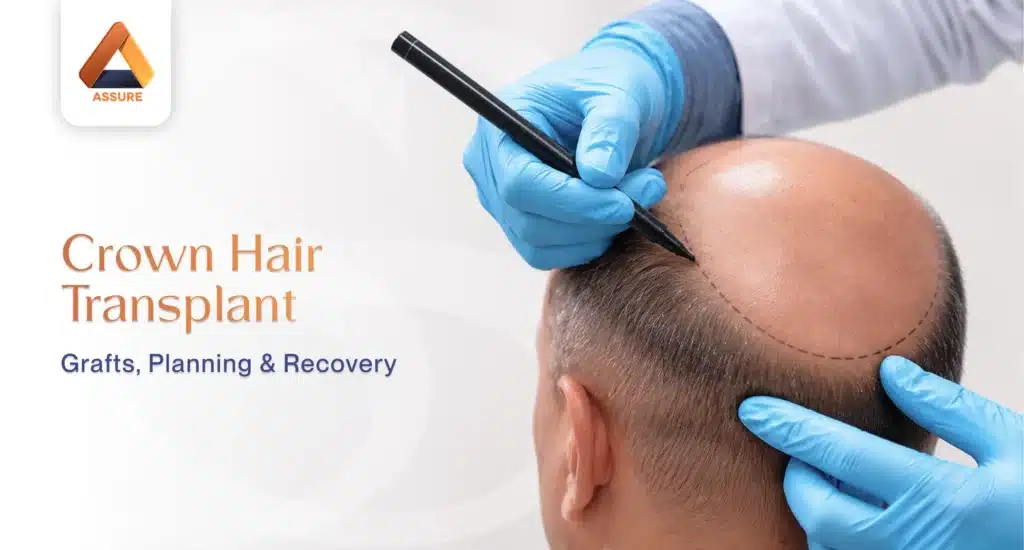
A crown hair transplant is performed to increase hair in your crown/vertex area. This is the round area towards the back of the top of your head where your hair would naturally grow in a circle around one central point creating a whorl.
Healthy hair follicles (grafts) are taken from your donor area, usually the back/sides of your scalp and implanted into the thin areas. Not only will the grafts help cover the visible areas of your scalp but they will also be placed in the correct angle and direction to flow with the surrounding hair (Goldin, Zito and Raggio, 2025).
How much hair you still have in your crown or how much baldness you have will determine how many grafts you will need, and how they will be dispersed. Your crown area will need to be considered as part of your whole scalp, especially if you are also experiencing thinning in your hairline/mid scalp.
Why Does the Crown Need Different Planning?
The crown area differs from your hairline area due to the hair growth and size. Firstly the whorl will need to appear natural. The hair in your crown area doesn’t grow in one direction. Instead the hair grows to create a whorl and the angle will frequently change. The grafts have to be placed to follow this pattern and blend with any natural hair.
Secondly the area may be larger than expected. Often crown thinning can include more fine and weak hair around the bald area. Therefore the whole crown area will be assessed.
Finally every graft matters. You will have limited donor grafts and if you are also experiencing thinning in your mid scalp/hairline the surgeon will have to consider how to best use your grafts across your scalp. Therefore crown area restoration isn’t just to fill a gap but will consider how to best utilise your donor hair to provide useful coverage whilst considering your future plans (Carman and Rassman, 2024).
How Many Grafts are Needed for a Crown Hair Transplant?
The amount of grafts needed for a crown hair transplant will mainly depend on how large the thin area is and how much natural hair is present.
If your thinning is minimal you may require fewer grafts as the new hair will blend with your natural hair. However if you have more extensive thinning you will likely require more grafts. But the amount of grafts doesn’t necessarily equate to how full your crown will look. Two people could receive the same amount of grafts but due to differences in hair thickness, texture, donor density, crown size and hairs per graft they could have very different results.
Below is a table outlining factors that can impact how many grafts you will need.
| Factor | What it usually means |
| Crown Size | More area = More grafts |
| Natural hair | More natural hair will increase coverage. |
| Hair Thickness | Thick hair will increase coverage. |
| Follicular Units | Grafts can contain 1+ hairs. |
| Whorl | Determines how and where grafts are placed. |
| Donor Density | How many safe grafts can be taken from your back/sides. |
| Overall Hair Loss | You may need donor hair in your hairline/mid scalp now or in the future. |
Therefore whilst you may receive 1,500/2,000 grafts this is only part of the planning. How much coverage the grafts can provide is what matters.
Why Would 2,000 Grafts Look Different?
The same amount of grafts can look very different. One person may have a small amount of thinning, thick hair and some natural hair whereas the other may have more extensive baldness, fine hair and little coverage. The amount of grafts is the same but the amount of coverage they need to provide will differ.
Your hair type can also play a role. Thick/wavy hair will increase fullness whereas fine/straight hair may mean you still see more scalp.
| Worth Knowing Grafts don’t equate to hairs. Grafts are usually natural follicular units containing 1+ hairs. When planning your crown area consideration is given to how well your grafts can provide coverage (Goldin, Zito and Raggio, 2025). |
How Does the Whorl Change a Crown Hair Transplant?
The whorl determines how your hair will turn and flow throughout the crown area. A large consideration when making sure the crown looks natural.
When planning the surgeon will firstly identify the centre of your whorl. They will then consider how the hair flows around the whorl. As the grafts move away from the centre they need to follow the natural flow. The position of the whorl will also determine how the grafts are dispersed throughout your crown area and how they join with your mid scalp.
| Expert Hair Insight “Patients usually come and show me only their bald crown area. I always tell them that the crown area can’t be planned on its own. I consider where the whorl is, the angle of the natural hair, how much donor hair we have and what may be needed in the future for their mid scalp/front. Only then do I decide how the grafts should be dispersed.”Dr. Abhishek Pilani, MBBS, MD (Dermatology, Venereology & Leprosy)Co-Founder and Chief Hair Transplant Surgeon, Assure Clinic | Reg. No. 2011020289 (MMC) |
Should You Transplant the Crown Before the Hairline?
If you are experiencing hair loss in your front and crown area your surgeon will usually consider your whole scalp to determine which area to treat first. There is a limited amount of grafts available in your donor area so if lots are used in your crown area less may be available for your hairline/mid scalp.
Sometimes the front area is treated first as this will change your appearance the most. However if your donor area is strong enough the crown and front can be part of the same plan. Your age, hair loss pattern and amount of thinning will also play a role. Using the Norwood scale can help to describe how your hair loss is impacting your hairline, mid scalp and crown area.
Is a Crown Hair Transplant Right for You?
A crown hair transplant may be suitable for you if you have established thinning and your donor area can provide sufficient healthy grafts. Your surgeon will assess the following.
- How much thinning you have
- Whether your hair loss is continuing
- How strong and dense your donor area is
- Whether your hairline/mid scalp needs treating
- How much natural hair you have
- What coverage you are hoping to achieve
This will help determine whether a crown transplant is suitable for you, how many grafts you may need and how they can be dispersed. If you are unsure whether your crown is ready to be treated meeting with the doctor will give you a much clearer understanding than estimating how many grafts you may need based on photos.
What Happens During a Crown Hair Transplant?
A crown hair transplant follows the same process as other hair transplants however there is more consideration to the whorl and changing hair direction.
Your surgeon will firstly assess your thinning area to determine how large it is, how much natural hair you have and where your natural whorl is.
They will then consider your donor area to determine how dense and high quality it is. They will decide how many safe grafts can be used. This is particularly important if other areas may need treating.
The grafts will then be removed and prepared.
They will be placed into your scalp in the planned angles and directions to follow the natural flow of your crown area and blend around your whorl and natural hair.
Once your procedure is complete you will be given advice on how to care for your donor and transplanted areas whilst your scalp heals.
Crown Hair Transplant Recovery
Your scalp will begin to heal shortly after your transplant. However new hair will grow slowly over the next few months. Below is a table outlining what you may experience.
| Time since transplant | What you may experience |
| First few days | Slight redness, swelling, soreness and small scabs. |
| 1-2 weeks | Continuing healing and scabs will begin to settle. |
| First few months | Some of your transplanted hair may fall out. This is natural. |
| 3-6 months | Early regrowth will begin to be visible. |
| 6-12 months | More hair will start to grow and strengthen. Coverage becomes easier to assess. |
| 12-18 months | Coverage can continue to improve. |
Everyone will experience slightly different recovery and our hair transplant results timeline outlines how shedding, early regrowth and maturation will usually occur.
Why Can the Crown Still Look Thin After New Hair Grows?
You won’t instantly see your crown look full. Usually you will see short fine hair growing. This won’t provide much coverage.
Due to the hair parting around your whorl you may also see more scalp. This can be made worse if your hair is wet, short or under bright overhead lighting. As your hair grows longer and thicker it will provide more coverage for your crown area. Crown coverage can be better assessed after several months.
Can Hair Loss Continue Around a Transplanted Crown?
Yes it can. Whilst a crown transplant will increase coverage in the treated area your natural hair will continue to follow its own hair loss pattern. This is why when planning crown area the surgeon will take into consideration your hairline, mid scalp, donor area and natural hair to provide a balanced long term plan.
Sometimes one treatment is enough to cover the areas you wish to restore. However if your hair loss pattern changes a lot over the years a second hair transplant can be part of your long term plan.
How Assure Clinic Plans a Crown Hair Transplant
A crown hair transplant will need to be planned considering more than just the bald area.
At Assure Clinic we undertake a proper assessment of your scalp and donor area to determine how many grafts to use and how to treat you. We consider your natural whorl, natural hair, donor strength and the rest of your scalp to determine how many grafts to use and where. This means you will have a clearer understanding of what can be achieved with your own donor hair.
Book a Consultation
Frequently Asked Questions
How many grafts are usually needed for a crown hair transplant?
There is no fixed answer. This depends on how large the thin area is, how much natural hair you have, donor density and how much coverage you want. A proper estimation of how many grafts can only be given once your crown and donor area have been assessed.
Are 2,000 grafts enough for the crown?
Whilst this can provide useful coverage for some crown areas this will not look the same for everyone. The crown area can be large, you may have natural hair and differences in hair thickness, texture and hairs per graft will impact the outcome.
Why may I need more grafts for the crown?
The crown can cover a large area of your scalp. The grafts need to be dispersed around the changing whorl. The amount of natural hair and how large the area has become will impact how many grafts you need.
Does 1 graft mean 1 hair?
No. Usually a graft will be a follicular unit containing 1+ hairs.
Can the hairline and crown be transplanted at the same time?
Sometimes yes if your donor supply and overall hair loss pattern allows. The surgeon will have to determine how best to divide up your grafts between your crown, mid scalp and front.
How long does a crown hair transplant take to show results?
Usually early regrowth will begin to show after the first few months. Your crown will continue to change as your new hair begins to grow, become thicker and mature. Results can be assessed over months.
References
Brinks, A.L., Needle, C.D., Kearney, C.A. et al. (2026) ‘Hair transplant: Patient candidacy, medical optimization, and surgical considerations’, International Journal of Dermatology, 65(2), pp. 245-256.
Carman, T.P. and Rassman, W. (2024) ‘Follicular unit excision donor area management and considerations of the scalp’, Facial Plastic Surgery, 40(2), pp. 195-204.
Goldin, J., Zito, P.M. and Raggio, B.S. (2025) ‘Hair transplantation’, StatPearls. Treasure Island, FL: StatPearls Publishing.
Vañó-Galván, S., Bisanga, C.N., Bouhanna, P. et al. (2023) ‘An international expert consensus statement focusing on pre and post hair transplantation care’, Journal of Dermatological Treatment, 34(1), 2232065. doi:10.1080/09546634.2023.2232065.