
Key Takeaways
- The best hair loss treatment depends on your Norwood stage: early stages respond to medication, advanced stages need a hair transplant.
- Norwood stages 1 to 2 are best managed with minoxidil and finasteride to slow loss.
- Norwood stages 3 to 4 benefit from medication plus supportive PRP or GFC, and become candidates for a transplant.
- Norwood stages 5 to 7 need a hair transplant, as medication cannot restore fully bald areas.
- Matching the treatment to your exact stage is the single most important factor in getting a result.
Introduction
The best hair loss treatment for you depends entirely on your Norwood stage. The Norwood scale measures male pattern baldness from stage 1 (no real loss) to stage 7 (extensive baldness). Early stages respond well to medication, while advanced stages can only be restored with a hair transplant. According to the American Hair Loss Association, hair loss is progressive, which is why the right treatment changes as the stage advances.
This guide matches the best treatment to each Norwood stage, so you can see exactly what works for where you are now. The honest principle is simple: medication maintains and slows in early stages, but only a transplant restores hair once an area has gone bald.
Dr. Abhishek Pilani, founder of Assure Clinic and an ISHRS-certified hair transplant surgeon, has led over 20,000 procedures across 13 clinics in India and Dubai.
Get Your Personalized Hair Transplant Cost Estimate
Takes 60 seconds. See your expected cost range based on your hair loss stage and preferred city — transparent pricing, no hidden fees.
Calculate Your Cost →Not sure which Norwood stage you are at? Use the free baldness calculator to check in 60 seconds, then find your stage below.
Best Treatment by Norwood Stage: Quick Reference
| Norwood Stage | What It Looks Like | Best Treatment |
|---|---|---|
| Stage 1 to 2 | Minimal recession | Minoxidil, finasteride |
| Stage 3 | Visible recession at temples | Medication plus PRP or GFC, transplant option |
| Stage 4 | Recession plus crown thinning | Medication plus transplant consultation |
| Stage 5 to 7 | Large bald areas | Hair transplant (only option) |
The Best Treatment at Each Stage
Norwood Stage 1 to 2 — Early Thinning
At this stage, hair loss is minimal, with only slight recession at the temples. The goal is to slow or pause progression.
Best treatment: Minoxidil (topical) and finasteride (for men) are the most effective options. They maintain existing hair and can slow further loss. Started early, they can preserve your hairline for years. A transplant is not appropriate yet, as there is no significant loss to restore.
- Goal: Preserve and maintain
- Transplant needed: No, too early
Norwood Stage 3 — The Turning Point
Stage 3 shows clear recession at the temples, forming an M shape. This is the stage where many patients first consider serious treatment.
Best treatment: Continue or start medication, and add supportive PRP or GFC to improve density. Stage 3 is also the point where a hair transplant becomes a viable option, especially if the recession bothers you or medication is not holding. Check the norwood scale guide to confirm your stage.
- Goal: Slow loss, consider restoration
- Transplant needed: Optional, becomes viable
Norwood Stage 4 — Recession Plus Crown
Stage 4 shows deeper frontal recession along with thinning at the crown, with a band of hair separating the two areas.
Best treatment: Medication can slow further loss, but the areas that have already thinned significantly are best restored with a hair transplant. This is a common stage for a transplant consultation, as the pattern is established and the donor area is usually still strong.
- Goal: Restore lost areas
- Transplant needed: Recommended consultation
Norwood Stage 5 to 7 — Advanced Loss
These stages show large bald areas across the front, top, and crown, with only a horseshoe of hair remaining at the sides and back.
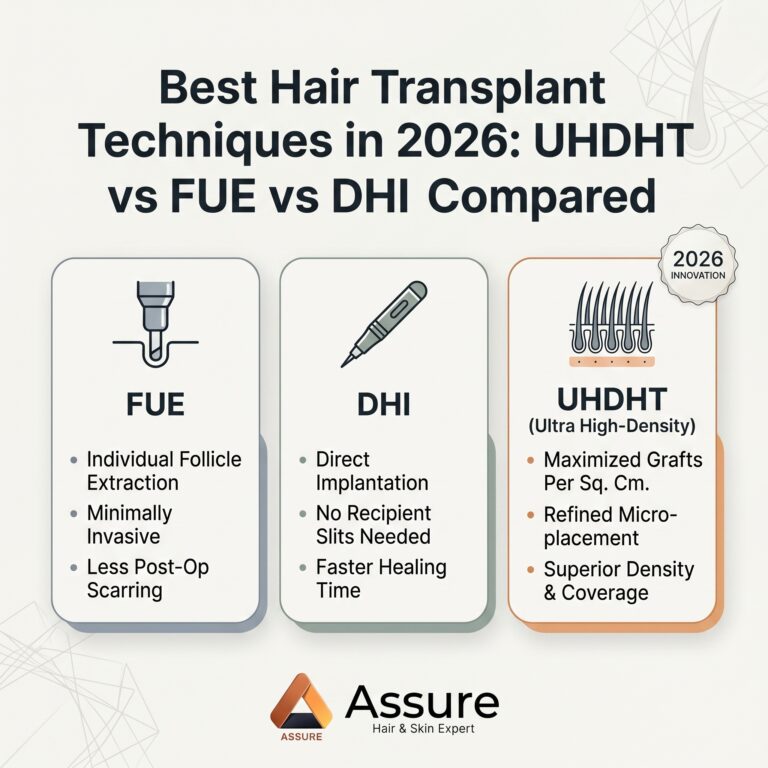
Best treatment: A hair transplant is the only option that restores hair at these stages, because medication cannot regrow hair on fully bald areas. The UHDHT method, which achieves 60 to 80 grafts per square centimetre, is well suited to covering larger areas with natural density. Careful donor management by qualified doctors is essential at these stages.
- Goal: Permanent restoration
- Transplant needed: Yes, the only option
“The biggest mistake patients make is using the wrong treatment for their stage. Medication on a stage 6 scalp is wasted money, and a transplant on a stage 1 scalp is premature. Match the treatment to the stage and you get a result,” says Dr. Abhishek Pilani, founder of Assure Clinic.
Why Stage Matters More Than the Treatment
| Stage | Medication Effective? | Transplant Appropriate? |
|---|---|---|
| 1 to 2 | Yes, ideal | No |
| 3 | Yes, plus support | Optional |
| 4 | Partial | Recommended |
| 5 to 7 | No, cannot restore bald areas | Yes, only option |
The same treatment can be perfect at one stage and useless at another. This is why a proper assessment of your Norwood stage comes before any treatment decision.
When Should You Consider a Hair Transplant?
Based on stage, a transplant becomes the right choice when:
- You are at Norwood stage 3 or beyond.
- Medication is no longer holding your hairline.
- You have bald areas that will not regrow with medication.
- You want a permanent, one-time restoration.
Confirm your stage first with the free baldness calculator, then book a consultation.
At Assure Clinic, qualified doctors confirm your Norwood stage and donor strength before recommending treatment. With 20,000+ procedures at a 95 percent graft survival rate, the clinic matches each patient to the right stage-appropriate plan. See best hair transplant in Mumbai, check hair transplant cost in India, or find your nearest clinic on the locations page.
Continue your research
Frequently Asked Questions
What is the best hair loss treatment for my stage?
Early stages (Norwood 1 to 2) respond best to minoxidil and finasteride. Mid stages (3 to 4) benefit from medication plus supportive therapy and become transplant candidates. Advanced stages (5 to 7) need a hair transplant, the only option that restores fully bald areas.
At what Norwood stage should I get a hair transplant?
A hair transplant generally becomes appropriate from Norwood stage 3 onward, and is the only effective option at stages 5 to 7. Qualified doctors confirm the right timing after assessing your donor area and pattern stability.
Can medication work at advanced Norwood stages?
No. Medications like finasteride and minoxidil can slow loss and maintain existing hair, but they cannot regrow hair on areas that are already bald. At advanced stages, only a transplant restores hair.
How do I know my Norwood stage?
A baldness calculator gives an initial estimate of your Norwood stage in about 60 seconds. Qualified doctors confirm it during a scalp assessment, which also checks your donor area.
Is stage 3 too early for a transplant?
Not necessarily. Stage 3 is the point where a transplant becomes viable. Whether to proceed depends on how much the recession bothers you and whether medication is holding. Many patients at stage 3 choose to start with medication and reassess.
What treatment works at Norwood stage 6?
At stage 6, a hair transplant is the only treatment that restores hair, because the bald areas cannot be regrown with medication. The UHDHT method is well suited to covering the larger areas involved.
Does the donor area matter at every stage?
Yes, especially at advanced stages. The donor area at the back and sides supplies the grafts for a transplant. Qualified doctors assess donor strength to plan how much coverage is achievable.
Can women use this stage-based approach?
Women follow the Ludwig scale rather than the Norwood scale, but the same principle applies: early thinning responds to medication and supportive therapy, while advanced loss may need a transplant.
Conclusion
The best hair loss treatment is the one matched to your Norwood stage. Early stages respond to medication, mid stages benefit from a combination plus a transplant option, and advanced stages can only be restored with a transplant. Knowing your stage is the essential first step.
Check your Norwood stage with the free baldness calculator, then book a free consultation for a stage-matched plan.
Book a Free Consultation: Call +91 95861 22444 or visit any of Assure Clinic’s 13 locations across India and Dubai.
Last Updated: June 2026 Medically Reviewed by: Dr. Abhishek Pilani, MBBS MD Dermatology (Gold Medalist), ISHRS Member, DHA-Licensed