
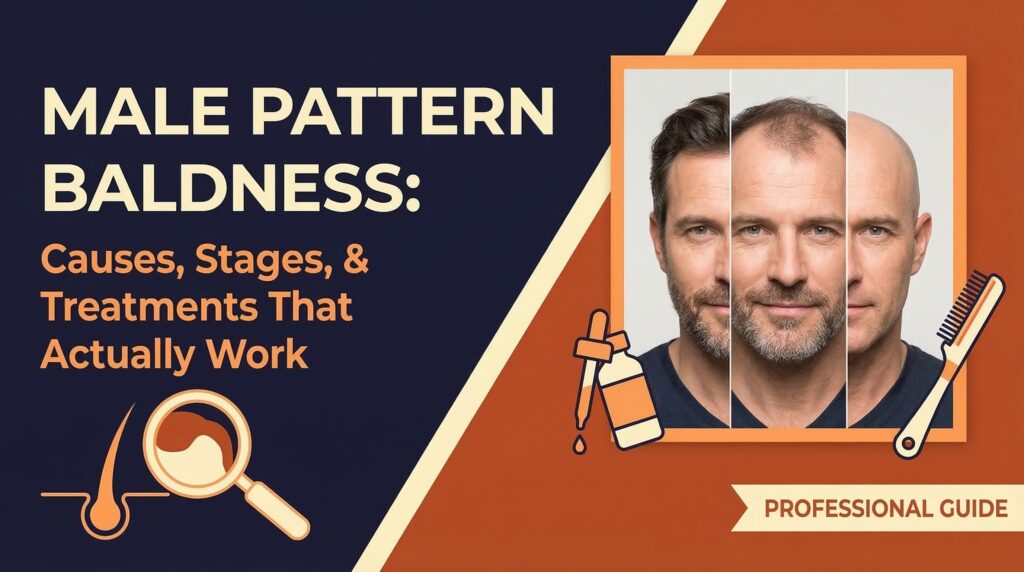
Male pattern baldness known medically as androgenetic alopecia is the most common cause of hair loss in men. It affects approximately 50% of men by age 50, and for many men, it begins well before that in the mid-to-late 20s or early 30s.
Understanding what is actually causing your hair to fall is the essential starting point for making informed decisions about what to do about it. This guide covers the biology of male pattern baldness, how to recognise the stages, and what treatments are effective at each stage.
What Causes Male Pattern Baldness?
The Role of DHT
The primary driver of male pattern baldness is a hormone called DHT (dihydrotestosterone). DHT is produced when the enzyme 5-alpha reductase converts testosterone into a more potent androgenic form. In men with a genetic predisposition to male pattern baldness, the hair follicles on the scalp are sensitive to DHT.
When DHT binds to the androgen receptors in these susceptible follicles, it progressively shrinks them a process called miniaturisation. Over successive growth cycles, each affected follicle produces a thinner, shorter hair shaft until eventually the follicle becomes inactive and the hair stops growing altogether.
Crucially, DHT sensitivity is inherited it is written into your genetic blueprint. This is why male pattern baldness runs in families. You can inherit it from either your mother’s side or your father’s side (the “it only comes from your mother’s side” claim is a common myth).
Why Some Follicles Are Affected and Others Are Not
If DHT causes hair loss, why does the hair at the back and sides of the head remain? The answer is that follicles in the occipital (back) and temporal (side) regions of the scalp do not carry the same androgen receptor sensitivity. They are genetically resistant to DHT which is why they remain even in men with very advanced hair loss, and why they form the reliable “donor area” used in hair transplant surgery.
This genetic permanence of donor area hair is the biological foundation on which hair transplant surgery is built.
Other Contributing Factors
While DHT sensitivity is the primary cause, several factors can accelerate the process or worsen hair loss:
- Age: DHT sensitivity effects accumulate over time; hair loss typically worsens with age
- Stress: Significant physical or psychological stress can trigger telogen effluvium an additional diffuse shedding that accelerates visible thinning
- Nutritional deficiencies: Deficiencies in iron, vitamin D, zinc, or biotin can impair follicle health and worsen hair loss
- Thyroid disorders: Both hypothyroidism and hyperthyroidism can contribute to hair shedding
- Scalp health: Poor scalp circulation, dandruff, or seborrhoea does not cause androgenetic alopecia but can worsen existing thinning
Recognising the Stages: The Norwood Scale
The Norwood Scale is the standard classification system for male pattern baldness. It grades hair loss across seven stages:
| Norwood Stage | Description |
|---|---|
| Stage 1 | No significant hair loss. Normal hairline. |
| Stage 2 | Slight recession at the temples. Early hairline maturation. |
| Stage 3 | More pronounced temporal recession forming an M-shape. First visible signs of balding. |
| Stage 3 Vertex | Thinning beginning at the crown, with early temporal recession. |
| Stage 4 | Clear frontal recession and significant crown thinning. A bridge of hair separates the two areas. |
| Stage 5 | The bridge between frontal and crown loss narrows. |
| Stage 6 | Frontal and crown areas merge. Significant baldness across the top of the scalp. |
| Stage 7 | Most advanced stage. Only a horseshoe-shaped band of hair remains at the sides and back. |
Knowing your Norwood stage matters because it directly influences:
– Whether medical treatment, surgical treatment, or both is appropriate
– The graft count required for a hair transplant
– The realistic outcome achievable with surgical restoration
– The risk that future hair loss will affect areas adjacent to a transplanted zone
Use our Norwood classification tool or baldness calculator to assess your stage.
At What Age Does Male Pattern Baldness Start?
Hair loss can begin surprisingly early. Some men notice the first signs of temporal recession or crown thinning in their early 20s. By 30, around 25% of men have visible androgenetic alopecia. By 50, approximately half of men are affected to some degree.
The earlier hair loss begins, the more aggressive the eventual pattern tends to be. This is relevant to hair transplant planning: younger patients need a conservative approach that accounts for the probability of continued future hair loss, rather than a transplant designed for the current pattern only. Women experiencing hair loss follow different patterns read our women’s hair transplant guide for more.
Medical Treatments for Male Pattern Baldness
Several medical treatments are approved and evidence-based for androgenetic alopecia. None of them reverse baldness in areas where follicles have already become inactive, but they can slow progression and maintain existing hair in follicles that are still viable.
1. Finasteride (Oral)
Finasteride is an oral medication that inhibits the 5-alpha reductase enzyme reducing the conversion of testosterone to DHT by approximately 70% in the scalp. This directly addresses the primary cause of androgenetic alopecia.
Clinical trial evidence shows finasteride significantly slows hair loss progression and can increase hair count in the crown area in a substantial proportion of patients. It is most effective at Norwood Stage 2–4 where follicles are miniaturised but not yet inactive.
Important: Finasteride requires a medical prescription and should only be taken under medical supervision. Potential side effects (sexual dysfunction in a minority of patients) should be discussed with your doctor.
2. Minoxidil (Topical)
Minoxidil is a topical solution or foam applied directly to the scalp twice daily. It increases blood flow to hair follicles and prolongs the anagen (growth) phase. It does not address DHT directly but improves the biological environment of the follicle.
Minoxidil is most effective for crown and mid-scalp thinning, and less effective for frontal hairline recession. Results require consistent daily application discontinuation leads to a return to the natural hair loss trajectory within 3–6 months.
3. PRP Therapy (Platelet-Rich Plasma)
PRP injections to the scalp deliver concentrated growth factors that stimulate follicle activity, improve local blood supply, and may slow miniaturisation. It is a good adjunct option for patients who want a non-pharmacological intervention, or who use it alongside finasteride and minoxidil for a combined approach.
At Assure Clinic, PRP therapy is offered as part of a comprehensive management plan, not as a standalone “cure.”
4. Nutritional Optimisation
Addressing identifiable deficiencies in iron, ferritin, vitamin D, zinc, or biotin can meaningfully improve hair quality in patients where deficiency is contributing to loss. Blood testing before prescribing supplements is essential supplementing nutrients that are not deficient is unlikely to produce hair growth benefit.
Hair Transplant Surgery for Male Pattern Baldness
Hair transplant surgery is the only intervention that directly restores hair in areas where it has already been lost. Medical treatments maintain existing hair they cannot regrow hair in an area that is already bald.
How a Hair Transplant Addresses Male Pattern Baldness
Hair transplant surgery relocates DHT-resistant follicles from the permanent donor zone (back and sides of the scalp) to the thinning or bald areas. Because these follicles are genetically resistant to DHT, they maintain their resistance in their new location producing permanent, natural hair growth in the recipient area.
When is the Right Time for a Hair Transplant?
Hair transplant surgery is typically recommended when:
– Hair loss has progressed to Norwood Stage 3–4 or beyond
– The hair loss pattern has stabilised (or medical management is in place to slow progression)
– The patient is realistic about what surgery can achieve relative to their available donor supply
– For younger patients: a conservative, future-proof hairline design is agreed upon that accounts for ongoing hair loss
For patients in their early 20s: Most experienced surgeons recommend waiting. Hair loss at 21–25 is often still progressing rapidly, and the final extent of hair loss is unpredictable. Performing a transplant before the pattern is clear risks designing a hairline that looks unnatural years later as surrounding hair continues to thin.
Considering a hair transplant? Our qualified doctors at Assure Clinic Mumbai can assess your situation no pressure, no obligation. Book a free consultation →
What Assure Clinic Offers
Assure Clinic uses patented UFME and DSHI techniques ufme/" class="assure-autolink">Ultra Fine Micro Extraction and dshi-hair-transplant/" class="assure-autolink">Direct Simultaneous Hair Implantation developed by Dr. Abhishek Pilani. These techniques achieve a 95% graft survival rate and produce natural-looking density through doctor-only procedures no technicians perform any part of the surgical work.
Our Full Head Results pricing model covers the entire outcome, not a variable per-graft count. We also use a phased sessions approach where the required work is spread across multiple days ensuring surgical precision throughout and protecting graft quality. Visit our centre for hair transplant for male pattern baldness in Mumbai.
Combined Approach: Medical Management + Surgery
The most effective strategy for male pattern baldness is typically a combination:
-
Medical management (finasteride, minoxidil): To slow ongoing hair loss in existing, non-transplanted hair. This protects the long-term result of surgery by reducing the rate at which surrounding native hair continues to thin.
-
Hair transplant surgery: To restore density and coverage in areas already lost.
-
PRP therapy (adjunct): To support follicle health in miniaturised areas and improve surgical outcomes.
This is not a one-time intervention it is an ongoing relationship with your hair health. At Assure Clinic, our consultants help patients build a long-term management plan that addresses their current situation and accounts for future progression. For a full list of what to expect during recovery, read our hair transplant side effects guide.
Frequently Asked Questions
Can male pattern baldness be prevented?
Not fully if you have the genetic predisposition, DHT will affect those follicles. But early medical intervention (finasteride, minoxidil) can significantly slow progression and maintain hair for many years longer than without treatment.
Is male pattern baldness hereditary?
Yes. It is a polygenic condition meaning multiple genes contribute and it can be inherited from both maternal and paternal sides. Having a bald father or maternal grandfather both increase your risk.
At what Norwood stage should I get a hair transplant?
Most surgeons recommend Norwood 3–6 as the appropriate range for surgery. Stage 7 can be treated but donor supply limitations constrain what is achievable. Stages 1–2 are typically managed medically first.
Will a hair transplant stop my baldness from progressing?
The transplanted hairs will not fall out they are permanently DHT-resistant. But the non-transplanted hairs in the thinning zone will continue to be affected by androgenetic alopecia unless medical management is in place. This is why post-surgical medical management is usually recommended.
Can I take finasteride before a hair transplant?
Yes. In fact, being on a stable finasteride regimen for 6–12 months before surgery is often beneficial it helps stabilise the hair loss pattern and may improve the overall result.
How much does male pattern baldness treatment cost in India?
Medical treatments (finasteride, minoxidil) are relatively affordable and widely available. PRP therapy ranges depending on session count. Hair transplant surgery cost at Assure Clinic is based on a Full Head Results pricing model covering your target outcome rather than charging per graft. A consultation is the right starting point for accurate cost information.
Starting the Right Conversation
Male pattern baldness is not a condition you have to simply accept but managing it well requires accurate information, honest expectations, and a clear treatment plan. Whether that plan involves medical management alone, surgery, or a combination approach depends on your specific stage of hair loss, age, donor supply, and goals.
At Assure Clinic, we have been helping men understand and address androgenetic alopecia since 2015 20,000+ procedures, 60+ qualified doctors, and a team that takes long-term hair health seriously.
Ready to Take the Next Step?
Book a free consultation with our team of 60+ qualified doctors across 14 clinics. We’ll assess your situation honestly and only recommend what’s right for you.
Explore more:
– Best Hair Transplant in Mumbai →
– See Before & After Results →
– Find a Clinic Near You →
