Key Takeaways
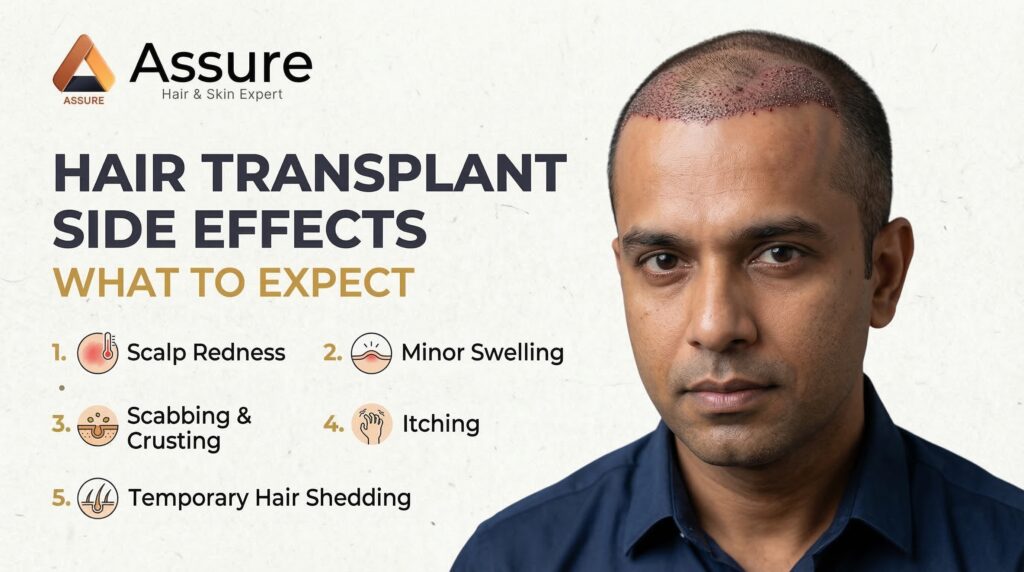
- Swelling, scabs, itching and tenderness are the most common hair transplant side effects. They are part of normal healing, and aftercare for them focuses on the first week.
- Shedding of existing hair around the grafts (shock loss) affected 3.7% of patients in one study of 621 people. New hair typically appears after 3 to 6 months.
- Infection is uncommon, at 1.4% to 2% in pooled data. Serious complications such as tissue necrosis are rare.
- Who performs the surgery matters. The ISHRS warns against unlicensed technicians performing surgical steps. At Assure Clinic, no technicians perform surgical steps.
- Your own hair keeps thinning after a transplant. That is why Assure plans every case as a Full Head Results commitment rather than a graft count, and we prescribe medication only when it is genuinely needed.
Most hair transplant side effects are temporary and expected: swelling, scabs, itching, tenderness and a short phase of shedding. Serious complications are rare in the hands of experienced providers, but they do happen (Liu et al., Aesthetic Plastic Surgery, 2025).
This guide separates normal effects from warning signs, gives the published numbers for each, and shares what our patients said about their recovery. It draws on 20,000+ procedures across Assure Clinic’s 13 clinics.
What are the side effects of a hair transplant?
Side effects range from expected healing, like swelling and scabs, to uncommon complications that need treatment and rare serious events.
Studies report very different overall rates because they define “complication” differently. Two large series put the overall complication rate at 1.2% and 4.7% (Liu et al., Aesthetic Plastic Surgery, 2025). A 10-year Indian series of 2,896 patients recorded no major or life-threatening complications (Garg and Garg, Indian Journal of Plastic Surgery, 2021). A 2025 meta-analysis that counted pain and swelling as complications found them in 442 of 2,353 patients (Khatib et al., Aesthetic Plastic Surgery, 2025).
| Side effect | How common in published studies | Type |
|---|---|---|
| Swelling of the forehead or face | Up to 50% | Expected |
| Crusts and scabs | Up to 54.8% | Expected |
| Numbness or changed sensation | 0.6% to 11% | Expected to uncommon |
| Shedding of existing hair near the grafts (shock loss) | 3.7% to 6.5% | Uncommon, temporary |
| Folliculitis (pimple-like bumps) | 1.1% to 12.1% | Uncommon |
| Infection | 1.4% to 2% | Uncommon |
| Tissue necrosis | 0.03% in one study | Rare, serious |
The ranges are wide because each study counts side effects differently. Each figure is sourced in the sections below.
Normal side effects in the first two weeks
Swelling. Forehead swelling is the most common early effect. A 2025 review found frontal swelling in up to 50% of patients and crusting in up to 54.8% (Liu et al., Aesthetic Plastic Surgery, 2025). For the first week, sleep with the head of your bed raised 15° to 30°. Ice your forehead, not the grafts, for 20 minutes every 2 to 3 hours (Goldin et al., StatPearls, 2025).
Nikhil Sanjeev, an Assure patient who filmed his own recovery, put it simply: “Day five, the swelling has come down. I don’t look like a puffer fish anymore.” (watch at 4:00)
Scabs and itching. Small crusts form over each graft and across the donor area. Crusts in the donor area can be gently rubbed away 5 to 7 days after surgery (Goldin et al., StatPearls, 2025). Ask your clinic how and when to wash the grafts themselves.
Itching comes with healing. Nikhil described day seven as “honestly, it’s itching like a lot.” (watch at 4:13) Ask your clinic what you can use for it rather than scratching.
Tenderness and pain. Pain and discomfort were the most reported complications in the 2025 meta-analysis (Khatib et al., Aesthetic Plastic Surgery, 2025). Saurabh Ranjan, another Assure patient, found the anaesthetic the hardest part: “The actual treatment is not that painful, but the treatment of numbing you down, using so many injections, the anesthesia part, the anesthesia part is extremely painful.” (watch at 10:22) Our guide to whether a hair transplant is painful covers what to expect on the day.
Bleeding. Bleeding that needed medical attention was reported in up to 8% of patients in one review (Liu et al., Aesthetic Plastic Surgery, 2025). For a day-by-day picture of these first weeks, see our hair transplant recovery timeline.
Shock loss after a hair transplant
Shock loss means shedding after surgery, and two kinds are normal.
The transplanted hairs shed first. StatPearls notes this shedding “typically occurs after several days and may take several months to regrow” (Goldin et al., StatPearls, 2025).
Existing hair around the grafts can shed too. Of 621 FUE patients in one study, 23 (3.7%) had this, and women were far more likely to be affected than men (Okochi et al., Aesthetic Plastic Surgery, 2024). A 2025 review found shedding at the donor and recipient sites in up to 4.1% and 6.5% of patients (Liu et al., Aesthetic Plastic Surgery, 2025). An Indian case series describes patchy shedding in the donor area 2 to 3 weeks after FUE (Kerure et al., Journal of Cutaneous and Aesthetic Surgery, 2020). This shock loss is temporary, and new hairs typically appear after 3 to 6 months (Goldin et al., StatPearls, 2025).
Waiting for growth can be stressful. Tejas Sinha described it this way: “Once you get it done, you don’t know what the result is, right, till you perhaps cross the 6 months, seven months stage.” Along the way there were moments of “hang on, this is not looking good” and others of “oh, this is looking awesome.” (watch at 17:46) If growth still seems missing later on, read our guide to no growth after a hair transplant.
Numbness and changes in sensation
Numbness in the donor or recipient area is a recognised side effect. Published rates range from 0.6% of patients in one large Indian practice (Garg and Garg, Indian Journal of Plastic Surgery, 2021) to persistent numbness in up to 11% of patients in a 2025 review (Liu et al., Aesthetic Plastic Surgery, 2025).
Both temporary and permanent numbness of the scalp are recognised risks (Goldin et al., StatPearls, 2025). The studies do not say how long numbness typically lasts, so we will not guess.
Anand Sachdeva, an Assure patient, described the feeling during his procedure: “You don’t feel pain because the numbness is there, but because of the numbness, you feel a little bit heavy on your head, especially when you’re sleeping.” (watch at 7:26)
Uncommon complications: folliculitis, infection and cysts
Folliculitis is inflamed, pimple-like bumps around healing follicles. It was the most common complication in one Indian practice, affecting 203 of 2,896 patients (7%), and those cases were sterile, meaning no infection was involved (Garg and Garg, Indian Journal of Plastic Surgery, 2021). Pooled studies put folliculitis between 1.1% and 12.1%, and common complications like this are generally self-limited (Sturm et al., Journal of Craniofacial Surgery, 2026).
Infection is uncommon because the scalp has a rich blood supply (Goldin et al., StatPearls, 2025). Minor infection occurs in 1.4% to 2.0% of patients in pooled studies (Sturm et al., 2026). In the Indian series of 2,896 patients, only two infections occurred, both in patients with diabetes (Garg and Garg, 2021).
Cysts and ingrown hairs can form where grafts sit. They usually clear up on their own, though they may rarely trigger wider inflammation around the grafts (Goldin et al., StatPearls, 2025).
Rare but serious risks
Serious complications are rare. These are the ones worth knowing about.
- Tissue necrosis. This is when skin in the treated area dies. One study recorded it in 0.03% of patients (Sturm et al., Journal of Craniofacial Surgery, 2026). In one published case, increasing scalp pain was followed by a dark scab of dead tissue by day five (Horta and Rodrigues-Guimarães, Journal of Craniofacial Surgery, 2026). Risk factors for complications in general include smoking, diabetes, very dense graft packing and injury to blood vessels (Sturm et al., 2026).
- Reactions to the anaesthetic. Allergic reactions, anaesthetic overdose and anaphylaxis are all recognised risks (Goldin et al., StatPearls, 2025). Toxicity from a local anaesthetic during a hair transplant has been reported (Ağaçkiran et al., Dermatologic Surgery, 2021). In another case, a patient who used cannabis needed more anaesthetic than usual (Gupta et al., Journal of Dermatological Treatment, 2025), so tell your surgeon if you use it.
- Scarring. FUE is preferred partly because it avoids the linear scar of strip harvesting (Goldin et al., StatPearls, 2025). Some scarring is still possible: keloid scars after FUE are rare, but they are documented, including in Indian patients (Garg et al., International Journal of Trichology, 2017).
Reactions to the anaesthetic, described above, are among the recognised serious risks during surgery. The professional body also documents the danger of illegal clinics: in 2024, 59% of ISHRS members reported black-market hair transplant clinics in their own cities, up from 51% in 2021 (ISHRS, 2025).
Is a hair transplant safe? Who performs it matters
For most patients, yes. Reviews call the surgery generally safe (Khatib et al., Aesthetic Plastic Surgery, 2025), and serious problems are uncommon when experienced providers do the work (Liu et al., 2025). You cannot control every risk in surgery, but you can control who performs it.
The International Society of Hair Restoration Surgery (ISHRS) warns that unlicensed technicians performing surgical steps put patients at risk of misdiagnosis and of unnecessary or ill-advised surgery (ISHRS, 2024). Repairs of black-market transplants made up 10% of its members’ repair cases in 2024, up from 6% in 2021, and in October 2025 Dubai police arrested a man running an illegal hair transplant clinic from an apartment (ISHRS, 2025). India’s dermatosurgery guidelines say the doctor performing a hair transplant should have postgraduate training in dermatology and training in dermatosurgery (Patwardhan and Mysore, Indian Journal of Dermatology, Venereology and Leprology, 2008).
The serious risks earlier in this guide are also the clearest reason to check who operates. A reaction to the local anaesthetic can happen during surgery (Ağaçkiran et al., Dermatologic Surgery, 2021), and recognising and treating one is a doctor’s job. Very dense graft packing and injury to blood vessels raise the risk of complications (Sturm et al., Journal of Craniofacial Surgery, 2026), so how closely grafts are placed is a surgical judgement. An over-harvested donor area can be very difficult to correct (ISHRS, 2025), so deciding how many grafts your donor area can safely give has to happen before the first graft is taken.
Other clinics may let technicians carry out surgical steps. At Assure Clinic, our qualified doctors make every incision, extract every graft and place every graft, and no step of the surgery is carried out by a technician.
Saurabh Ranjan listed this as one of his conditions before choosing a clinic: “I need to be operated by doctors, and not assistants or nurses. I think that was a very, very important consideration.” (watch at 6:28)
A lower price does not by itself make a clinic unsafe. Whichever clinic you are considering, ask:
- Who will make the incisions, and who will place the grafts?
- What training does that doctor have in dermatology and hair surgery?
- How long before and after surgery should I stop smoking?
- Who do I call about a warning sign after hours?
Our guide to choosing a hair transplant clinic lists more questions, and our hair transplant failure guide shows what goes wrong when corners are cut.
What Assure does not do
- We do not let technicians perform surgery. Every surgical step is carried out by a qualified doctor.
- We do not charge per graft. Per-graft pricing rewards taking more grafts. A Full Head Results plan does not, and there is no per-graft upselling.
- We do not offer “unlimited grafts”. No donor area has unlimited capacity, and our doctors plan graft numbers around what yours can safely give.
Normal or warning sign? A quick comparison
What you notice in the first weeks is usually healing. The warning signs below match the complications described above. If in doubt, call your clinic early.
| What you notice | Usually normal | Contact your clinic |
|---|---|---|
| Swelling | Forehead swelling in the first week | Swelling with fever, or redness that keeps spreading |
| Scabs | Small crusts over grafts and the donor area | Dark patches of skin that spread or come with worsening pain, or crusts with pus |
| Pain | Tenderness that eases with the painkillers you were given | Pain that keeps getting worse after the first days |
| Bumps | A few pimple-like bumps in the weeks after surgery | Many painful, pus-filled bumps |
| Bleeding | Light spotting on the first dressing | Bleeding that does not stop with gentle pressure |
| Shedding | Grafts and some nearby hair shedding in the first weeks | No new growth at all by month 6: raise it at your follow-up |
| Swelling of the throat or lips, or trouble breathing | Never normal | Go to emergency care immediately |
Long-term side effects of a hair transplant
The main long-term issue is not the grafts but the rest of your hair. Pattern hair loss is progressive and may affect the remaining hair, so most patients need ongoing medical treatment after a transplant (Patwardhan and Mysore, Indian Journal of Dermatology, Venereology and Leprology, 2008; Goldin et al., StatPearls, 2025). At Assure Clinic, every plan is built for full head coverage rather than a graft count, and we prescribe medication only where it is genuinely needed.
Other lasting risks named in the literature are an unnatural hairline, visible scarring and graft failure (Goldin et al., StatPearls, 2025). Hairline design and careful donor harvesting matter as much as the surgery itself, and our page on the UHDHT method explains how Assure approaches both.
What happens 10 or 20 years after a hair transplant is not well studied. We could not find published follow-up studies that track FUE patients over that long, so any clinic that promises you a specific 20-year outcome is guessing.
What a hair transplant cannot promise
- It cannot stop your own hair loss. Most patients still need medication to protect the hair around the grafts (Patwardhan and Mysore, 2008). At Assure Clinic we judge that case by case rather than prescribing by default.
- It cannot come with zero side effects. Even with experienced doctors, swelling, scabbing and some shedding are part of healing.
- It cannot show the final result quickly. Grafts mature over 6 to 12 months (Goldin et al., StatPearls, 2025), and India’s guidelines say proper growth can be expected after about 9 months (Patwardhan and Mysore, 2008).
- It cannot create unlimited hair. Your donor area has a finite supply, and over-harvested donor areas can be very difficult to correct (ISHRS, 2025).
How to lower your risk of side effects
- Stop smoking. Smoking is a recognised risk factor for complications (Sturm et al., Journal of Craniofacial Surgery, 2026). Ask your surgeon how long before and after surgery to stop.
- Share your full medical history. Diabetes raises the risk too (Sturm et al., 2026). Tell your surgeon about every medicine you take, and about cannabis use.
- Protect your scalp from the sun. Chronic sun damage adds to the risk as well (Sturm et al., 2026).
- Choose who operates. Pick a clinic where qualified doctors perform every surgical step.
- Keep your follow-up visits, and contact your clinic early about anything in the warning-sign table above.
Frequently Asked Questions
Are hair transplant side effects permanent?
Most are not. Swelling, scabs and shedding are part of healing. Numbness can last: one review found persistent numbness in up to 11% of patients, and StatPearls lists permanent numbness as a possible risk. Scarring or poor growth can also be lasting.
Is a hair transplant safe?
For most patients, yes. Reviews describe it as generally safe, with serious complications rare in experienced hands. Who performs the surgery, and their training, is something you can check before you book.
What happens 10 or 20 years after a hair transplant?
Long-term follow-up studies are scarce. What is known is that pattern hair loss keeps progressing, so the hair around your grafts can thin over the years unless you continue medical treatment.
Can a hair transplant go wrong?
Yes. Poor growth, an unnatural hairline, visible scarring and over-harvested donor areas are all documented. The ISHRS links scarring, thin patches and over-harvested donor areas to illegal clinics in particular. Our failure guide explains the causes and fixes.
Does every hair transplant succeed?
No surgeon can promise that. Growth is judged after about 9 to 12 months, and results depend on your donor area, your health, your aftercare and who performs the surgery.
Will I have a scar?
FUE-based methods leave tiny scattered marks rather than the linear scar of strip harvesting. At normal hair length these are usually hard to see. Keloid scars after FUE are rare but possible.
What is the biggest risk with a hair transplant in India?
There is no published ranking of risks for India. The risk you can most easily avoid is surgery by unqualified staff: the ISHRS reports black-market clinics are becoming more common worldwide, so ask any clinic who will operate before you book.
Take the Next Step
A consultation with our medical consultants covers your donor area, the side effects that apply to you, and whether surgery is the right choice for you at all. You can also see our real patient results before you decide.
While hair transplant has a high success rate, it is a surgical procedure with potential risks. Individual results may vary. Always consult with a qualified dermatologist to discuss your specific situation, expectations, and any concerns before proceeding with treatment.
Last Updated: September 2026 · Medically Reviewed by Dr. Abhishek Pilani, MBBS, MD Dermatology (Gold Medalist), ISHRS Member, DHA Licensed Specialist
Sources
- Liu RH, Xu LJ, McCarty JC, et al. A scoping review on complications in modern hair transplantation: more than just splitting hairs. Aesthetic Plastic Surgery. 2025;49(3):585-595. PubMed
- Garg AK, Garg S. Complications of hair transplant procedures: causes and management. Indian Journal of Plastic Surgery. 2021;54(4):477-482. PubMed
- Khatib M, Skorochod R, Wolf Y. Complications following hair transplantation: a systematic literature review and meta-analysis. Aesthetic Plastic Surgery. 2025;49(23):6393-6405. PubMed
- Sturm SR, Slavin BR, Jessup M, et al. Safety considerations in hair restoration procedures: a comprehensive review. Journal of Craniofacial Surgery. 2026 (online ahead of print). PubMed
- Goldin J, Zito PM, Raggio BS. Hair Transplantation. StatPearls. 2025. NCBI Bookshelf
- Okochi H, Onda M, Momosawa A, Okochi M. An analysis of risk factors of recipient site temporary effluvium after follicular unit excision. Aesthetic Plastic Surgery. 2024;48(7):1258-1263. PubMed
- Kerure AS, Agrawal SM, Dhurat R, Ginzburg A. Donor area acute effluvium following follicular unit extraction. Journal of Cutaneous and Aesthetic Surgery. 2020;13(1):31-34. PubMed
- Horta R, Rodrigues-Guimarães T. Recipient site necrosis following hair transplantation: a rare event. Journal of Craniofacial Surgery. 2026 (online ahead of print). PubMed
- Ağaçkiran İ, Özdamar Y, İlhan B, Aksu NM. Bupivacaine-induced systemic toxicity in a hair transplantation procedure. Dermatologic Surgery. 2021;47(4):573-574. PubMed
- Gupta AK, Talukder M, Keene SA. The impact of cannabis use on local anesthetic dosing during hair restoration surgery. Journal of Dermatological Treatment. 2025;36(1):2482009. PubMed
- Garg S, Kumar A, Tuknayat A, Thami GP. Extensive donor site keloids in follicular unit extraction hair transplantation. International Journal of Trichology. 2017;9(3):127-129. PubMed
- International Society of Hair Restoration Surgery. “World Hair Transplant Repair Day” shines light on proliferation, dangers of black-market hair transplant clinics worldwide. Press release, 29 October 2025. ISHRS
- International Society of Hair Restoration Surgery. Beware of unlicensed technicians performing hair restoration surgery. Updated 10 January 2024. ISHRS
- Patwardhan N, Mysore V; IADVL Dermatosurgery Task Force. Hair transplantation: standard guidelines of care. Indian Journal of Dermatology, Venereology and Leprology. 2008;74 Suppl:S46-53. PubMed