
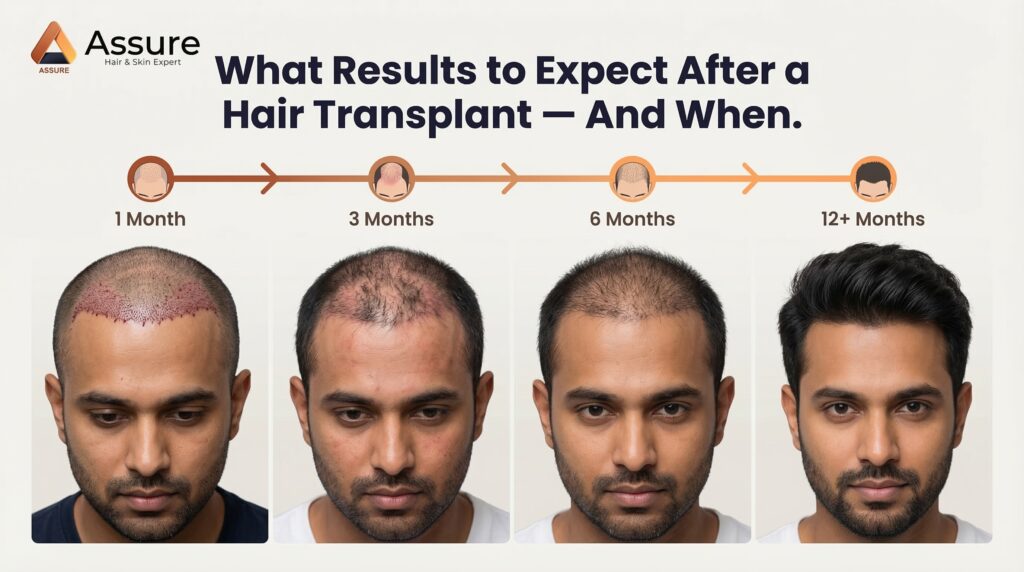
The most common post-procedure question we receive at Assure Clinic is: “When will I see the results?” It is a completely understandable question you have invested time, money, and trust, and you want to know when the outcome will be visible.
The honest answer is: results from a hair transplant unfold over 12–18 months, following a predictable biological timeline that cannot be rushed. Understanding that timeline in detail including the phases that look discouraging before they look good is the best way to manage your expectations and stay focused on the end result.
This guide explains what happens month by month, what is and is not visible at each stage, and what the final outcome of a well-performed hair transplant looks like.
Why Hair Transplant Results Take Time
A hair transplant moves living follicles from one area of your scalp to another. These follicles are biological tissue they need time to re-establish their blood supply, recover from the physical relocation, and cycle back into active growth.
Human hair grows in phases:
– Anagen (growth phase): Active hair growth, lasting 2–6 years
– Catagen (transition phase): Brief 2–3 week transition
– Telogen (resting phase): 3-month resting period before shedding and regrowth
When a follicle is relocated during a hair transplant, it is temporarily forced into the telogen phase it sheds the existing hair shaft and “rests” before beginning a new growth cycle. This is why results take months rather than weeks.
Month-by-Month: What to Expect
Immediately After (Day 1–7)
The transplanted grafts are in place. Tiny scabs form around each implanted follicle within 24–48 hours. Redness, minor swelling, and scalp sensitivity are expected during the first week.
The scalp looks quite different from what the final result will be this is not representative of the outcome. The grafts are embedded and beginning to establish blood supply, but no visible growth has occurred yet. Read our complete recovery timeline for detailed post-operative care instructions.
Key milestone: Scabs fall away naturally within 10–14 days.
Month 1–2: Shock Loss
During Months 1–2, the majority of the implanted hair shafts shed. This is called shock loss (or telogen effluvium), and it happens because the follicles have entered their resting phase. For a full list of expected and uncommon side effects, see our hair transplant side effects guide.
This is the phase that tests patience the most. The transplanted area may look thinner than it did immediately after the procedure which can feel alarming if you are not prepared for it. It is not a sign that the procedure has failed.
What is happening: The follicle is dormant but intact beneath the skin, preparing to begin a new growth cycle. The hair shaft falls away but the root remains.
Key milestone: Shock loss is temporary. Regrowth begins in the months that follow.
Month 3–4: Early Regrowth Begins
The dormant follicles re-enter the anagen (active growth) phase. Fine, new hairs begin to emerge from the implanted follicles. At first these hairs are thin in diameter and lighter in colour than the surrounding hair this is normal and temporary.
This is a genuine turning point. Progress may be subtle but it is real. Some patients see earlier growth than others individual biological variation is normal.
Key milestone: Visible new growth begins. Progress is real but modest.
Month 5–6: Growth Accelerates
The new hairs become progressively thicker and more defined. The outline of the restored hairline or filled area begins to take clear shape. Many patients first start to feel genuinely pleased with their progress during this phase.
Hair colour normalises and the texture begins to match the surrounding hair. The density visible at Month 6 is approximately 40–50% of the final result.
Key milestone: Visible transformation is now clear to the patient and to others.
Considering a hair transplant? Our qualified doctors at Assure Clinic Mumbai can assess your situation no pressure, no obligation. Book a free consultation →
Month 7–9: Density Builds Significantly
Month by month, additional hairs continue to grow and thicken. By Month 9, most patients have approximately 70–80% of their final density visible. The hairline (if treated) appears more defined and natural. Crown coverage fills progressively.
This phase is when the quality of the surgical work becomes most apparent. The angle, direction, and density of each implanted graft decisions made during the procedure are now visible in the growing hair.
Assure Clinic’s DSHI technique is designed specifically for hairline precision. During this phase, the natural growth direction of each graft produces a hairline that looks completely organic rather than planted.
Key milestone: 70–80% of final result visible. Most patients are significantly satisfied.
Month 10–12: Near-Final Result
By Month 12, the full result is 85–95% established for most patients. Hair diameter, density, and coverage are close to final. At this point, the quality of the outcome is clear.
Patients return for a formal 12-month review at Assure Clinic. This assessment documents the final result, compares pre- and post-procedure photography, and determines whether any additional work (a second session for enhanced density) is appropriate.
Key milestone: Formal outcome assessment. Result is near-final.
Month 12–18: Complete Final Result
The remaining 5–15% of growth and thickening completes between Months 12 and 18. Hair diameter continues to mature, and the overall density reaches its maximum point. For most patients, the change between Month 12 and Month 18 is a refinement of an already excellent result.
By Month 18, the outcome is permanent. Transplanted hairs harvested from the genetically stable donor zone are resistant to DHT and will not undergo the same miniaturisation process as the original hair. Barring significant additional hair loss in surrounding areas, the result is lasting.
What Good Results Look Like
A well-performed hair transplant should produce:
Natural hairline: Irregular along the very edge (soft, not perfectly straight), with single-hair grafts at the front gradually transitioning to multi-hair grafts behind. A hairline that looks natural from arm’s length and close up.
Consistent density: Even distribution of grafts across the treated area, without patches of higher or lower density. Density typically targets 40–60 units per cm² in the hairline zone and up to 80 units per cm² in certain areas using advanced techniques.
Correct growth direction: Every implanted hair growing at an angle that matches the natural flow of the surrounding hair. This is the detail that separates a result that looks organic from one that looks operated-on.
Seamless blending: The transplanted area transitions naturally into the untreated zones no visible boundary between transplanted and native hair.
Factors That Affect Your Results
Graft Survival Rate
The percentage of transplanted follicles that successfully establish and grow is the single most important variable. Assure Clinic’s measured graft survival rate is 95% achieved through doctor-only procedures, our patented UFME extraction technique, and minimal graft handling time.
A lower graft survival rate directly reduces the density of the final result.
Surgeon Skill and Experience
The artistry of hairline design, the consistency of graft distribution, and the precision of implantation angle all depend on the surgeon performing the procedure. This is why Assure Clinic’s policy of doctor-only procedures is fundamental to our outcomes standard. Learn more about how to choose the right clinic for your procedure.
Donor Hair Quality
The calibre (thickness) of donor hair directly affects how much visual density a given number of grafts can produce. Thicker hair creates more visual coverage per follicle than fine hair.
Post-Operative Care
Following post-operative instructions precisely during the critical first two weeks protects graft survival. Patients who do not follow care instructions risk dislodging grafts or introducing infection.
Medical Adjuncts
PRP therapy, used post-operatively, can enhance blood supply to the recipient area and support graft survival and growth speed. Some patients at Assure Clinic combine their procedure with a series of PRP sessions for optimised results.
Can Results Be Improved After 12 Months?
Yes some patients elect to have a second session after their 12-month review to add further density to areas that have filled but could be denser, or to address continued natural hair loss in surrounding areas that has become visible in contrast to the transplanted zone.
Second sessions are planned with full knowledge of the final result from the first procedure making them more precisely targeted than the initial surgery.
Frequently Asked Questions
Will I see any results within the first month?
Not typically in terms of visible new growth. Month 1 is characterised by shock loss. Most patients do not see early new growth until Month 3–4.
Why is my hairline looking worse at Month 2?
Shock loss. The hair shaft sheds but the follicle is alive and dormant. This is expected, normal, and temporary. Regrowth begins in the months that follow.
My friend’s hair grew faster than mine is something wrong?
Individual variation in follicle cycling is normal. Some patients see earlier, faster growth; others are slower. If you are concerned at the 6-month mark with no visible growth, consult your clinical team for an assessment.
What if I am not happy with my results at 12 months?
At Assure Clinic, every patient receives a 12-month review. If the outcome is below expectations, we assess the contributing factors and discuss options. In most cases, a second session is the appropriate response to address density.
Do results look better than they did before the transplant?
Yes that is the goal. The transplanted area achieves density and coverage that the native hair could no longer produce. The final result should represent a meaningful, visible improvement that meets the expectations set during consultation.
How long do the results last?
Transplanted hairs are permanent. They come from the DHT-resistant donor zone and maintain this resistance in their new location. The transplanted result does not “fall out” over time. However, surrounding non-transplanted hair may continue to miniaturise with ongoing androgenetic alopecia, which is why continued medical management is often recommended.
The Assure Clinic Standard
At Assure Clinic, result quality is tracked and measured. Our 20,000+ procedures since 2015 including hair transplant results at Assure Mumbai have produced a large body of documented outcomes across diverse hair loss profiles, age groups, and techniques. This volume of experience directly informs how we plan procedures including realistic density targets, phased session planning, and honest pre-operative expectations setting.
Every patient at Assure Clinic receives a structured post-operative review programme with photographic documentation at key milestones. Your journey does not end when you leave the clinic. Browse our before and after gallery to see documented patient transformations.
Ready to Take the Next Step?
Book a free consultation with our team of 60+ qualified doctors across 14 clinics. We’ll assess your situation honestly and only recommend what’s right for you.
Explore more:
– Best Hair Transplant in Mumbai →
– See Before & After Results →
– Find a Clinic Near You →
