
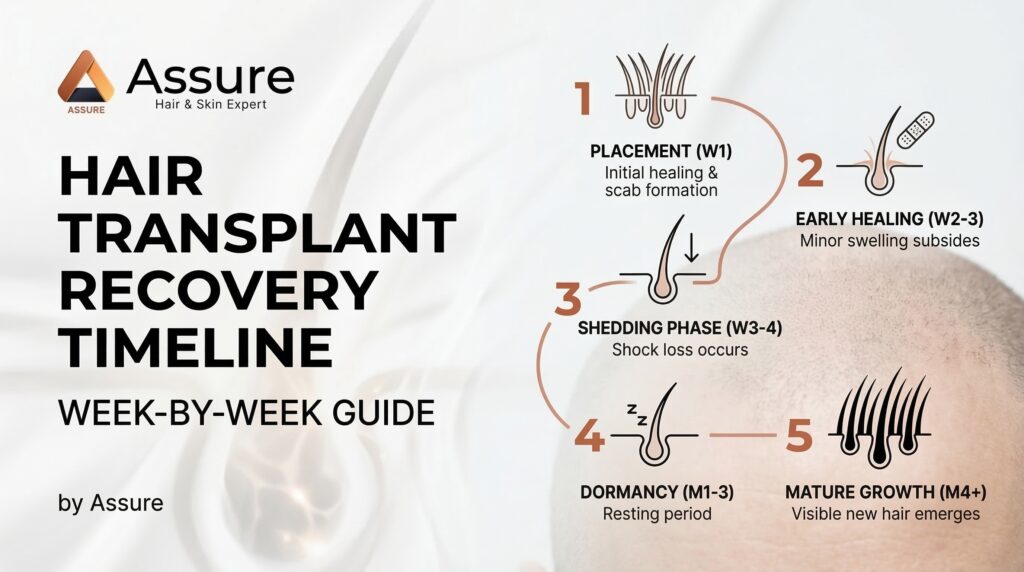
One of the most common concerns patients bring to their first consultation is not about the procedure itself it is about what happens after. How long will I be off work? When will the redness go away? When will I actually see the hair growing?
These are the right questions to ask. Recovery from a hair transplant is a gradual, staged process that unfolds over months rather than days. Understanding each phase in advance helps you plan realistically, protect your grafts, and stay patient during the phases where progress is not yet visible.
This guide covers the complete hair transplant recovery timeline, based on what our patients at Assure Clinic experience following our UFME and DSHI procedures.
The Day of Your Procedure
By the time you leave the clinic, your scalp has already done the hardest work. The grafts are implanted and embedded in their new positions. The first 72 hours are critical the grafts are still establishing their blood supply and are vulnerable to displacement.
You will leave with:
– A light bandage over the donor area
– Mild redness and minor swelling in the recipient area
– A small spray bottle of saline solution for graft hydration
– Detailed post-operative care instructions from our team
Most patients describe the feeling after the procedure as mild tightness and sensitivity not sharp pain. Standard mild pain relief is sufficient if needed.
Day 1 to Day 3: The Critical Window
The first 72 hours are the most sensitive phase of recovery. During this period, the transplanted grafts are not yet anchored by new blood vessel connections. Disrupting them physically by touching, rubbing, or direct pressure can dislodge them from their new positions.
What is normal:
– Redness across the recipient and donor areas
– Minor swelling (most noticeable on Day 2–3, particularly around the forehead if the frontal hairline was treated)
– Tiny, pinpoint scabs beginning to form around each implanted graft
– Some tightness or numbness in the scalp
What to do:
– Sleep with your head elevated (at least 45 degrees) to minimise swelling
– Use the saline spray as directed typically every 30–60 minutes while awake on Day 1
– Avoid touching, rubbing, or scratching the recipient area
– Do not bend forward or put your head in a downward position
– Wear only loose, front-button clothing do not pull clothing over your head
What to avoid:
– Direct water pressure on the scalp (no shower jets on the grafted area)
– Alcohol and smoking (both impair circulation and graft survival)
– Any physical exercise
– Sun exposure to the scalp
Day 4 to Day 7: Initial Healing
By Day 4, the grafts are more secure in their positions. The small scabs around each graft are now clearly visible and the redness is beginning to subside.
What is normal:
– Scabs across the recipient area (this is the expected healing response)
– Continued mild redness
– Possible itching this is normal and indicates healing, but must not be scratched
– Some shedding of existing hair near the transplant area (normal shock effect)
Returning to work:
Most patients with desk-based or indoor jobs can return to work by Day 5–7. Work that involves heavy physical activity, direct sunlight, or contact with dust and sweat should be avoided for longer.
Washing your hair:
Our post-op instructions include a specific washing protocol beginning around Day 3–4. A gentle, diluted shampoo is applied with a cup no rubbing, no scrubbing. The goal is to keep the scalp clean without disturbing the scabs prematurely.
Week 2: Scabs Fall Off
By the end of Week 2, the scabs will have naturally detached from most of the recipient area. This is an important milestone it signals that the surface layer of the scalp has healed.
What is normal:
– Scabs detaching and falling away naturally with gentle washing
– The recipient area may look slightly pinkish-red after scabs fall
– Itching continues as healing progresses
– Small hairs may be visible within the implanted areas at this stage
Important: Do not manually pick or remove scabs. Premature scab removal can dislodge or damage the graft underneath. Allow them to fall off naturally through gentle washing.
Month 1 to Month 3: Shock Loss Phase
This is the phase that surprises many patients and causes unnecessary concern if they are not prepared for it. During Months 1–3, the majority of the newly transplanted hairs will shed. This is called shock loss or telogen effluvium, and it is a completely normal part of the process. For a full list of expected and uncommon side effects, read our hair transplant side effects guide.
What is happening biologically:
The transplanted hair follicle enters a resting phase (telogen) immediately after being relocated. The hair shaft sheds, but the follicle itself remains dormant beneath the skin, preparing to regrow. Think of it as a reset period for the follicle.
What is normal:
– Visible shedding of transplanted hairs you may see hairs in your pillow or in the shower
– The transplanted area may look thinner than it did immediately after surgery
– The donor area scars continue to fade and are typically undetectable by Week 4–6
What to do:
Stay consistent with your follow-up appointments. Our team monitors your progress during this phase to confirm that healing is on track.
Considering a hair transplant? Our qualified doctors at Assure Clinic Mumbai can assess your situation no pressure, no obligation. Book a free consultation →
Month 4 to Month 6: New Growth Begins
This is when anticipation turns into visible progress. The dormant follicles begin to enter the anagen (active growth) phase, and new hairs start to emerge from the scalp.
What to expect:
– Fine, thin hairs beginning to appear in the transplanted area
– Initial growth may be slightly wavy or lighter in texture this normalises over time
– Density is still building the full picture is not yet visible
– The donor area is typically fully healed and any redness has resolved
Hair care during this phase:
– Regular gentle washing continues
– Most patients can resume normal exercise and physical activity from Month 2–3 onwards
– Some patients benefit from PRP therapy during this phase to support follicle recovery and accelerate growth
– Hair colour and chemical treatments should be avoided until at least Month 6
Month 7 to Month 12: Density Builds
Month by month, the new hairs thicken in diameter and the overall density of the transplanted area becomes increasingly visible. By Month 9–10, most patients are genuinely pleased with what they see.
What to expect:
– Consistent, progressive thickening of transplanted hairs
– The hairline (if treated) becomes clearly defined
– Crown and mid-scalp coverage fills in
– The transplanted area blends more naturally with existing hair
For patients who chose Assure Clinic’s DSHI technique, the hairline artistry becomes particularly apparent during this phase the angular precision of each graft produces growth that mirrors the natural direction of the surrounding hair.
Month 12 to Month 18: Final Results
By Month 12, approximately 80–90% of the final result is visible. The remaining growth and thickening continues until around Month 18, when the full outcome of the procedure is established.
Final result characteristics:
– Full density as planned in the procedure
– Natural hairline, natural growth direction
– Transplanted hairs are permanent they are genetically programmed not to fall out (because they come from the permanent donor zone at the back of the scalp)
– Some patients elect for a second session at this point to address any areas requiring additional density
For a detailed look at what good results look like at each milestone, see our hair transplant results timeline. Browse our before and after gallery to see real patient transformations.
Recovery Timeline at a Glance
| Phase | Duration | What Happens |
|---|---|---|
| Immediate | Day 0–3 | Redness, swelling, grafts establishing |
| Early healing | Day 4–14 | Scabs form and fall away |
| Shock loss | Month 1–3 | Transplanted hairs shed (normal) |
| Early growth | Month 4–6 | New fine hairs emerge |
| Density building | Month 7–12 | Hairs thicken, density increases |
| Final result | Month 12–18 | Full outcome visible |
Post-Operative Do’s and Don’ts: Summary
Do:
– Follow the prescribed washing protocol exactly
– Sleep elevated for the first 5–7 days
– Attend all follow-up appointments
– Stay hydrated and maintain a balanced diet
– Use any prescribed medications as directed
Don’t:
– Touch, rub, or scratch the recipient area in the first two weeks
– Exercise heavily in the first 2–3 weeks
– Expose the scalp to direct sunlight without SPF protection for 3 months
– Smoke or drink alcohol for at least 2 weeks post-procedure
– Use hair dye or chemical treatments for at least 6 months
Frequently Asked Questions
When can I go back to the gym?
Light walking is fine from Week 2. Gym workouts, heavy lifting, and any activity causing significant sweating should be avoided until Week 3–4. Contact sports should wait until at least Month 2.
When will the swelling go away?
Any post-operative swelling typically peaks on Day 2–3 and resolves completely within Day 5–7. Sleeping with your head elevated significantly reduces swelling.
Is shock loss guaranteed?
Shock loss affects the majority of patients to some degree. In most cases it is temporary and the follicle recovers fully. Rarely, some pre-existing miniaturised hairs near the transplant area may not regrow this is one reason why a thorough pre-operative assessment matters.
When can I colour my hair?
Hair colouring and chemical treatments should be avoided for at least 6 months post-procedure, to allow the transplanted follicles to establish properly before being exposed to harsh chemicals.
When will I see full results?
The full, final result is visible between 12 and 18 months. The process cannot be accelerated follicle biology follows its own timeline.
What if I don’t see growth by Month 6?
Some patients are slower growers. If you are concerned at the 6-month mark, contact our team we will review your progress, assess the scalp, and advise accordingly.
Do the transplanted hairs require any special care permanently?
Once fully grown, transplanted hairs behave exactly like natural hairs. You can wash, cut, style, and treat them in the same way as the rest of your hair.
Support Throughout Your Recovery
Every Assure Clinic patient receives structured post-operative care as part of their treatment. This includes follow-up appointments at key recovery milestones, direct access to our care team for questions, and detailed written aftercare instructions.
If you experience anything unexpected during recovery unusual pain, signs of infection, or significantly delayed growth our team is available to assess and advise.
Assure Clinic has completed 20,000+ procedures since 2015. Our team provides dedicated hair transplant recovery at our Mumbai clinic and across all 14 centres. Every recovery follows a predictable, well-documented pathway and we are with you throughout every stage of it.
Ready to Take the Next Step?
Book a free consultation with our team of 60+ qualified doctors across 14 clinics. We’ll assess your situation honestly and only recommend what’s right for you.
Explore more:
– Best Hair Transplant in Mumbai →
– See Before & After Results →
– Find a Clinic Near You →
