
Choosing between FUE and DHI is one of the most common questions we hear at Assure Clinic. Both are modern, minimally invasive hair transplant methods but they are not the same, and the right choice depends entirely on your specific hair loss pattern, scalp condition, and the outcome you are aiming for.
This guide breaks down the real differences between FUE and DHI: how each technique works, who is best suited for which, what results to expect, and what our experienced team at Assure Clinic recommends based on 20,000+ successful procedures.
What is FUE Hair Transplant?
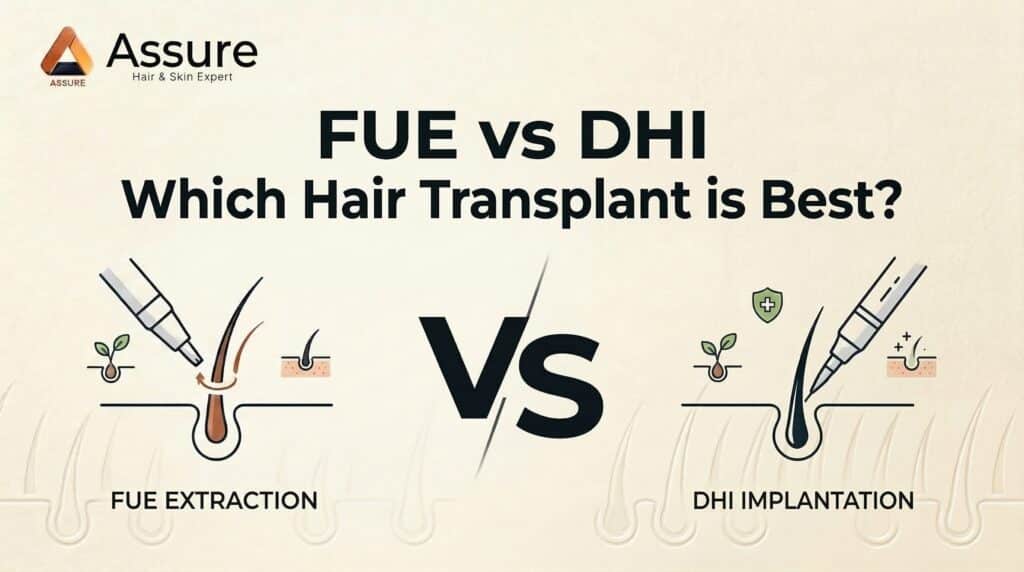
FUE (Follicular Unit Extraction) is a technique where individual hair follicles are extracted one by one from the donor area typically the back or sides of the scalp using a small, circular punch tool. These grafts are then stored temporarily before being implanted into tiny incisions made in the recipient area.
The key advantage of FUE is its versatility. Because the follicles are harvested individually rather than as a strip, there is no linear scar. Recovery is relatively quick, and the donor area heals with minimal trace.
At Assure Clinic, our proprietary UFME (Ultra Fine Micro Extraction) technique is a precision refinement of standard FUE. Using a patented 0.6–0.8mm punch finer than the industry standard our qualified doctors extract grafts with significantly less trauma to the follicle and surrounding tissue. This directly contributes to our 95% graft survival rate.
How FUE Works Step by Step
- The donor area is trimmed and locally anaesthetised
- Individual follicular units (containing 1–4 hairs each) are extracted using a micro-punch
- Grafts are sorted, inspected, and stored in a preservation solution
- Small recipient sites (channels) are created in the thinning or bald area
- Grafts are implanted into the prepared channels one by one
What is DHI Hair Transplant?
DHI (Direct Hair Implantation) is a variation of FUE where the extracted grafts are implanted directly into the scalp using a specialised implanter pen without first creating separate incisions. The extraction and implantation happen in a more integrated sequence.
Because the implanter pen controls both the depth and angle of each graft placement, DHI offers very precise directional control. This makes it particularly well suited for adding density to areas where existing hair is present, since there is less risk of damaging surrounding follicles.
At Assure Clinic, our DSHI (Direct Simultaneous Hair Implantation) technique is our patented evolution of standard DHI. It improves on conventional DHI by reducing graft handling time and ensuring even more consistent angulation both critical factors for natural-looking results.
How DHI Works Step by Step
- The donor area is trimmed and locally anaesthetised
- Follicular units are extracted (same as FUE)
- Each graft is loaded directly into an implanter pen
- The pen pierces the scalp and deposits the graft simultaneously
- No separate incision step is required
FUE vs DHI: Side-by-Side Comparison
| Feature | FUE | DHI |
|---|---|---|
| Incision method | Separate channel creation, then grafting | Simultaneous incision and implantation |
| Suitable for | Larger bald areas, full scalp coverage | Density addition, areas with existing hair |
| Hair shaving required | Full or partial shave | Can be partially unshaven |
| Control over angle/direction | Moderate | High |
| Procedure time | Shorter per session | Slightly longer (pen-loading adds time) |
| Graft handling | Grafts stored before implanting | Minimal out-of-body time |
| Recovery time | 7–10 days | 7–10 days |
| Best for | Norwood 3–6, large coverage areas | Norwood 2–4, density work, hairline refinement |
| At Assure Clinic | UFME (patented) | DSHI (patented) |
Key Differences Explained
1. The Incision Step
In standard FUE, the surgeon first creates channels (tiny incisions) across the entire recipient area, and then grafts are placed into those channels. In DHI, the implanter pen creates the incision and deposits the graft in a single motion.
This means DHI theoretically reduces the time grafts spend outside the body. However, the pen-loading process has its own time demands so the total graft survival advantage is dependent heavily on the team’s speed and efficiency.
2. Density and Direction
DHI gives surgeons finer control over the angle, depth, and direction of each implanted hair. This matters enormously for natural-looking results, particularly at the hairline where hair grows at specific angles. For patients seeking to restore density in areas where they still have some hair, DHI is often the preferred choice.
3. Shaving Requirements
FUE typically requires the donor area (and often the recipient area) to be fully shaved. DHI can sometimes be performed with only the donor area shaved, allowing the existing hair in the recipient zone to cover the transplanted area immediately after surgery a meaningful advantage for patients who are not comfortable with a fully shaved look.
4. Scalp Coverage Area
FUE tends to be more efficient for covering large bald areas in a single or phased session. DHI is slower per unit area due to pen-loading. For patients with significant hair loss across the crown or mid-scalp, FUE (or Assure’s UFME) is often the faster route to full coverage.
Considering a hair transplant? Our qualified doctors at Assure Clinic Mumbai can assess your situation no pressure, no obligation. Book a free consultation →
Which is Better: FUE or DHI?
There is no single correct answer the better technique is the one that matches your specific situation.
FUE (UFME at Assure) is typically recommended if:
– You have a large area of thinning or baldness to cover
– You are Norwood Scale 4–6
– You require a higher graft count (3,000–5,000+)
– Cost efficiency per session is a priority
DHI (DSHI at Assure) is typically recommended if:
– You want to add density to an area where hair still exists
– You are Norwood Scale 2–3, or treating early hairline recession
– You are concerned about angular precision and a natural hairline
– You prefer to avoid a fully shaved appearance
In many cases, Assure Clinic uses a combination approach UFME for extraction and large-area coverage, combined with DSHI for precision implantation at the hairline. This hybrid method draws on the strengths of both techniques and is one of the reasons we consistently achieve natural-looking density even in complex cases.
FUE vs DHI: Results and Recovery
Both FUE and DHI involve the same fundamental healing process:
- Day 1–3: Minor swelling and redness in the recipient area
- Week 1–2: Tiny scabs form around the implanted grafts and fall off naturally
- Month 1–3: Shock loss occurs the transplanted hairs shed temporarily (this is normal and expected)
- Month 4–6: New hair growth begins to emerge
- Month 9–12: Significant density and coverage becomes visible
- Month 12–18: Final results are fully visible
Final results from both FUE and DHI appear at the same timeframe there is no meaningful difference in how long either technique takes to produce its full outcome. For a detailed breakdown of what to expect at each stage, read our hair transplant recovery timeline and results timeline guide.
What About Cost? FUE vs DHI Pricing
At Assure Clinic, we use a Full Head Results pricing model meaning you pay for the outcome you are targeting, not a per-graft rate that can escalate unexpectedly. This is fundamentally different from clinics that quote a “per graft” cost.
The actual cost of your procedure depends on:
– Your Norwood scale classification (how advanced your hair loss is)
– The technique chosen (UFME, DSHI, or a combination approach)
– The number of sessions required
– The clinic location
To get a precise, personalised cost estimate, a consultation with our medical team is the right starting point. We do not provide standardised per-graft pricing because individual scalp conditions vary too significantly for that model to be honest or accurate.
Why Assure Clinic’s Versions of FUE and DHI Are Different
Most clinics offer standard FUE and DHI as taught in training courses. At Assure Clinic, both techniques have been refined and patented:
UFME (Ultra Fine Micro Extraction) our FUE advancement:
– Uses a 0.6–0.8mm punch (finer than industry standard)
– Reduces follicle transaction rate
– Preserves surrounding tissue better
– Contributes to our 95% graft survival rate
– Patent held by Dr. Abhishek Pilani
DSHI (Direct Simultaneous Hair Implantation) our DHI advancement:
– Reduces graft out-of-body time
– Provides more consistent depth and angle control
– Designed for the specific hair texture and density requirements of Indian and South Asian patients
– Patent held by Dr. Abhishek Pilani
Every procedure at Assure Clinic is performed exclusively by qualified doctors never by technicians. This is a non-negotiable standard that directly protects graft quality and surgical outcomes.
Frequently Asked Questions
Is FUE or DHI more painful?
Both techniques use local anaesthesia, so neither is painful during the procedure. Post-operative discomfort is mild and similar for both methods. Most patients describe it as tenderness rather than pain, manageable with standard pain relief. For a comprehensive overview, see our hair transplant side effects guide.
Which technique has better hair growth results?
When performed by an experienced team, both FUE and DHI produce comparable long-term results. The quality of the outcome depends far more on surgeon skill, graft handling, and scalp condition than on the technique label.
Can I choose which technique I want?
Yes however, our medical consultants will assess your scalp and recommend the most appropriate technique for your specific situation. In many cases, a combination approach (UFME extraction + DSHI implantation) produces the best result.
How many grafts can be done in one session?
Typically 2,000–4,000 grafts per session depending on your donor density. For larger requirements, Assure Clinic uses a phased approach multiple sessions spread over several days which preserves graft quality and allows the surgeon to maintain precision throughout.
Is DHI really “needle-free”?
This is a marketing claim used by some clinics. DHI still involves piercing the scalp the implanter pen is a needle. The difference is that the incision and graft placement happen simultaneously rather than in two separate steps.
How long does the full procedure take?
FUE sessions typically run 6–8 hours for a standard graft count. DHI sessions are slightly longer due to pen-loading time. Assure Clinic uses phased sessions to ensure surgeon precision is maintained throughout.
Will the transplanted hair look natural?
Yes when hair is implanted at the correct angle, depth, and density to match the surrounding hair’s natural growth pattern, the results are indistinguishable from natural hair. This is a function of technique and experience, not which method is used. See real patient outcomes in our before and after gallery.
Who is not a candidate for either FUE or DHI?
Patients with active scalp infections, insufficient donor density, autoimmune hair loss (alopecia areata), or certain medical conditions may not be suitable candidates. A proper medical consultation will determine your eligibility.
Next Steps
The best way to understand which technique is right for you is a personalised consultation with Assure Clinic’s medical team. During your consultation, we assess your Norwood scale, donor density, scalp condition, and expectations and give you an honest recommendation, not a sales pitch.
Assure Clinic has completed 20,000+ hair transplant procedures since 2015, with 60+ qualified doctors across 14 centres in India and Dubai. Visit our best hair transplant clinic in Mumbai for a personalised consultation. Every procedure is doctor-led, and our patented UFME and DSHI techniques are exclusive to Assure Clinic.
Ready to Take the Next Step?
Book a free consultation with our team of 60+ qualified doctors across 14 clinics. We’ll assess your situation honestly and only recommend what’s right for you.
Explore more:
– Best Hair Transplant in Mumbai →
– See Before & After Results →
– Find a Clinic Near You →
