
Hair Transplant Essentials to Know
|
Many people comparing FUT vs FUE hair transplant techniques will search online and start to think that one technique is better than the other. The truth is that both techniques do the same job. They both involve taking healthy hair from the back and sides of your head (this hair is usually more resistant to pattern baldness) and moving it to the thinning areas. The difference between them is how the grafts are removed.
Once grafted into your balding area both techniques can look very similar. The difference is in the back of your head. This will determine how noticeable your scar will be, how your donor area will look with short hair, how quick you will heal in your first couple of weeks and how much donor hair will be left for you.
In this blog we will help explain the difference between FUE vs FUT hair transplant in simple terms, what scars you will get, what graft yield means, how long you will recover from FUE vs FUT and how Assure Clinic will plan your transplant.
What is the Difference Between FUE and FUT Hair Transplant?
FUE stands for Follicular Unit Excision. FUT stands for Follicular Unit Transplantation or The Strip Technique. The only real difference between them is how your grafts are removed.
Your hair grows in small bundles at the back. Each bundle contains 1-3 hairs. With FUE your doctor will individually remove these bundles using a small punch tool. With FUT a thin strip of skin is removed. This is stitched or stapled up. The team will then sit and separate your strip into individual grafts under a microscope.
Prior to FUE your donor area will usually be shaved short. With FUT your hair is usually left longer around the area. Once removed the grafts are placed into your balding area the same way in both (NHS, 2023).
FUE vs FUT at a Glance
Below is a table to show you what can happen to your donor area.
| Factor | FUE | FUT |
| Graft Removal | Individual removal with a small punch | Strip of skin is removed and separated |
| Scars | Many small dots | One line |
| Stitching | Usually no | Yes |
| Shaving | Back of head is shaved short | Only the strip area |
| First Few Days | Small scabs that will heal by themselves | Longer period of tightness from the cut |
| Monitoring by Doctor | Spacing to avoid thinning at the back | Scalp laxity |
| Future Sessions | Density reduces with each session | Depends on how much scalp laxity you have |
| Usually Chosen | You like very short hair | You are ok with a line and your scalp is loose |
You may also hear some clinics talk about DHI and Sapphire FUE. DHI is just how the grafts are put in and in Sapphire FUE the small holes are made with sapphire tipped blades, but in both the grafts are still taken out with FUE.
What do FUE and FUT Scars Look Like?
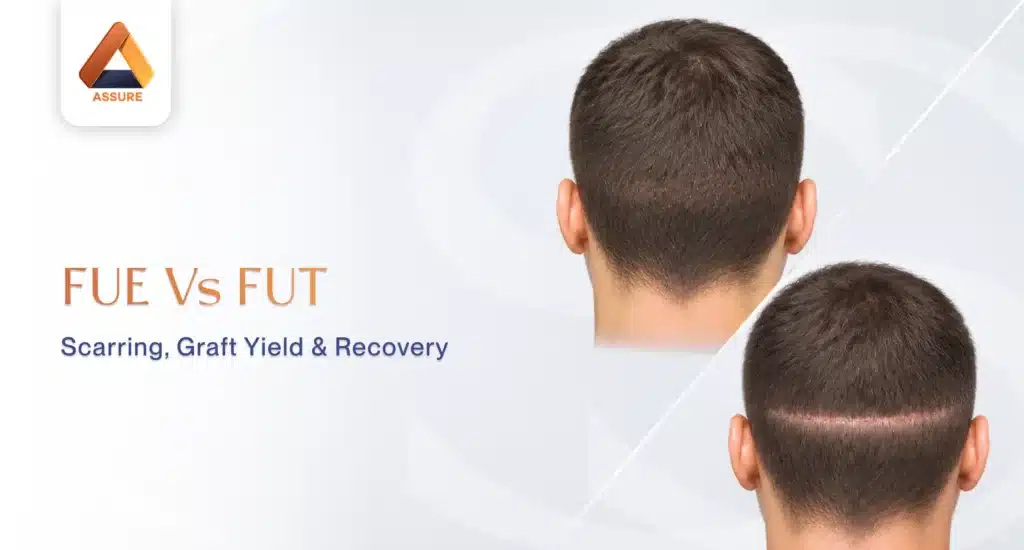
Both techniques will leave a mark at the back of your head. FUE will leave many small dots and FUT will leave one thin line. How noticeable they are will depend on how you cut your hair and how your skin heals.
FUE Scars
Each graft removed will leave a small circular mark. The size will depend on your skin type and punch size. Once the hair has grown back the dots will usually be hidden within your hair. However overall FUE can leave more scar tissue than a strip for the same amount of grafts (ISHRS, 2024).
Problems can occur if your doctor removes too many grafts from one area. This can cause patchiness or translucency at the back. This is known as overharvesting and can be difficult to fix. Indian hair transplant guidelines recommend spacing out your grafts and only harvesting a safe amount to protect your remaining donor hair (Mysore et al., 2021).
FUT Scars
FUT will leave one line scar. This is usually across the back of your head. The cut will be stitched or stapled up and these will generally be removed within 1-2 weeks if they are not dissolving (NHS, 2023).
If the scar heals well it will normally be a thin line that will be well hidden within your hair. As long as you keep your hair to at least 2-3cm it will generally not be noticeable (Cooley et al., 2024). However the size will depend on how wide the strip was, the tightness of the stitch, laxity of your scalp and how well your skin heals. Some scars can widen over time.
If the scar does become noticeable it can be fixed with scar revision or grafting into the scar. Scalp micropigmentation can also create the look of short stubble. If you have previously had raised scars or your wounds heal slowly let your surgeon know.
What if I Like to Keep My Hair Short?This is one of the most practical things to consider. If you like skin fades or very short clipper cuts the line from FUT is more likely to show. FUE dots are generally not as noticeable however if you have a very close shave they can show. Especially if you have a large or repeat session. If you keep your hair short but not shaved then a well healed FUT scar can be hidden as long as the hair around the area is long enough. FUE scars are also generally not noticeable. If you keep your hair longer then both scars are generally easy to hide. Sometimes dark hair on fair skin can make scars more noticeable. We recommend telling your doctor how short you realistically want to keep your hair for years. |
FUE vs FUT Graft Yield and Hair Coverage
Graft yield means how many grafts can be removed from your donor area. Some patients will have more grafts available over time with FUT however this does not necessarily mean better coverage. How many hairs are in each graft and how well they survive will also play a part.
How many grafts can be removed?
How many you can have will depend on your donor area. This will depend on how dense your donor hair is, how large your safe donor area is, hair thickness, scalp laxity and how much more hair loss you may have.
With FUT you will have one concentrated area to take your grafts from. This is an efficient way to utilise your donor hair throughout your lifetime. You will have less total scarring for each graft in many cases (Cooley et al., 2024). FUE can cover a larger area however you cannot take unlimited amounts from one area without looking thin.
How many hairs in each graft?
A graft is not a single hair. Each follicular unit can contain 1-3 or more hairs. Two patients receiving the same amount of grafts may actually receive very different amounts of hairs.
A study was carried out on patients having both FUT and FUE at different times. It was found that the FUE samples contained more 3+ hair units and had a higher average number of hairs (Takata Pontes et al., 2024).
| Worth Knowing The authors said this does not prove FUE is better as in FUE the surgeon can choose which units to remove, so this could explain the difference. The study only looked at how many hairs were in each graft and does not show that FUE grafts survive better, provide more hairs over your lifetime or give a better final density. |
How Well do the Grafts Survive?
Graft survival is how well the grafts settle and grow once transplanted. This is dependent on the whole surgery and not just the removal technique. Below are factors that usually affect how well they survive.
- Transection is when a follicle is accidentally cut when removing or separating.
- How long the grafts are outside your body and how well they are stored and kept moist.
- How gently the grafts are handled and how carefully they are planned.
- Blood supply and healing in the area.
No fixed survival rate should be promised for either technique. When comparing plans ask how many grafts you may get, how many hairs will be in each graft and how much donor hair will be left.
How Do FUE and FUT Affect Your Donor Area?
Your donor hair is limited. Once a graft has been moved it will not regrow at the back of your head. This means that every graft used today will mean one less graft for tomorrow.
This is important as pattern baldness usually continues after surgery (Carman and Rassman, 2024). Having repeat sessions of FUE will reduce the density over a wider area and cause more small scars. FUT will remove a strip of skin and further strip surgery may depend on how much flexibility you have in your scalp. Some surgeons may use both techniques in different sessions to make the most of your donor hair (Cooley et al., 2024).
Your age and if you are still experiencing hair loss will also affect your plan. If you are still thinning then your surgeon will need to keep some donor hair aside for the future.
| Expert Hair Insight “Patients usually only ask me one question and that is how many grafts they will get. I always tell them that the amount of grafts tells us how much hair we can move. It does not tell us how your donor area will look. FUT will leave a line which will need enough hair over it. FUE will leave small dots across your scalp. I always ask how short you like to keep your hair and how much you may need in the future.”Dr. Abhishek Pilani, MBBS, MD (Dermatology, Venereology & Leprosy)Co-Founder and Chief Hair Transplant Surgeon, Assure Clinic | Reg. No. 2011020289 (MMC) |
FUE vs FUT Recovery Time and Healing
Most people want to know how fast they can go back to normal and here also the main difference is at the back of your head. FUE gives you lots of small wounds that close by themselves within few days while FUT has one stitched wound which takes a bit longer, but the front where the new grafts go heals almost the same in both.
Below is a table to show you what you may notice.
| Recovery | FUE | FUT |
| Donor Area | Sore for a few days | Tight along the cut, can stay like that a bit longer |
| Scabs | Small scabs, gone in 1-2 weeks | Front scabs same. Back heals as one wound. |
| Stitching/Stapling | Usually none | Taken out around 10-14 days if they don’t dissolve |
| Returning to Work | Few days off depending on your job | Same, just don’t stretch the cut |
| Exercise | No gym till your surgeon says ok | Longer rest for anything that pulls the back |
| New Hair | Hair may shed first | Same |
Don’t worry if your back looks fine in a few weeks but the front still looks the same, because the new follicles are only just starting to grow at that time. Usually new hair comes after several months and the full result can take around 10-18 months (NHS, 2023). You can see how this looks on our hair transplant results page.
Your scalp may feel tight, sore or a bit swollen for a few days with either method. Like with any operation there is a small risk of bleeding, infection and reaction to anaesthetic and some grafts may not survive (NHS, 2023). Contact your clinic if you get severe pain, swelling that keeps going up, signs of infection or anything that worries you.
How Assure Clinic Will Plan Your Hair Transplant
At Assure Clinic your hair transplant is performed by our doctors. Your doctor first does a proper check of your scalp with trichoscopy, sees your Norwood stage and hair loss pattern and also checks your donor density, hair thickness and whether your hair loss has become stable or is still going on.
This will determine how many grafts may be suitable for you now and how much donor hair to keep safe for the future. We offer an FUE hair transplant. During your consultation you will understand the following.
- The number of grafts you may need.
- Areas of your scalp that can be treated.
- How your donor area will be managed.
- How you will recover. This also includes the timeline with aftercare.
- Risks and limitations of the procedure.
If another technique or non surgical option would be better for you this should be properly discussed.
Frequently Asked Questions
Is FUE less painful than FUT?
Both FUE and FUT are done under local anaesthetic so you should not feel much pain during the surgery. You may feel the pinch of injections. After surgery FUT can cause longer tightness along the cut. FUE will cause soreness across many small wounds. This can vary from person to person.
Does FUE leave permanent scars?
Yes it leaves small dots. However they are very small, pale and spread out so you will generally not notice them once your hair has grown back. Don’t believe anyone saying FUE is scar free.
Will I get a visible scar with FUT and short hair?
This depends on how short you go. If you have a skin fade or zero cut then the line is more likely to show. If you keep around 2-3cm of hair then it will generally be hidden.
Can I get more grafts with FUT?
In some patients yes. This is usually if you have a lax scalp and thick donor hair. Big FUE sessions can also be done. Your doctor will only decide on a safe amount once they have assessed your donor area.
Which technique is better for short hair?
If you like to keep your hair very short then FUE is generally preferred. There is no line at the back. However if you have a very close shave then the dots can show.
Will I heal slower with FUT?
Yes generally you will take a little longer to heal at the back of your head. This is because there are stitches which will be removed after 1-2 weeks. New hair will take months to grow with both.
When will I see results?
There isn’t a fixed time. New hair will generally start to come through after a few months. Full results can take 10-18 months. Be patient in the first few weeks.
Can I have FUE after a previous FUT transplant?
Yes in many cases. Your doctor can take grafts from around your old strip scar. Sometimes they can also graft into the scar. Your doctor will first assess how much donor hair you have left.
Which is better, FUE or FUT hair transplant?
Neither technique is better for everyone. FUE may suit you if you like to keep your hair very short, while FUT may suit you if you have a loose scalp and want to save more donor hair for future sessions. Once the grafts grow, both can look very similar in front, so your doctor will suggest a technique only after checking your donor area, hair type and future hair loss.
References
Carman, T.P. and Rassman, W. (2024) ‘Follicular unit excision donor area management and considerations of the scalp’, Facial Plastic Surgery, 40(2), pp. 195-204.
Cooley, J.E., Finner, A., Gambino, V., Radwanski, H. and Unger, R. (2024) ‘Clinical practice guidelines for follicular unit transplantation (FUT)’, Hair Transplant Forum International, 34(6), pp. 197, 202-204.
International Society of Hair Restoration Surgery (ISHRS) (2024) ‘Is FUE scarless?’.
Mysore, V. et al. (2021) ‘Hair transplant practice guidelines’, Journal of Cutaneous and Aesthetic Surgery, 14(3), pp. 265-284.
NHS (2023) ‘Hair transplant’.
Takata Pontes, L., Ruston, A. and de Moraes, A.M. (2024) ‘Strip harvesting follicular unit transplantation versus follicular unit excision: Comparing the number of hairs and the ratio of hairs to follicular unit’, Dermatologic Surgery, 50(9), pp. 851-854.