Key Takeaways
- PRP and GFC are supportive therapies that improve density and slow loss, while a hair transplant is the only one that permanently restores hair.
- PRP and GFC work best for early thinning and as add-ons to other treatments, not for bald areas.
- A hair transplant is the only option that regrows hair on fully bald areas, with a 95 percent graft survival rate at Assure Clinic.
- PRP and GFC require ongoing maintenance sessions; a transplant is one-time and permanent.
- The right choice depends on your hair loss stage, which qualified doctors assess before recommending treatment.
Introduction
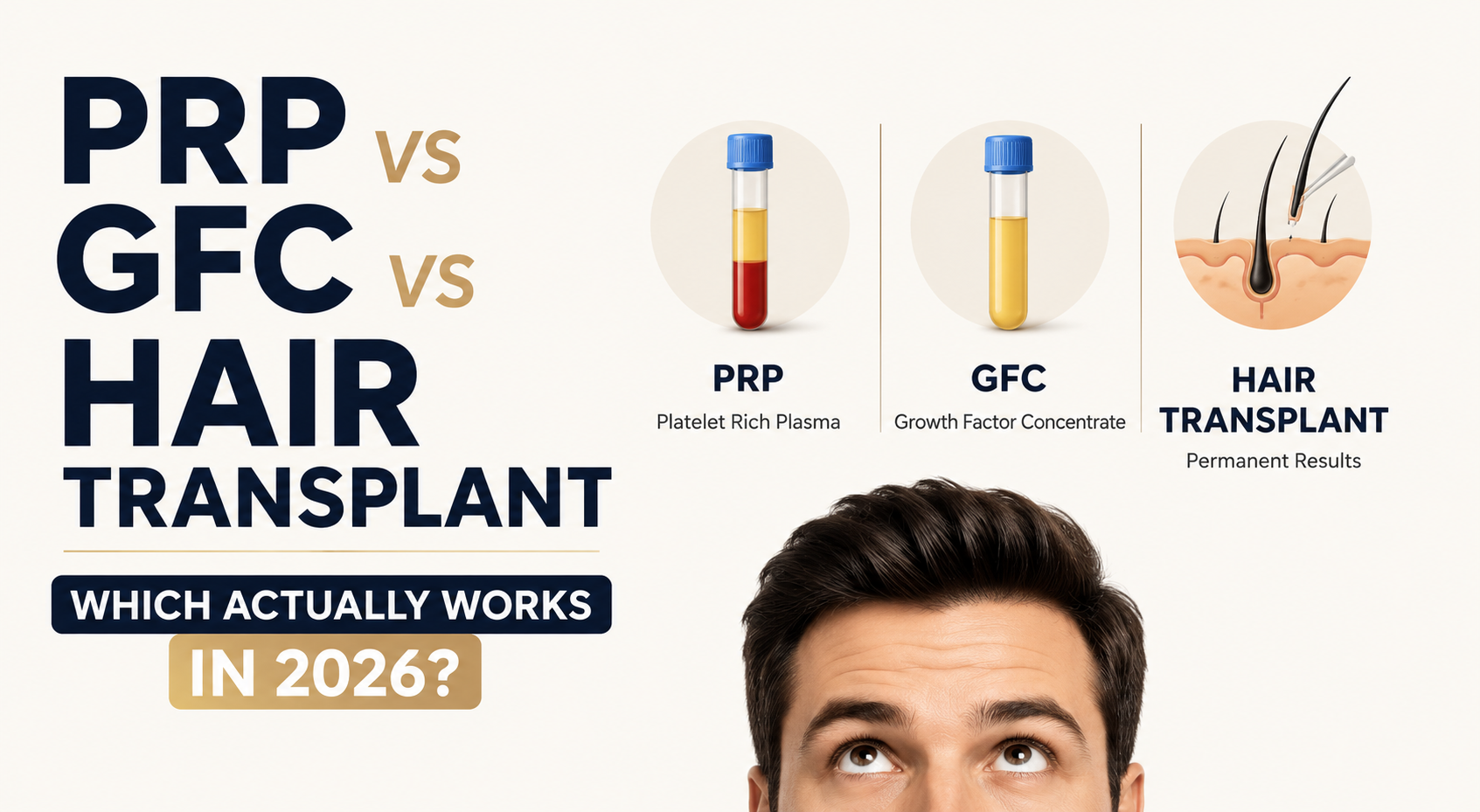
PRP, GFC, and hair transplant are often compared, but they solve different problems. PRP and GFC are supportive therapies that improve the density of thinning hair and slow shedding. A hair transplant is the only one of the three that permanently restores hair, including on areas that have gone bald. According to the International Society of Hair Restoration Surgery, supportive therapies and transplantation are complementary rather than competing options.
This guide compares PRP, GFC, and hair transplant honestly: what each does, what it cannot do, and when each is the right choice. PRP and GFC genuinely help in the early stages, but only a transplant restores hair that is already gone.
Dr. Abhishek Pilani, founder of Assure Clinic and an ISHRS-certified hair transplant surgeon, has led over 20,000 procedures across 13 clinics in India and Dubai.
Get Your Personalized Hair Transplant Cost Estimate
Takes 60 seconds. See your expected cost range based on your hair loss stage and preferred city — transparent pricing, no hidden fees.
Calculate Your Cost →Not sure which treatment your hair loss needs? Use the free baldness calculator to check your Norwood stage in 60 seconds.
PRP vs GFC vs Hair Transplant: Quick Comparison
| Factor | PRP | GFC | Hair Transplant |
|---|---|---|---|
| Regrows bald areas | No | No | Yes |
| Permanent | No | No | Yes |
| Sessions needed | Ongoing | Ongoing | One-time |
| Best for | Thinning, support | Thinning, support | Bald or advanced loss |
| Result type | Improved density | Improved density | Full restoration |
The Three Treatments Compared
Hair Transplant — The Only Permanent Restoration
A hair transplant moves your own DHT-resistant follicles to thinning or bald areas, where they grow for life. It is the only one of the three that regrows hair on fully bald areas and the only permanent option.
What it does: Permanently restores hair, including on bald areas, in a one-time procedure. At Assure Clinic, the UHDHT method combines the UFME and DSHI techniques to achieve 60 to 80 grafts per square centimetre, with a 95 percent graft survival rate across 20,000+ procedures (internal data, 2016 to 2026).
What it cannot do: It is not a preventive measure for very early thinning, where supportive therapy or medication is more appropriate.
- Best for: Bald or advanced loss, anyone wanting a permanent result
- Learn more: UHDHT hair transplant method
GFC Therapy — Advanced Growth Factor Support
GFC (Growth Factor Concentrate) therapy uses a high concentration of growth factors derived from your own blood to stimulate hair follicles and improve density.
What it does: Improves the density of thinning hair and slows shedding, often with fewer sessions than PRP because of its higher growth factor concentration. Works well as an add-on to medication or after a transplant to support healing.
What it cannot do: It does not regrow hair on bald areas and is not permanent, requiring ongoing maintenance. Learn more about GFC hair treatment.
- Best for: Early thinning, supportive and combination use
PRP Therapy — Proven Density Support
PRP (Platelet-Rich Plasma) therapy injects a concentration of your own blood platelets into the scalp to stimulate follicles and improve density.
What it does: Improves density in thinning areas and slows shedding, especially when combined with medication. A well-established supportive therapy with years of clinical use.
What it cannot do: Like GFC, it does not restore bald areas and is not permanent, requiring an initial course followed by maintenance sessions.
- Best for: Thinning hair, supportive and combination use
The Honest Verdict: They Are Not Competitors
PRP and GFC are not alternatives to a hair transplant. They solve different problems at different stages.
| Your Situation | Best Choice |
|---|---|
| Early thinning, still have coverage | PRP or GFC, often with medication |
| Thinning plus some recession | PRP or GFC plus consider a transplant |
| Bald areas that will not regrow | Hair transplant (only option) |
| Want a permanent result | Hair transplant |
| Supporting recovery after a transplant | PRP or GFC |
The smartest approach for many patients combines them: supportive therapy to protect existing hair, and a transplant to restore what is already lost.
“Patients often ask whether PRP can save them from a transplant. For early thinning, yes, it helps. But once an area is bald, no injection will bring it back. That is the line: PRP and GFC support, a transplant restores,” says Dr. Abhishek Pilani, founder of Assure Clinic.
When Should You Consider a Hair Transplant?
A transplant becomes the right choice over PRP or GFC when:
- You have bald areas that no longer grow hair.
- Your loss has reached Norwood stage 3 or beyond. Check with the norwood scale guide.
- Supportive therapy is no longer enough to maintain density.
- You want a permanent result rather than ongoing sessions.
Use the free baldness calculator to check your stage, then book a consultation.
At Assure Clinic, qualified doctors assess whether supportive therapy, a transplant, or a combination suits you. With 20,000+ procedures at a 95 percent graft survival rate, the clinic builds the right plan. See best hair transplant in Mumbai, check hair transplant cost in India, or find your nearest clinic on the locations page.
Continue your research
Frequently Asked Questions
Is PRP or a hair transplant better?
They serve different purposes. PRP improves the density of thinning hair and slows loss but cannot restore bald areas. A hair transplant is the only option that permanently regrows hair on bald areas. For early thinning, PRP may be enough; for bald or advanced loss, a transplant is needed.
What is the difference between PRP and GFC?
Both use growth factors from your own blood to improve density. GFC uses a higher concentration of growth factors, often needing fewer sessions. Both are supportive therapies that do not restore bald areas or provide permanent results.
Can PRP regrow bald spots?
No. PRP improves density in areas that still have hair and slows shedding, but it cannot regrow hair on fully bald areas. A hair transplant is the only option for bald spots.
Can I use PRP or GFC after a hair transplant?
Yes. PRP and GFC are often used after a transplant to support healing and improve the density of surrounding non-transplanted hair. They complement a transplant well.
Which lasts longer, PRP, GFC, or a transplant?
A hair transplant is permanent because it relocates DHT-resistant follicles. PRP and GFC results are temporary and require ongoing maintenance sessions to sustain.
Is PRP cheaper than a hair transplant?
PRP and GFC have lower per-session costs, but they require ongoing sessions indefinitely. Over time, for advanced loss, a one-time transplant is often more cost-effective. Assure Clinic uses Full Head Results pricing for transplants.
Do PRP and GFC hurt?
Both involve injections into the scalp and are generally well tolerated with minimal discomfort. They are non-surgical and require no downtime.
When should I choose a transplant over PRP?
Choose a transplant when you have bald areas, when your loss is at Norwood stage 3 or beyond, or when supportive therapy is no longer maintaining your density. Qualified doctors confirm the right choice after an assessment.
Conclusion
PRP and GFC are valuable supportive therapies for early thinning, but they are not permanent and cannot restore bald areas. A hair transplant is the only option that permanently regrows hair, including on bald areas. For many patients, the best approach combines supportive therapy with a transplant.
Check your Norwood stage with the free baldness calculator, then book a free consultation for a plan matched to your stage.
Book a Free Consultation: Call +91 95861 22444 or visit any of Assure Clinic’s 13 locations across India and Dubai.
Last Updated: June 2026 Medically Reviewed by: Dr. Abhishek Pilani, MBBS MD Dermatology (Gold Medalist), ISHRS Member, DHA-Licensed