
Key Takeaways:
- PCOS causes hair loss through excess androgen production — particularly testosterone and DHT
- PCOS-related hair loss follows female androgenetic alopecia patterns: diffuse crown thinning, widened parting
- The condition affects an estimated 1 in 5 women of reproductive age in India (Allahbadia & Merchant, Journal of Obstetrics and Gynaecology of India, 2011)
- Treatment requires addressing both the hormonal root cause and the hair loss itself
- Hair transplant is an option for women with PCOS where thinning is stable and donor hair is adequate
Hair loss is one of the most emotionally distressing symptoms of PCOS — and one of the least discussed. Women with Polycystic Ovary Syndrome are often told to focus on weight, cycles, and fertility. But for many, the daily reality of PCOS is a clump of hair in the shower drain and a widening parting in the mirror.
This is not a cosmetic problem. PCOS-related hair loss has a clear biological mechanism — and it is treatable.
Take the Free 2-Minute Hair Loss Assessment
Answer 5 quick questions and get your personalized Norwood grade plus treatment recommendations from our doctors.
Start Free Assessment →Dr. Abhishek Pilani, MBBS MD Dermatology (Gold Medalist), ISHRS Member, and Founder of Assure Clinic, sees a significant number of women with PCOS-related hair thinning among the 20,000+ procedures performed at Assure's 13 clinics across India and Dubai. "PCOS hair loss is androgen-driven, which means the treatment logic is similar to male pattern baldness — but the presentation is different, the hormonal context is different, and the approach needs to reflect that," he notes.
Here's what drives PCOS hair loss, how to recognize it, and what the evidence supports for treatment.
Why Does PCOS Cause Hair Loss?
Polycystic Ovary Syndrome is a hormonal disorder characterized by elevated androgens (male sex hormones) in women. In a normal hormonal environment, women produce small amounts of testosterone — enough for energy, libido, and bone health. In PCOS, the ovaries (and sometimes adrenal glands) overproduce androgens, pushing levels into a range that has downstream effects throughout the body.
One of those effects is on hair follicles.
Research confirms the link: a landmark study by Sanke et al. (Journal of Clinical and Aesthetic Dermatology, 2016) found women with early androgenetic alopecia showed hormonal profiles similar to PCOS phenotypes — elevated androgens, insulin resistance, and elevated LH:FSH ratios. A 2019 meta-analysis in JAMA Dermatology confirmed that women with PCOS have a significantly higher prevalence of female pattern hair loss compared to age-matched controls.
The androgen-follicle pathway:
- Elevated testosterone in women with PCOS is partially converted to DHT (dihydrotestosterone) by the enzyme 5-alpha reductase in scalp tissue
- DHT binds to androgen receptors in scalp hair follicles
- Follicles with genetic sensitivity to DHT (inherited) undergo miniaturization — each cycle they produce thinner, shorter hair
- Over years of this process, visible thinning develops
- In the final stage, the follicle becomes dormant — no hair production
This is the same mechanism that causes male pattern baldness — the difference is that women's follicles tend to be less uniformly sensitive to DHT, and the patterning of loss is different.
Additional PCOS mechanisms:
- Insulin resistance (present in ~70% of PCOS cases) elevates circulating insulin, which stimulates ovarian androgen production — worsening the DHT load on follicles
- Chronic low-grade inflammation in PCOS amplifies follicle sensitivity to androgens
- Elevated prolactin (common in PCOS) can trigger telogen effluvium — a separate shedding pattern that compounds androgenetic thinning
- Nutritional deficiencies (ferritin, vitamin D, B12) often accompany PCOS and independently worsen hair loss
What Does PCOS Hair Loss Look Like?
PCOS hair loss presents as female pattern androgenetic alopecia, which differs from male pattern loss in location, uniformity, and hairline preservation.
Typical PCOS hair loss characteristics:
- Widening of the central parting — the most reliable early sign. The scalp becomes more visible along the central part line.
- Diffuse thinning at the crown — volume loss across the top of the scalp rather than a defined bald patch
- Hairline usually preserved — the frontal hairline is typically maintained, unlike male pattern baldness
- Temporal recession — mild recession at the temples (in some women)
- Miniaturized hairs — new growth appears thinner and shorter than existing strands (visible on trichoscopy)
- Increased shedding — more hairs in the brush, shower, or on pillows
PCOS hair loss is classified using the Ludwig Scale (Stages I-III):
- Ludwig I: Mild thinning at the crown, parting slightly widened
- Ludwig II: Moderate thinning, scalp visible at the crown under normal lighting
- Ludwig III: Severe diffuse thinning, scalp clearly visible across the crown
Most women seek help at Ludwig Stage I-II — this is the optimal window for non-surgical treatment.
PCOS Hair Loss vs Other Types
It is important to distinguish PCOS androgenetic alopecia from other hair loss types that women with PCOS may also experience:
| Type | Pattern | Cause | Reversibility |
|---|---|---|---|
| PCOS androgenetic alopecia | Diffuse crown thinning, widened parting | Chronic DHT excess | Partially — with treatment |
| Telogen effluvium | Diffuse whole-scalp shedding | Stress, illness, hormonal crash | Usually reversible in 6-12 months |
| Nutritional deficiency alopecia | Diffuse thinning | Low ferritin, B12, D | Reversible when deficiency corrected |
| Frontal fibrosing alopecia | Hairline recession (band pattern) | Autoimmune | Poorly reversible |
| Alopecia areata | Patchy loss | Autoimmune | Variable |
Women with PCOS frequently experience multiple types simultaneously — androgenetic alopecia from DHT excess layered with telogen effluvium from stress or nutritional deficiencies. Trichoscopy is essential for accurate diagnosis.
How to Treat PCOS Hair Loss
Treatment for PCOS hair loss requires a two-pronged approach: address the androgen excess and treat the hair loss directly.
1. Hormonal Management (With a Gynaecologist / Endocrinologist)
- Combined oral contraceptives (containing anti-androgenic progestins like cyproterone acetate or drospirenone) reduce ovarian androgen production and lower available DHT
- Spironolactone (aldactone) — an anti-androgen that blocks DHT at the follicle receptor level; widely used for PCOS hair loss
- Metformin — reduces insulin resistance, which lowers androgen stimulation from the ovaries
- Lifestyle interventions — weight management and regular exercise significantly reduce androgen levels and insulin resistance in PCOS
These address the root cause but take 6-12 months to show hair improvement.
2. Direct Hair Loss Treatment
- Topical minoxidil (2-5%) — the most evidence-backed topical for female androgenetic alopecia. Extends anagen phase, increases follicle size. Results visible at 4-6 months.
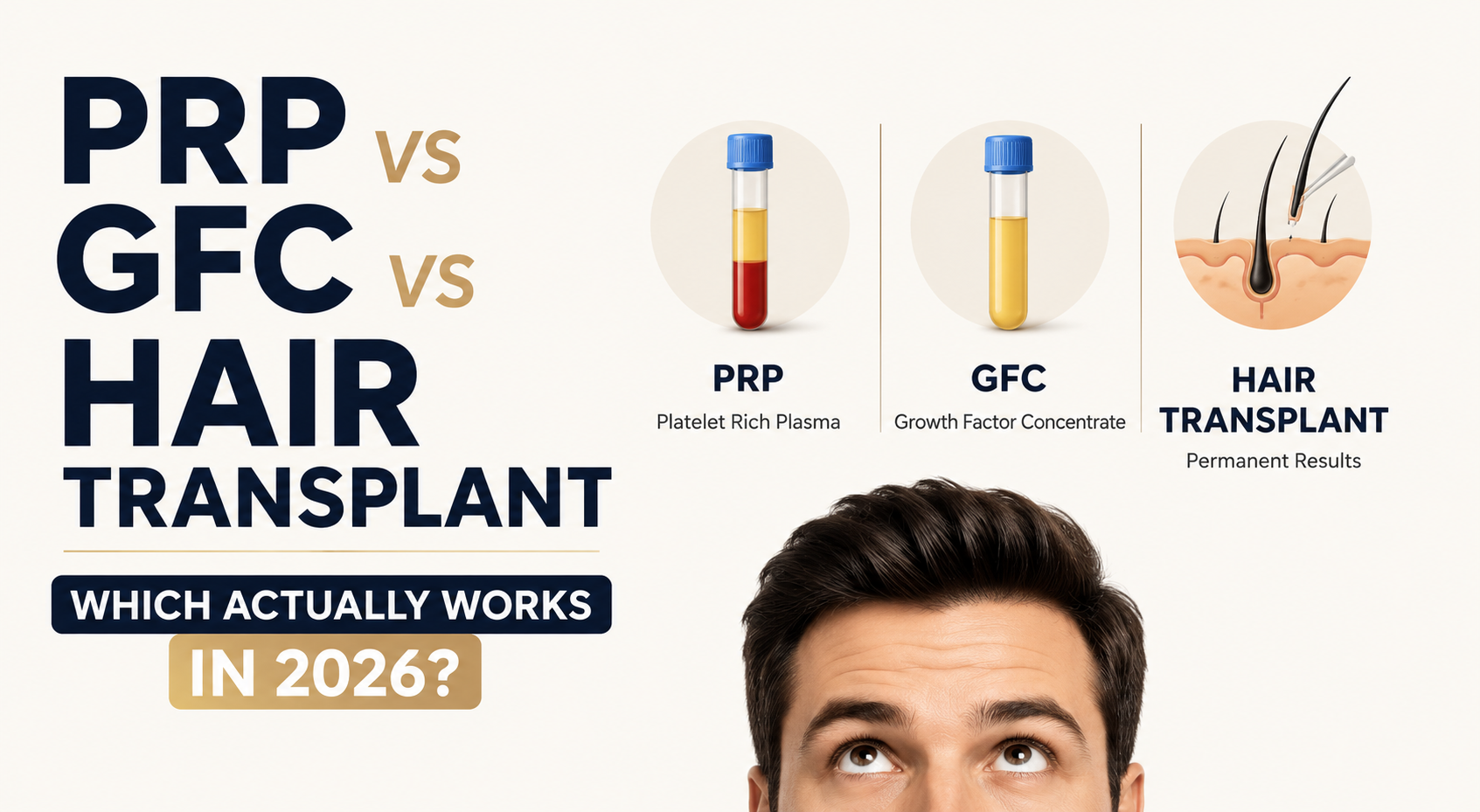
- GFC (Growth Factor Concentrate) — Assure's preferred non-surgical option for PCOS hair thinning. Delivers concentrated growth factors (PDGF, VEGF, EGF) directly to follicles, stimulating dormant growth. 3-4 sessions, 4 weeks apart. Highly effective for Ludwig Stage I-II.
- PRP — older-generation equivalent to GFC. Effective but less concentrated. Still a valid option.
- Nutritional supplementation — Biotin, ferritin (iron), vitamin D, vitamin B12, and zinc are commonly deficient in PCOS and should be corrected before evaluating hair treatment response.
- Low-level laser therapy (LLLT) — adjunct option for stimulating follicle activity. Works best as a complement to GFC or minoxidil.
Dr. Abhishek Pilani's approach for PCOS patients at Assure:
"I always look at the full picture — trichoscopy findings, blood panel (androgens, ferritin, vitamin D, B12, insulin), and symptom duration. PCOS hair loss is rarely a single-mechanism problem. The most effective results come from treating the androgen excess medically while supporting the follicles directly with GFC or a similar intervention."
Hair Transplant for PCOS Hair Loss — Is It an Option?
Hair transplant is a valid option for women with PCOS-related hair loss — but only under specific conditions.
When a transplant is appropriate:
- Hair loss is stable — no active, progressive shedding. PCOS must be under hormonal control before transplant is considered.
- Donor hair density is adequate — women with PCOS typically have thicker, more viable donor hair at the back and sides of the scalp
- Loss is patterned and predictable — not diffuse across the entire scalp (which may indicate the donor area is also at risk)
- Patient is committed to ongoing hormonal management post-transplant
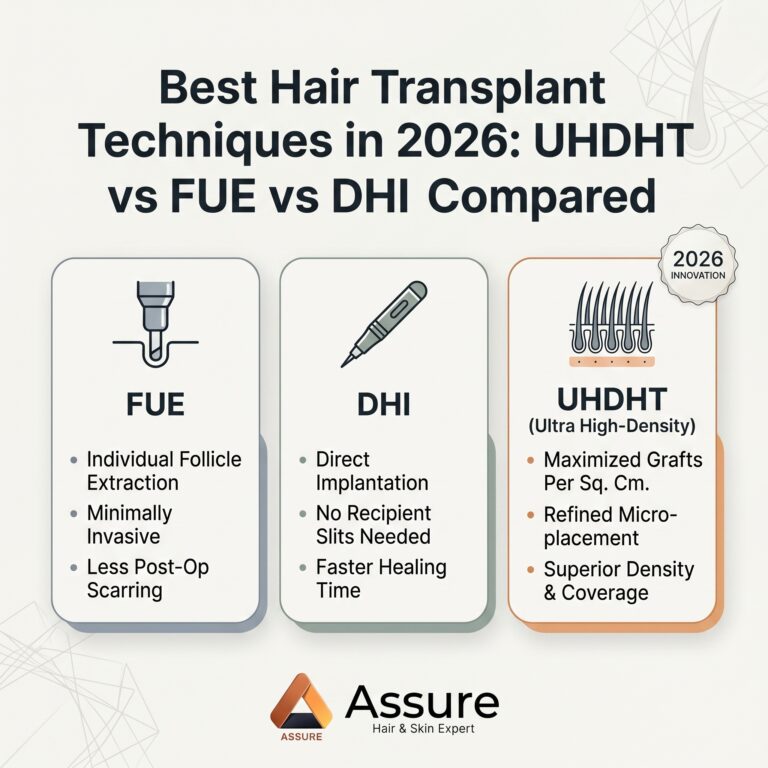
Assure's UHDHT method for women: Assure's UHDHT (Ultra High Density Hair Transplant) technique — using UFME extraction (0.7-0.8mm micro-punch) and DSHI implantation — is suitable for women with PCOS-related alopecia at Ludwig Stage II+ where non-surgical treatment has reached its limits.
The advantage of the UHDHT approach for women: the smaller extraction punch preserves donor density, critical for women who cannot afford visible scarring at the donor site.
Important: Hair transplant treats the lost area — it does not fix the underlying PCOS hormonal imbalance. Without ongoing management, transplanted areas remain safe (donor hair is DHT-resistant) but surrounding native hair may continue thinning. This is why hormonal control is a prerequisite, not optional.
Can PCOS Hair Loss Be Reversed?
The honest answer: partial reversal is achievable; complete reversal depends on stage and timeline.
What can be reversed:
- Miniaturization at early stages (Ludwig I-II) — GFC and anti-androgen therapy can stop miniaturization and thicken existing strands
- Telogen effluvium component — resolves when trigger (stress, deficiency) is addressed
- Nutritional deficiency component — resolves fully with supplementation
What cannot be reversed without surgical intervention:
- Follicles that have been dormant for several years and are no longer producing hair
- Significant density loss at Ludwig Stage III
The key message: start early. Every month of untreated PCOS hair loss represents more follicles advancing from miniaturization toward dormancy. The window for non-surgical reversal is real — but it closes.
Frequently Asked Questions
Is hair loss a symptom of PCOS?
Yes. Hair loss — specifically female pattern androgenetic alopecia — is one of the classic symptoms of PCOS alongside irregular periods, acne, weight gain, and excess facial hair. It affects an estimated 70-80% of women with PCOS to varying degrees.
How do I know if my hair loss is from PCOS?
PCOS hair loss typically presents as diffuse crown thinning, a widened parting, and hair miniaturization. It usually coexists with other PCOS symptoms. A dermatologist can confirm via trichoscopy; blood tests (androgens, insulin, DHEAS) and gynecological evaluation confirm the PCOS diagnosis.
Will treating PCOS stop hair loss?
Treating PCOS — through hormonal therapy, anti-androgens, and insulin-sensitizing medications — removes the androgen excess driving follicle miniaturization. This stops progression and can trigger partial recovery. But existing hair loss often requires direct treatment (GFC, minoxidil, or transplant) for meaningful improvement.
Does minoxidil work for PCOS hair loss?
Yes. Topical minoxidil (2-5%) is the most evidence-backed topical treatment for female androgenetic alopecia, including PCOS-related loss. It extends the anagen (growth) phase and increases follicle size. Results appear at 4-6 months with consistent daily use.
Can I get a hair transplant if I have PCOS?
Yes, under the right conditions. PCOS must be under hormonal control (stable hair loss, not progressing), donor hair density must be adequate, and the loss pattern must be predictable. Assure's UHDHT method is suitable for women with PCOS at Ludwig Stage II+ where non-surgical options are insufficient.
Does PCOS hair loss grow back on its own?
Rarely, without intervention. PCOS hair loss is androgen-driven and progressive if the hormonal imbalance is not addressed. Spontaneous regrowth is uncommon — treatment is required.
What vitamins help with PCOS hair loss?
Correcting nutritional deficiencies that commonly accompany PCOS improves hair loss response: iron (ferritin above 70 ng/mL), vitamin D, vitamin B12, and zinc. Biotin supplementation is commonly used but its effect is primarily relevant if you are biotin-deficient. Always test before supplementing.
How long does it take to see improvement in PCOS hair loss?
Timeline depends on treatment: GFC shows improvement at 8-12 weeks after the first 3-4 session cycle. Hormonal treatment (anti-androgens, OCPs) takes 6-12 months to reduce the androgen load enough for visible improvement. Minoxidil shows results at 4-6 months. Combining approaches produces faster outcomes.
Take the Next Step
PCOS hair loss is manageable — but it requires an accurate diagnosis, a structured approach, and patience. Generic hair loss shampoos and biotin gummies will not address androgen-driven follicle miniaturization.
At Assure Clinic, consultations for women with suspected PCOS hair loss include trichoscopy evaluation, a review of your hormonal history, and a personalized treatment recommendation. Our Medical Consultants work with 60+ qualified doctors trained under Dr. Abhishek Pilani's protocols.
India: +91 95861 22444 | WhatsApp: wa.me/919586122444 | Dubai: +971 547 370 350
Last Updated: April 2026 Medically Reviewed by Dr. Abhishek Pilani, MBBS MD Dermatology (Gold Medalist), ISHRS Member, DHA Licensed