
Turkey or India for a Hair Transplant?
Medically reviewed by Dr. Abhishek Pilani, MBBS, MD Dermatology (Gold Medalist), ISHRS Member, Founder of Assure Clinic. Reviewed October 2026.
Turkey has become the default answer to hair transplant cost, and for understandable reasons: the packages are cheap, they are all-inclusive on paper, and they are marketed better than almost anything in Indian healthcare. If you are reading this from India or the Gulf, you have almost certainly seen the four-day itinerary, the airport pickup, and the five-star hotel bundled into a single price.
This page is not an argument that Turkey is bad. Turkey has excellent surgeons, and it also has an industrialised low-cost tier that behaves very differently. The question worth answering is not which country is better. It is what the quoted price includes, who will actually be holding the instruments, and what happens if something needs fixing a year later. Those three questions separate a good outcome from an expensive lesson in either country.
We have an unusual source for this. One of our patients, Varaprasad Shetty, a professional living in Dubai, had shortlisted Turkish clinics, chosen one, and was close to booking when he stopped. He later had his procedure with us, and we recorded a full conversation about how he made that comparison. It runs 41 minutes and he is not coached.
Varaprasad Shetty Almost Booked Turkey
Varaprasad’s hair loss started after moving to Dubai, which he attributes to some mix of water, stress and late nights. He tried the usual first: oil massages, home remedies, a year and a half of watching a previous treatment fail to change anything. Then he began researching transplants seriously, shortlisted two Turkish clinics, narrowed to one, and got as far as a schedule.
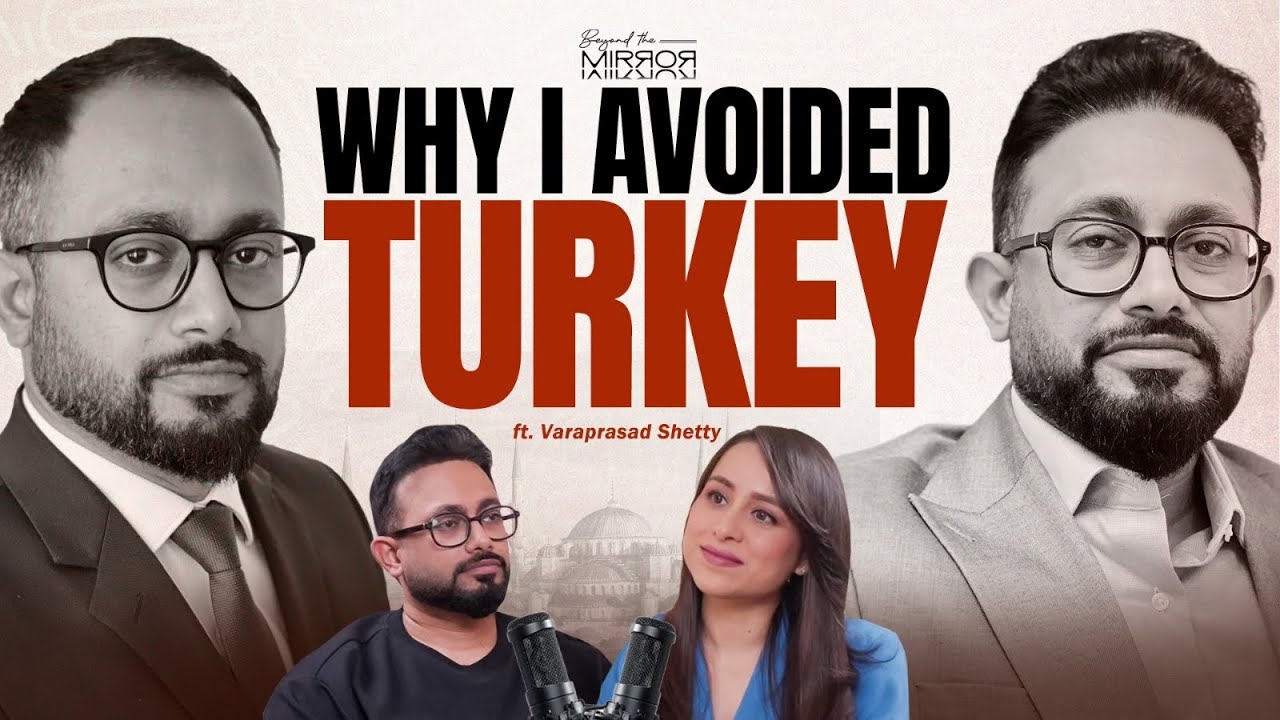
Three things changed his mind, and none of them were the headline price.
The quote did not include what happens afterwards
When he asked whether the package covered post-procedure medication, the answer was no. In his account, aftercare medication was quoted separately and presented as optional. That is his experience of one quote, and yours may differ. The pattern is what matters: the number that gets advertised and the number you actually pay are often different numbers, and the gap sits in the things you cannot skip.
This is not unique to Turkey. Indian clinics quoting per graft do the same thing, which is why we quote one fixed plan instead. But it is worth knowing that “all-inclusive” is a marketing phrase, not a definition, and the only way to test it is to ask what is excluded, in writing, before paying anything.
Four days, then a flight home
The schedule he was given ran roughly: a day of testing, a day of surgery, a day of recovery, then cleaning appointments, then fly home. His discomfort was straightforward and, we think, correct. As he puts it, when you see a doctor you generally expect to be able to go back to that doctor. A schedule built around a return flight is built around logistics, not around your recovery.
Hair transplant results are not visible in four days, or four weeks. The shedding phase, the crawl of early regrowth, and the first honest assessment of density are spread across months, and every one of those checkpoints is a conversation with the person who operated on you. Our own published patient journeys document months 1, 3, 6, 8, 10 and 12 for exactly this reason.
The second procedure problem
The point he makes most sharply concerns coverage. If a first procedure addresses only the frontal area and the crown needs work later, someone who travelled abroad has to travel abroad again, or start over with a new surgeon who has no record of what was done. Hair loss is progressive. Planning for one procedure in isolation is planning for half the problem.
What the Comparison Actually Looks Like
Setting marketing aside, here is how the two options differ on the things that determine outcomes.
| What you are comparing | The Turkey package model | A doctor-led procedure in India |
|---|---|---|
| Headline price | Lower, bundled with travel and hotel | Higher on the sticker, no travel bundled |
| What sits outside the quote | Commonly aftercare medication, sometimes PRP and follow-ups. Ask explicitly | Varies by clinic. Ours is a fixed plan agreed at consultation |
| Who performs the extraction and implantation | Varies widely. In the high-volume tier, technicians do much of the work | Varies by clinic. At Assure Clinic, a qualified doctor, never a technician |
| Follow-up over the first year | Remote, or requires flying back | In person, at whichever of our 13 clinics is nearest |
| If a second session is needed | Another flight, or a new surgeon with no record of the first procedure | Same team, same records, planned as part of the original strategy |
| If something goes wrong | Cross-border, with limited practical recourse | Accountable locally, under Indian medical regulation |
The Technician Question Nobody Raises Upfront
The most consequential difference between a good and a poor hair transplant is not the technique name in the brochure. It is who makes the incisions, at what angle and density, and how the grafts are handled between extraction and placement.
The International Society of Hair Restoration Surgery has been explicit that patients should establish who will actually perform their surgery, because in some clinics the physician’s involvement is limited. Their patient guidance is worth reading before booking anywhere, in any country: see ishrs.org. The surgical literature makes the same point from the other direction, documenting how complications and poor growth trace back to handling and technique rather than to the marketing category of the procedure. See Kerure and Patwardhan, Complications in Hair Transplantation.
“Every follicle is a vital biological resource that must be managed with surgical thrift,” says Dr. Abhishek Pilani. “The donor area does not grow back. Whoever is handling it should be qualified to make that judgement, and you are entitled to know their name before you pay.”
What a Hair Transplant Costs in India
For the comparison to be useful you need a real number on the Indian side. Indian clinics that charge per graft typically quote between ₹25 and ₹100 per graft depending on technique and city. At those rates a 3,000-graft procedure works out between ₹75,000 and ₹3,00,000 before add-ons, and that base figure usually excludes OT charges, medication, PRP and follow-ups.
Assure Clinic does not price per graft, for the reason above: charging by graft count rewards taking more grafts than the patient needs from a donor area that is finite. Our Full Head Results pricing runs from ₹2 lakh to ₹15 lakh, fixed at your consultation and based on the coverage you actually need. You can see your likely band in about a minute with our cost estimator.
When Turkey Is Genuinely the Right Choice
An honest page has to include this section. Turkey is the right answer for some people.
- You have found a specific surgeon, not a package. If you can name the doctor, verify their credentials and ISHRS membership, confirm they personally perform the surgery, and see their own long-term cases, Turkey has skilled practitioners.
- You are travelling anyway and can return. Follow-up is the weak point. If returning is genuinely easy for you, that weakness shrinks.
- Your case is small and well-defined. A limited hairline procedure on a stable pattern carries less planning risk than advanced or progressive loss.
- You have costed the whole thing. Flights, hotel, aftercare medication, time off work, and the possibility of a second session. If that total still beats a local all-inclusive quote, the maths is the maths.
What we would caution against is choosing a country instead of choosing a surgeon. The failure cases we see in repair consultations are rarely about geography. They are about nobody being accountable for the plan.
Questions to Ask Any Clinic, in Either Country
- Who physically performs the extraction and the implantation, and what are their qualifications?
- What is excluded from this quote? Ask for the exclusions in writing, not the inclusions.
- What does follow-up look like at months 1, 3, 6 and 12, and what does it cost?
- What is the plan if my hair loss progresses and I need a second session?
- Can I see month-by-month photographs of your own patients, including the awkward middle months?
- What happens, specifically, if the result is poor at twelve months?
A clinic that answers all six plainly is a reasonable bet in Istanbul or in Indore. A clinic that deflects on any of them is a risk at any price.
The Standard We Publish
Assure Clinic publishes complete month-by-month photographic journeys with written patient consent, including the unflattering middle months, and records unscripted conversations with patients about how they chose. Every procedure is performed by a qualified doctor, never a technician, across 13 clinics in India and Dubai.
If you are weighing Turkey against India right now, the most useful next step is a real assessment of your own scalp rather than another comparison article. Book a consultation, or call +91 95861 22444.
Frequently Asked Questions
Book Your Consultation
Fill in your details and our specialists will reach out to you shortly.
Book an Appointment
Contact us to book an appointment at any of our 13 clinics.
