
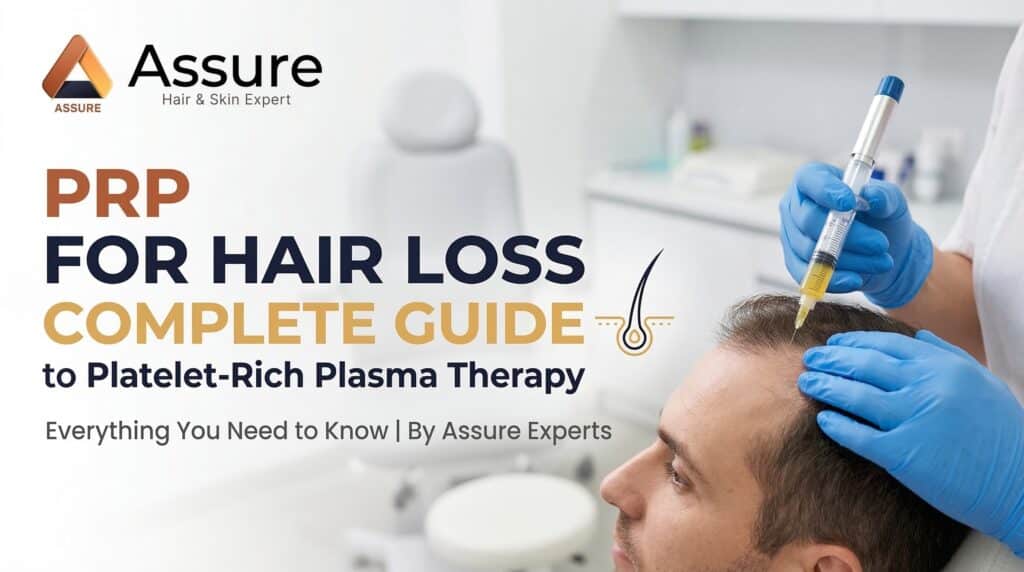
Platelet-Rich Plasma (PRP) therapy has become one of the most discussed non-surgical treatments for hair loss. It is used both as a standalone treatment and in combination with hair transplant surgery. But what does it actually do, who does it benefit, and how does it fit into an overall hair restoration plan?
This guide explains PRP therapy for hair loss in clear, clinical terms what the evidence says, what results to realistically expect, and how it is used at Assure Clinic.
What is PRP Therapy?
PRP stands for Platelet-Rich Plasma. It is a concentration of platelets derived from your own blood. Platelets are blood cells that play a central role in healing they contain growth factors that signal the body to repair tissue and stimulate cell regeneration.
In PRP therapy for hair loss, these growth factors are delivered directly to the scalp with the goal of stimulating dormant or weakened follicles, improving blood supply to the hair root, and slowing the miniaturisation process associated with androgenetic alopecia.
Because PRP is derived from the patient’s own blood, it is classified as autologous meaning it uses your own biological material and carries no risk of rejection or allergic reaction.
How PRP Therapy Works The Process
Step 1: Blood Draw
A small volume of blood (approximately 20–30ml) is drawn from the patient, typically from the arm exactly as it would be for a routine blood test.
Step 2: Centrifugation
The blood is placed in a centrifuge machine that spins at high speed, separating the blood components by density. This separates plasma (the liquid portion) from red blood cells. The plasma is then processed further to produce a concentrated platelet-rich fraction.
Step 3: Activation
In some protocols, the PRP is activated with calcium chloride or thrombin to trigger release of the growth factors. In other protocols, activation occurs naturally on injection.
Step 4: Scalp Injection
The PRP is injected directly into the scalp at the level of the hair follicles, typically using a series of microinjections across the treatment area. The procedure takes approximately 45–60 minutes.
A local anaesthetic cream or injected local anaesthesia is applied before the injections to minimise discomfort. Most patients describe the sensation as mild pressure or a prickling feeling rather than significant pain.
What Are the Growth Factors in PRP?
The effectiveness of PRP therapy is attributed to a range of growth factors released by platelets, including:
- PDGF (Platelet-Derived Growth Factor): Stimulates cell proliferation and blood vessel formation
- TGF-β (Transforming Growth Factor Beta): Modulates hair follicle cycling
- VEGF (Vascular Endothelial Growth Factor): Promotes blood vessel development around follicles
- EGF (Epidermal Growth Factor): Stimulates epithelial cell growth
- IGF-1 (Insulin-like Growth Factor): Promotes hair follicle activity and length of the growth phase
The combined effect of these growth factors on the scalp is to improve the biological environment around the follicle enhancing blood supply, reducing inflammation, and potentially extending the anagen (active growth) phase of affected follicles.
What Does the Evidence Say?
The evidence base for PRP in hair loss is growing, though research quality varies. The most consistent findings from clinical studies support:
- Significant improvement in hair density and thickness in patients with androgenetic alopecia (male and female pattern hair loss) after a series of PRP sessions
- Slowing of hair loss progression in patients with active androgenetic alopecia
- Improved graft survival and accelerated growth when PRP is used in combination with hair transplant surgery
- Increased hair count per unit area compared to control groups in randomised studies
It is important to be honest about the limits of current evidence: PRP is not a cure for androgenetic alopecia. It does not reverse advanced baldness. Its effects are most pronounced in patients with early to moderate hair loss where follicles are weakened but still viable. It is a treatment for thinning, not for areas that are already bald.
Who Benefits Most from PRP?
PRP therapy is most effective for:
1. Early to moderate androgenetic alopecia (male or female)
Patients who are experiencing active thinning hair that is becoming progressively finer and less dense are the best candidates. PRP can slow or partially reverse this process by supporting the biological health of affected follicles.
2. Patients who are not yet suitable candidates for a hair transplant
Younger patients in their early-to-mid 20s, or patients whose hair loss is not yet advanced enough to warrant surgery, can use PRP as a proactive maintenance treatment while they monitor progression.
3. Post-hair transplant patients
PRP used in combination with hair transplant surgery improves graft survival and may accelerate the growth timeline. At Assure Clinic, PRP is routinely recommended in the post-operative period for patients whose scalp condition or donor density suggests they would benefit.
4. Patients with non-scarring alopecia
Beyond androgenetic alopecia, PRP has shown benefit in some studies for alopecia areata (patchy autoimmune hair loss) and chronic telogen effluvium (diffuse shedding). Evidence is less consistent here, and results vary.
Considering a hair transplant? Our qualified doctors at Assure Clinic Mumbai can assess your situation no pressure, no obligation. Book a free consultation →
Who is Not a Good Candidate?
PRP may not be appropriate for:
– Patients with active scalp infection or inflammation
– Patients taking blood thinners (anticoagulant medication)
– Patients with blood disorders affecting platelet function
– Patients with very advanced androgenetic alopecia (areas that are fully bald with no remaining follicular activity)
– Patients with active autoimmune conditions or in active cancer treatment
A medical assessment before starting PRP treatment is essential to confirm suitability.
PRP as a Standalone Treatment vs. Combined with Hair Transplant
PRP alone:
PRP as a standalone treatment is most suitable for patients with early hair loss who want to slow progression and improve existing hair density. Results are typically gradual and require a committed series of sessions. It is a maintenance and supportive treatment not a replacement for hair transplant surgery in patients with significant hair loss.
PRP combined with hair transplant:
The combination of PRP with hair transplant surgery is where the evidence is most compelling. PRP injected into the recipient area at the time of surgery (or immediately post-procedure) improves graft survival by enhancing blood supply to the newly placed follicles. It also supports the surrounding miniaturised hairs helping existing hair in the thinning areas respond better to the new environment created by the transplant. For a comparison of surgical techniques, see our FUE vs DHI guide.
At Assure Clinic, we discuss PRP as an adjunct treatment for eligible patients, particularly those with miniaturised hairs in the thinning areas that may respond positively to growth factor stimulation alongside the surgical procedure.
What Results Should You Realistically Expect?
From a standalone PRP programme:
– Reduced hair shedding is typically noticed after 1–3 sessions
– Increased hair thickness and density becomes visible after 3–6 months of treatment
– Hair count improvements of 20–40% have been documented in controlled studies
– Results are not permanent maintenance sessions are required to sustain them
From PRP combined with a hair transplant:
– Improved graft survival (higher percentage of transplanted follicles establishing successfully)
– Potentially faster early growth (some patients notice regrowth emerging earlier than the typical Month 3–4 window)
– Improved condition of surrounding miniaturised hairs
How Many Sessions Are Required?
A typical initial PRP programme consists of 3–4 sessions, spaced 4–6 weeks apart. This induction phase is followed by maintenance sessions every 3–6 months to sustain results.
The frequency and duration of maintenance depends on the individual patient’s response and the degree of ongoing androgenetic alopecia.
PRP at Assure Clinic
Our team offers PRP and hair transplant in Mumbai as part of a comprehensive hair restoration approach not as a standalone marketing product. Our medical team assesses whether PRP is appropriate for your specific situation, explains what realistic results look like for your case, and recommends it only when the evidence supports it for your hair loss pattern and stage.
PRP is not a substitute for hair transplant surgery where surgery is appropriate. It is a valuable adjunct and a standalone option for patients at earlier stages of hair loss who are not yet surgical candidates.
Assure Clinic has been providing PRP treatments since 2015, with 60+ qualified doctors across 14 centres in India and Dubai delivering treatments under consistent clinical protocols. Learn more about our PRP treatment services.
Frequently Asked Questions
Is PRP painful?
The injections are performed after topical or local anaesthesia. Most patients describe mild pressure or a brief prickling sensation. Post-procedure tenderness is minimal and resolves within a day or two.
How long does a PRP session take?
Including the blood draw, centrifugation, and injection, a typical session takes 45–60 minutes.
When will I see results?
Reduction in shedding can be noticed after 1–3 sessions. Visible improvement in density and thickness typically becomes apparent after 3–6 months of treatment.
Can I get PRP if I am also using minoxidil?
Yes, PRP and minoxidil are compatible and are often used together. PRP works through a different mechanism and the two treatments can complement each other.
Is PRP a permanent solution?
PRP improves hair density and slows loss, but androgenetic alopecia is a progressive condition. Without maintenance sessions, the effects diminish over time as the underlying process continues.
How is Assure Clinic’s PRP different from other clinics?
The key variables in PRP quality are: the concentration of platelets achieved (which depends on the centrifuge protocol), the injection technique, and the clinical judgement about which patients are appropriate candidates. At Assure Clinic, PRP is administered by qualified doctors using a validated protocol not by technicians.
Can PRP reverse baldness?
No. PRP can support and improve follicles that are weakened but still viable. It cannot restore follicles that have been completely lost from a fully bald area. For areas of complete baldness, hair transplant surgery is the appropriate approach.
Is PRP Right for You?
The best way to determine whether PRP therapy is appropriate for your hair loss situation is a consultation with our medical team. We will assess your hair loss pattern, stage, and underlying causes and give you an honest recommendation about whether PRP alone, hair transplant surgery, a combination approach, or a different treatment entirely is the right pathway for you.
Ready to Take the Next Step?
Book a free consultation with our team of 60+ qualified doctors across 14 clinics. We’ll assess your situation honestly and only recommend what’s right for you.
Explore more:
– Best Hair Transplant in Mumbai →
– See Before & After Results →
– Find a Clinic Near You →
