
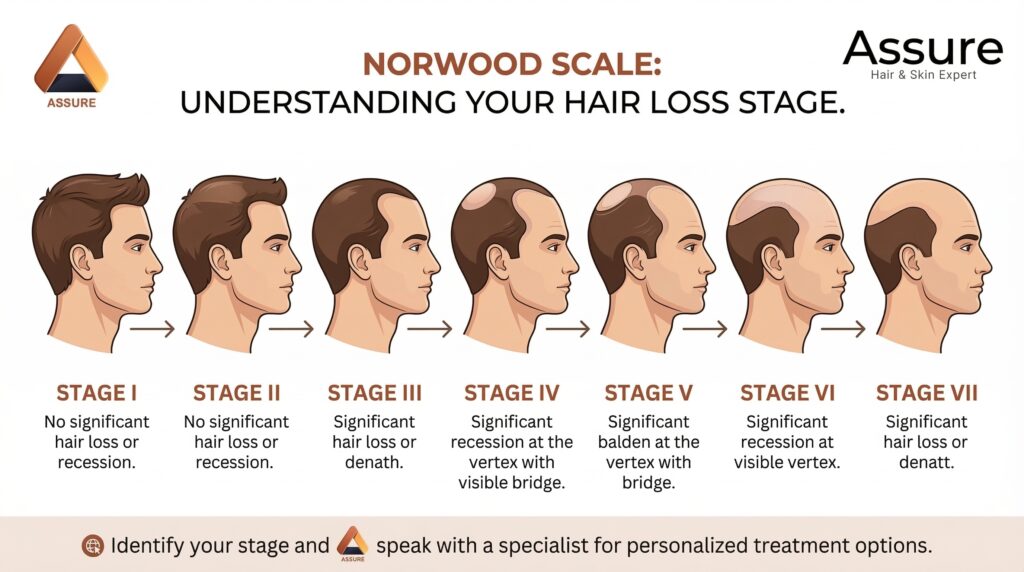
If you have been researching hair loss or hair transplants, you have almost certainly come across the term “Norwood Scale.” It is the standard classification system used by hair restoration specialists worldwide to describe the progression of male pattern baldness and knowing your Norwood stage is one of the most useful pieces of information you can have when planning a hair restoration strategy.
This guide explains each stage of the Norwood Scale in detail, how to identify which stage you are at, and what treatment options are most appropriate at each level.
What is the Norwood Scale?
The Norwood Scale (formally the Hamilton-Norwood Scale) was first developed by Dr. James Hamilton in the 1950s and later refined by Dr. O’Tar Norwood in the 1970s. It classifies male androgenetic alopecia (male pattern baldness) into seven stages based on the pattern and extent of hair loss.
The scale is used by hair restoration surgeons, dermatologists, and trichologists globally because it provides a shared language for describing hair loss severity, planning treatment, and setting realistic expectations for outcomes.
Norwood Scale: All 7 Stages Explained
Stage 1 No Significant Hair Loss
At Norwood Stage 1, there is no visible hairline recession and no thinning. The hairline is at its natural, youthful position typically 7–8cm above the eyebrows at the midpoint, following a natural curve across the forehead.
Most men in their late teens and early 20s fall into Stage 1, though some remain here throughout adulthood.
Treatment: No treatment is typically necessary. Monitoring is appropriate if there is a strong family history of early hair loss.
Stage 2 Hairline Maturation / Slight Recession
At Stage 2, minor recession at the temples begins the corners of the hairline pull back slightly. This is sometimes called “hairline maturation” because a degree of temporal recession is a normal part of adult male hairline development. Not all Stage 2 progression leads to significant further loss.
Some men remain at Stage 2 for decades or for life. Others progress rapidly through subsequent stages. The trajectory is determined by genetics and individual DHT sensitivity.
Treatment: Medical management (finasteride, minoxidil) is worth considering at this stage for men with a strong family history or rapid early progression. Hair transplant surgery is not typically recommended at Stage 2.
Stage 3 First Significant Recession
Stage 3 marks the point at which hair loss becomes more clearly visible. The temporal recession deepens, creating a distinctive M-shaped or V-shaped frontal hairline. The areas of recession at the temples may be thinning or entirely bald.
Stage 3 is where many men first seek professional advice. The change is visible in photographs and in mirrors and often is noticed by others.
Stage 3 Vertex Variant: Some men show the Stage 3 pattern at the crown rather than (or in addition to) the front a round patch of thinning or baldness developing at the vertex. This is classified as Stage 3 Vertex.
Treatment: Medical management is strongly recommended at Stage 3 to slow progression. Hair transplant surgery can be considered particularly for the hairline but must be planned conservatively in younger men to account for ongoing loss.
Stage 4 Moderate Hair Loss
At Stage 4, hair loss is well established across two distinct zones: the frontal/temporal recession and the crown thinning. A band of hair separates these two areas, but both zones are clearly thinning or bald.
Stage 4 is one of the most common stages at which men present for hair transplant consultation. The hair loss is visually significant and has typically been progressing for several years.
Treatment: Hair transplant surgery is often the right option at Stage 4. Donor supply is usually adequate to address both the frontal zone and the crown. A phased approach (addressing the frontal hairline first, then the crown in a subsequent session) is often recommended to use donor hair strategically. Compare FUE and DHI techniques to understand which approach suits your situation.
Stage 5 Significant Hair Loss
At Stage 5, the band of hair separating the frontal and crown loss areas has thinned and narrowed. The two areas of hair loss are beginning to merge, and the overall bald area has expanded substantially. Hair on the sides of the scalp remains, but the top of the scalp is significantly affected.
Treatment: Hair transplant surgery remains viable at Stage 5 in patients with adequate donor density. The total graft requirement increases significantly at this stage, and planning must account for optimal donor allocation prioritising areas of maximum cosmetic impact. Medical management is important post-surgery to protect remaining native hair.
Stage 6 Advanced Hair Loss
At Stage 6, the frontal and crown bald areas have merged fully. The previously separating bridge of hair is gone. The top and front of the scalp are largely bald, with a clear horseshoe outline of remaining hair beginning to form at the sides and back.
Hair transplant planning at Stage 6 requires careful donor management. The total bald area is large relative to available donor supply, so not all areas can necessarily be fully restored in a single phase. Strategic planning focusing on the frontal third to frame the face produces the most cosmetically significant improvement with available grafts.
Treatment: Surgery is possible at Stage 6 with experienced teams and adequate donor density. A thorough consultation to set realistic expectations is essential.
Stage 7 Most Advanced Stage
Stage 7 represents the most advanced form of male pattern baldness. Only a narrow horseshoe band of hair remains at the back and sides of the scalp. The entire top surface, from hairline to crown, is bald. The remaining donor hair may itself be relatively fine.
Hair transplant surgery at Stage 7 is technically possible but significantly constrained by donor supply. The amount of bald area to cover relative to available donor hair means that full coverage is typically not achievable. Realistic outcomes involve restoring a framed, natural-looking hairline and front section, with the understanding that full coverage is not the goal.
Some Stage 7 patients choose scalp micropigmentation (SMP) as a complementary approach to create the appearance of density in areas not covered by transplanted hair.
Treatment: Surgery is possible with specialist planning. Expectations must be carefully calibrated. Medical management to preserve remaining donor area density is important.
Norwood Scale Summary Table
| Stage | Pattern | Key Feature | Typical Treatment |
|---|---|---|---|
| 1 | No loss | Normal hairline | Monitoring |
| 2 | Slight temporal recession | Minor corner pullback | Medical management if high risk |
| 3 | M-shaped recession | First clearly visible change | Medical management + possible surgery |
| 3V | Crown thinning | Vertex patch developing | Medical management + surgery |
| 4 | Frontal + crown loss, separated | Two distinct zones | Surgery often appropriate |
| 5 | Zones narrowing | Bridge thinning | Surgery with strategic planning |
| 6 | Zones merged | Full top baldness | Surgery with realistic expectations |
| 7 | Horseshoe only | Most advanced | Surgery with constraints |
Considering a hair transplant? Our qualified doctors at Assure Clinic Mumbai can assess your situation no pressure, no obligation. Book a free consultation →
How to Identify Your Norwood Stage
Self-assessment of your Norwood stage is possible using good lighting and two mirrors one facing you and one held at the back to give you a top-down view of the crown. Photographs taken from above and from the front in natural light give the clearest picture of the overall pattern.
However, self-assessment has limitations:
– The early stages (2 and 3) can be difficult to distinguish without comparison to historical photographs
– Crown thinning (Vertex variant) is often underestimated because it is not visible face-on
– The density of remaining hair can obscure the pattern hair length and styling affect what the underlying scalp shows
A proper clinical assessment by a qualified dermatologist provides a more accurate classification and can distinguish between a genuine Stage 2 and a stable hairline maturation, between Stage 3 and 4, and between androgenetic alopecia and other causes of hair loss. You can also use our Norwood classification tool or baldness calculator for an initial estimate before your consultation.
Why Your Norwood Stage Matters for Hair Transplant Planning
Your Norwood stage is one of the most important inputs in hair transplant planning:
Graft count estimation: The size of the bald area (determined partly by your stage) influences how many grafts are needed to achieve target density. Larger bald areas require more grafts.
Donor allocation strategy: Available donor hair is finite. In lower Norwood stages (3–4), a single session may be sufficient. In higher stages (5–7), the donor hair must be allocated strategically across phases.
Future-proofing the design: In younger patients with lower current Norwood stages but a family history of Stage 6–7, the hairline design must account for anticipated future loss. A hairline designed purely for the current Stage 3 pattern can look unnatural at Stage 5 or 6 without the expected surrounding hair to frame it.
Realistic outcome expectations: Stage 3 and 4 patients can typically achieve full, natural-looking coverage. See our hair transplant results timeline for what to expect month by month. Stage 6 and 7 patients have a larger bald area relative to donor supply and the expectation should be significant improvement with a good cosmetic result, not necessarily complete coverage of the entire bald zone.
Frequently Asked Questions
What is the Norwood Scale used for?
It is used by hair restoration specialists to classify the severity and pattern of male androgenetic alopecia, guide treatment planning, set patient expectations, and track progression over time.
Is my hair loss definitely androgenetic alopecia if I fit a Norwood stage?
The Norwood Scale specifically describes the pattern of androgenetic alopecia. If your hair loss follows the M-shape recession or crown thinning pattern described by the Norwood stages, it is consistent with male pattern baldness. However, a clinical assessment is needed to rule out other causes of hair loss (thyroid disorders, nutritional deficiencies, alopecia areata) particularly if loss is rapid or does not follow the typical Norwood pattern.
Is there a Norwood Scale for women?
No women’s pattern hair loss typically follows the Ludwig Scale, which describes diffuse thinning across the crown rather than the recession-and-patching pattern of male androgenetic alopecia. Read our women’s hair transplant guide for how female hair loss is assessed and treated.
Can I slow or stop Norwood progression?
Medical treatments (finasteride, minoxidil) can significantly slow progression. Some patients remain stable at their current stage for years with appropriate medical management. However, the underlying genetic predisposition cannot be eliminated.
At what Norwood stage should I consider a hair transplant?
Most hair restoration specialists recommend considering surgery from Stage 3 onwards, provided the patient is 28+ and the loss pattern has reached a degree of stability. At Stage 2, medical management is typically the starting point.
Can a Stage 7 patient get a hair transplant?
Yes, but with important caveats. Available donor supply limits how much area can be covered, and expectations should be set accordingly. Results can still be meaningful and cosmetically significant, but full coverage of the entire bald area is typically not achievable.
Next Step: Know Your Stage, Then Plan
The Norwood Scale is not a sentence it is a map. Knowing your stage gives you the information you need to make an intelligent, well-planned decision about how to address your hair loss.
At Assure Clinic, every consultation begins with a precise scalp assessment that determines your Norwood stage, evaluates donor density, and builds a personalised treatment plan based on where you are and where you want to be. We have helped men at every stage of the Norwood Scale since 2015 with 20,000+ procedures completed by 60+ qualified doctors across 14 centres in India and Dubai. Visit our hair transplant clinic in Mumbai for a personalised Norwood assessment.
Ready to Take the Next Step?
Book a free consultation with our team of 60+ qualified doctors across 14 clinics. We’ll assess your situation honestly and only recommend what’s right for you.
Explore more:
– Best Hair Transplant in Mumbai →
– See Before & After Results →
– Find a Clinic Near You →
