
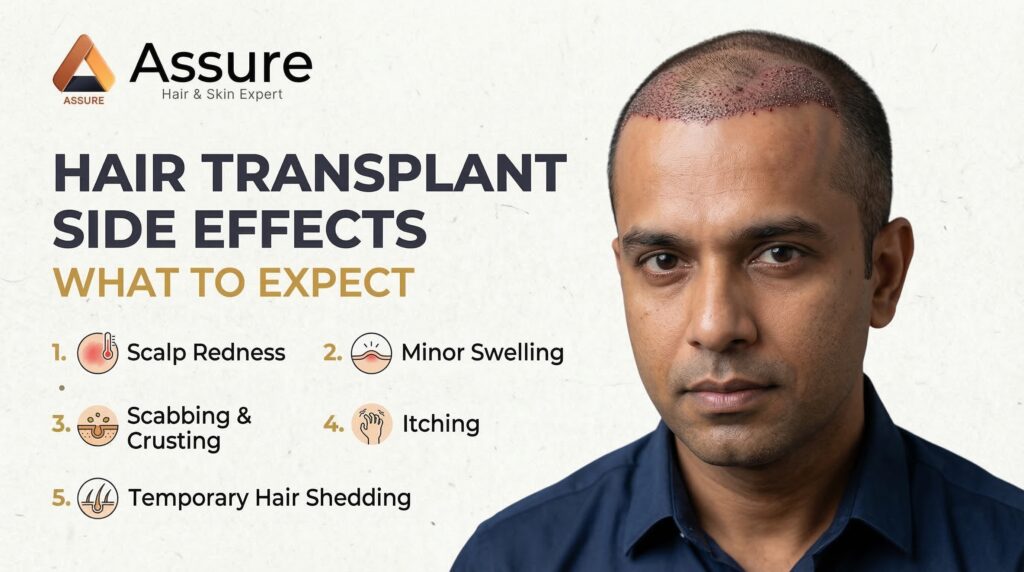
An honest question deserves an honest answer. Hair transplant surgery like any medical procedure involves a recovery period and a set of expected side effects. Most are temporary, predictable, and manageable. A small subset are uncommon but worth knowing about.
This guide covers both the normal side effects that virtually every patient experiences, and the rarer complications that can occur when a procedure is not performed correctly. Understanding both gives you a complete picture of what to expect before, during, and after your procedure.
Normal and Expected Side Effects
These are the standard responses that occur as part of the body’s healing process. They are expected, manageable, and resolve without treatment in most cases.
1. Redness and Swelling
Redness in both the recipient area (where grafts were implanted) and the donor area (where follicles were extracted) is a completely normal inflammatory response. It typically peaks on Day 1–2 and fades significantly within the first week.
Swelling, when it occurs, tends to concentrate around the forehead and above the eyebrows particularly for hairline work. This is because fluids from the procedure migrate downward due to gravity. Sleeping with your head elevated at 45 degrees for the first 5 days significantly reduces swelling.
Timeline: Resolves by Day 5–7 in most cases.
2. Scalp Tenderness and Sensitivity
Some degree of scalp tenderness is expected in both the donor and recipient areas during the first week. The scalp may also feel tighter or less sensitive than usual a temporary effect of local anaesthesia and the healing process.
Timeline: Resolves within 7–14 days.
3. Scab Formation
Small scabs form around each implanted graft within 24–48 hours of the procedure. This is a normal part of the healing process the scabs protect the graft as the surrounding skin closes around it. They detach naturally within 10–14 days with gentle washing.
It is important not to pick or scratch scabs manually. Premature removal can dislodge the graft underneath.
Timeline: Scabs detach naturally within 10–14 days.
4. Itching
Itching in the recipient and donor areas is a sign that healing is progressing. It is one of the more uncomfortable side effects particularly in the first two weeks but is normal and does not indicate a problem.
Do not scratch. If the itching is severe, contact your clinical team for guidance on safe management (such as a prescribed antihistamine).
Timeline: Typically fades after 2–3 weeks.
5. Shock Loss (Temporary Shedding)
During Months 1–3, most patients experience a shedding of the newly transplanted hairs. Known as shock loss or telogen effluvium, this occurs because the transplanted follicle enters a resting phase after being relocated. The hair shaft sheds, but the follicle remains alive beneath the skin and grows back.
This is the side effect that concerns patients most because it occurs precisely when they are looking for signs of success. The important thing to understand is that shock loss is expected, temporary, and does not indicate procedure failure.
In most cases, new hair growth from the affected follicles begins at Month 3–4. Full density builds through Month 9–12. See our hair transplant results timeline for a month-by-month breakdown.
Timeline: Shedding from Months 1–3; regrowth begins Month 3–4.
6. Donor Area Numbness
A degree of numbness or reduced sensation in the donor area is common in the first 2–4 weeks. This results from minor disruption of surface nerve endings during extraction and resolves as the tissue heals.
Timeline: Typically resolves within 4–8 weeks.
7. Minor Bleeding
Minimal bleeding at the graft sites or donor area during the first 24 hours is normal. Applying gentle pressure as directed is usually sufficient. If bleeding persists beyond 24 hours or is significant, contact your clinical team.
Uncommon Side Effects
These side effects can occur but are not the typical experience. Their frequency is largely determined by the skill of the surgical team and the quality of post-operative care.
8. Infection
Infection following a hair transplant is uncommon when standard sterile protocols are followed. Signs of infection include increased pain, pus or unusual discharge, significantly worsening redness after Day 3–4, or fever.
If you notice these signs, contact your clinical team promptly. Infections are treatable with antibiotics when identified early.
Prevention: All Assure Clinic procedures are performed in sterile clinical environments, and patients are given appropriate prophylactic antibiotics post-operatively.
9. Folliculitis
Folliculitis small, pimple-like bumps around the transplanted follicles can occur in the weeks following a procedure. It represents mild inflammation of the follicle and usually resolves on its own. In some cases a short course of antibiotics or topical treatment is prescribed.
10. Ingrown Hairs
As transplanted hairs begin to grow back, some may become ingrown curling back into the skin rather than growing outward. This is more common in patients with naturally coarser or curlier hair. It typically resolves without intervention, though clinical treatment may be needed in persistent cases.
11. Scarring in the Donor Area
With FUE-based techniques, individual tiny circular marks remain in the donor area where each follicle was extracted. With standard punch sizes (0.9–1.2mm), these are generally visible only with very close inspection of a shaved scalp.
Assure Clinic’s UFME technique uses a 0.6–0.8mm punch significantly smaller than the industry standard. This reduces the visibility of donor area marks and allows the area to heal with minimal trace.
Keloid scarring (raised, thickened scar tissue) can very rarely occur in patients with a genetic predisposition to keloids. A thorough pre-operative assessment should identify this risk factor.
12. Cyst Formation
In a small number of cases, small cysts can form in the recipient area as transplanted hairs begin to grow. These are typically benign and resolve independently or with minor intervention. They are more likely when grafts are implanted at an incorrect depth.
13. Shock Loss in Existing Hair
Beyond shedding of transplanted hairs, the trauma of surgery can occasionally trigger temporary shedding of existing hair near the transplant area. This is usually temporary and the hair regrows, but it can affect the immediate cosmetic appearance during recovery.
Considering a hair transplant? Our qualified doctors at Assure Clinic Mumbai can assess your situation no pressure, no obligation. Book a free consultation →
Rare but Serious Risks
These are genuinely rare and typically associated with clinics that do not follow appropriate surgical standards.
Graft Failure (Poor Survival)
If a significant percentage of transplanted grafts do not survive, the procedure will not deliver the expected result. Graft survival depends heavily on:
– Handling technique and time outside the body
– Surgeon skill and graft damage during extraction
– Appropriate implantation depth and angle
– Blood supply to the recipient area
At Assure Clinic, our measured graft survival rate is 95% achieved through doctor-only procedures, minimal graft handling time, and our patented UFME and DSHI techniques.
Necrosis (Tissue Death)
In extremely rare cases, insufficient blood supply to the recipient area can cause localised necrosis. This is a serious complication and is almost always associated with poor surgical technique, over-harvesting of the donor area, or underlying blood supply problems not identified pre-operatively.
Unnatural Appearance
A technically successful hair transplant that is designed poorly can produce an unnatural result including hairlines that look artificial, density that does not match surrounding hair, or grafts implanted at the wrong angle. This is an outcomes risk associated with inexperience or inadequate pre-operative planning, not a biological side effect.
Side Effects to Watch For: When to Contact Your Clinic
Contact your clinical team if you experience:
– Bleeding that does not stop with gentle pressure within 24 hours
– Signs of infection: pus, significant fever, worsening pain after Day 4
– Extreme swelling that does not begin to reduce by Day 5
– Complete absence of any new growth by Month 6–7
– Any concerning symptom not covered in your post-operative instructions
Frequently Asked Questions
Are the side effects of a hair transplant permanent?
The routine side effects redness, swelling, scabbing, shock loss, itching, tenderness are all temporary. Permanent side effects are rare and almost exclusively associated with poor technique or unaddressed complications.
How painful is a hair transplant?
The procedure is performed under local anaesthesia, so there is no pain during surgery. Post-operatively, most patients report mild tenderness or discomfort rather than significant pain. Standard over-the-counter pain relief is usually sufficient.
Can a hair transplant go wrong?
A poorly planned or executed hair transplant can produce unsatisfactory results. This is why the choice of clinic and surgeon matters enormously. Assure Clinic offers corrective procedures for patients who have experienced unsatisfactory results from other providers.
Do side effects differ between FUE and DHI?
The core side effects are similar for both techniques. DHI may involve slightly less bleeding at the recipient site (because incision and implantation are simultaneous), but the overall recovery experience is broadly similar.
Will I have a scar after the procedure?
With FUE-based techniques, tiny extraction marks remain in the donor area. With Assure Clinic’s UFME technique (0.6–0.8mm punch), these are significantly smaller than those left by standard FUE and are not visible to the naked eye on a normal hair length.
What is the biggest risk with a hair transplant in India?
The biggest risk is choosing a clinic where the procedure is performed by technicians rather than qualified doctors. This elevates the risk of poor graft survival, unnatural results, and preventable complications. Always verify who is physically performing your procedure. Learn how to choose the right hair transplant clinic.
A Note on Expectations
Every patient’s recovery experience is individual. Some patients sail through with minimal discomfort; others find certain phases particularly shock loss psychologically difficult. Both responses are normal.
The most important factor in managing side effects well is preparation. Knowing what to expect, having a clear post-operative care plan, and maintaining regular contact with your clinical team throughout recovery significantly reduces both the physical and psychological difficulty of the process.
At an experienced hair transplant clinic in Mumbai and across our 14 centres, every Assure Clinic patient receives structured post-operative support with follow-up appointments at key milestones. We are available throughout your recovery not just on the day of the procedure.
Ready to Take the Next Step?
Book a free consultation with our team of 60+ qualified doctors across 14 clinics. We’ll assess your situation honestly and only recommend what’s right for you.
Explore more:
– Best Hair Transplant in Mumbai →
– See Before & After Results →
– Find a Clinic Near You →
