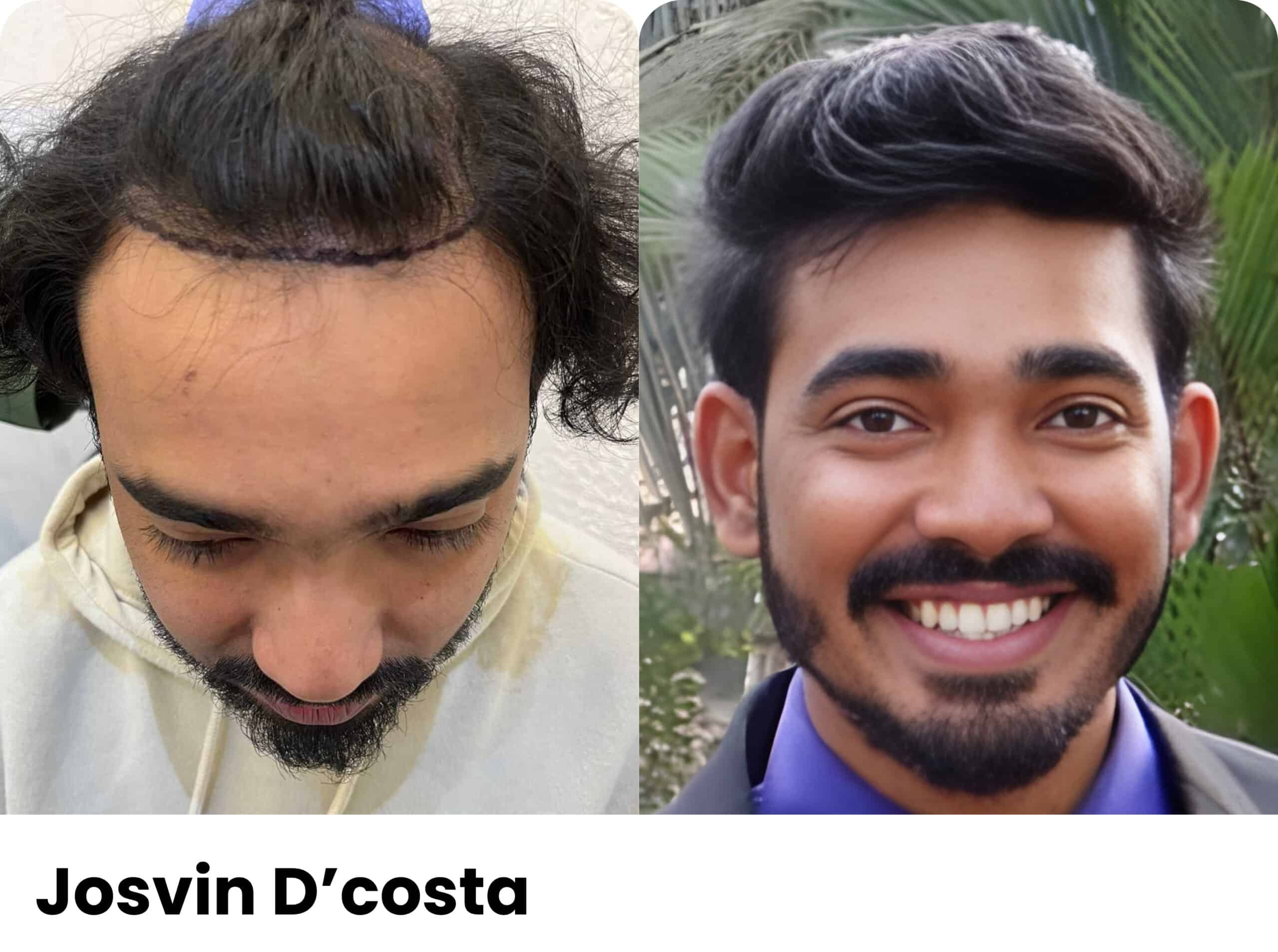
Moving abroad changes everything -- your career, your lifestyle, your environment. For Joswin D'Costa, it also changed his hair. After relocating from Mangalore to Dubai, he watched helplessly as severe hair fall accelerated year after year. By 31, with a Norwood Stage 6 classification and years of failed home remedies behind him, he made the decision that transformed not just his appearance but his entire outlook on life.
| Name | Joswin D'Costa |
| Age | 31 at time of procedure |
| Gender | Male |
| Location | Dubai (originally from Mangalore, India) |
| Profession | Purchase Manager -- Disposable Packaging Manufacturing |
| Hair Loss Type | Androgenetic Alopecia (strong genetic predisposition) |
| Norwood Grade | Stage 6 |
| Previous Treatment | Coconut oil, home remedies -- no medical treatments |
| Graft Count | 6000+ |
| Sessions | 4 |
| Technique | UHDHT (UFME extraction + DSHI implantation) |
| Results Timeline | 10 months |
Joswin D’Costa works as a Purchase Manager in a disposable packaging manufacturing company in Dubai. Originally from Mangalore, India, he moved to the UAE seeking better professional opportunities. The career transition was successful. The impact on his hair was not.
Shortly after arriving in Dubai, Joswin started experiencing severe hair fall — far worse than anything he had faced back home in India. The signs were impossible to ignore:
Within four to five years, what had started as unusual hair fall had progressed into significant balding.
While genetic predisposition was the underlying cause — Joswin had a strong family history of hair loss — the environmental shift to Dubai appears to have accelerated the process dramatically. Contributing factors included:
The combination of genetic vulnerability and environmental triggers created a rapid progression that caught Joswin off guard.
At 31, Joswin was living through what should be the most confident years of a man’s life. Instead, hair loss was casting a shadow over every aspect of his experience.
For a man between 25 and 32, the social stakes are uniquely high. Professional networking, social image, and matrimonial prospects are all influenced by appearance. Joswin felt this pressure acutely:
“When everything is ready but your hair doesn’t look right — it becomes a setback.”
The frustration was compounded by the fact that every other aspect of his life was on track — career, finances, social circle. Hair loss was the one problem that undermined everything else.
Before considering a transplant, Joswin did what most men do first: he turned to traditional remedies.
The outcome was the same story that millions of men experience: no significant improvement. The hair fall continued unabated.
The realization came slowly but definitively:
“When hair loss is genetic, these methods don’t reverse it.”
Coconut oil and home remedies can support general scalp health. They can nourish existing hair. But they cannot override genetic programming that causes follicles to miniaturize and die. For androgenetic alopecia, the only long-term solution is relocating DHT-resistant follicles to the affected areas — which is precisely what a hair transplant does.
Making the decision to undergo a hair transplant was not instantaneous. Joswin had genuine concerns:
His mother was concerned about safety — a natural maternal response to the idea of a surgical procedure. His father, after understanding the situation more fully, became supportive.
Ultimately, Joswin made the decision based on his own assessment:
“Proceed based on personal need — not external pressure.”
Several factors influenced his final choice:
| Treatment Detail | Value |
|---|---|
| Technique | UHDHT method — UFME extraction + DSHI implantation |
| Graft Count | 6000+ |
| Sessions | 4 (spread over multiple days) |
| Performing Doctor | Dr. Harshi, trained under protocols established by Dr. Abhishek Pilani (MBBS, MD Dermatology, Gold Medalist, ISHRS Member) |
| Clinic | Assure Clinic, Dubai |
The UHDHT technique combines two specialized components:
With 6000+ grafts required for his Norwood Stage 6 classification, the multi-session approach was essential. Spreading the work across four sessions allowed:
The procedure itself was smooth, with minimal discomfort. Initial recovery was straightforward, and Joswin was able to return to his routine quickly.
Joswin’s results unfolded over a clear timeline:
| Before | After |
|---|---|
| “I’m losing hair every day” | “My hair is growing back” |
| Stress and overthinking | Relief and positivity |
| Avoiding people and photographs | Looking forward to feedback |
| Low confidence | Self-assured |
“Earlier it was depressing… now it feels like I’m getting something back.”
Joswin’s story addresses several situations that are increasingly common among Indian professionals abroad:
Many men with genetic predisposition experience dramatically accelerated hair loss after moving to regions with different water quality and climate conditions. Dubai’s mineral-rich water, extreme heat, and environmental stressors can push a slow genetic process into rapid progression. Understanding this pattern helps expats make informed decisions earlier.
Coconut oil, home remedies, and lifestyle adjustments have genuine value for scalp health. But they cannot reverse androgenetic alopecia. Joswin’s experience mirrors that of millions of men who spend years on approaches that cannot address the underlying genetic mechanism.
Hair loss between ages 25 and 32 carries a disproportionate emotional weight. These are the years when professional identity, social networks, and personal relationships are being built. The confidence impact during this period is not cosmetic — it affects life trajectory.
Joswin specifically chose a clinic where qualified doctors performed the procedure, not technicians. This distinction matters enormously for outcomes, particularly in complex cases requiring 6000+ grafts where precision and graft survival rates determine the final result.
“Do it for yourself. Not because someone says it — because you feel it.”
“You don’t have to fight every battle in life, especially when there’s a solution.”
Learn about hair transplant cost or browse our before and after results.
20,000+ procedures. High graft survival. 60+ qualified doctors. Book a free consultation today.
Expert guide by Dr. Abhishek Pilani covering causes, treatments, and when to consider a hair transplant. Trusted by 10,000+ readers.