Key Takeaways
- Dry scalp is a moisture-deficiency condition where the skin produces insufficient natural oils, affecting roughly 20-30% of adults at any given time (Journal of Dermatological Treatment, 2020).
- Dry scalp and dandruff are different conditions: dry scalp produces small, white, powdery flakes from dehydrated skin, while dandruff produces larger, oily, yellowish flakes from fungal overgrowth.
- Chronic dry scalp left untreated can contribute to hair thinning, as persistent inflammation and scratching weaken follicles and push them into the telogen (shedding) phase prematurely.
- Evidence-based ingredients like hyaluronic acid, glycerin, ceramides, and coconut oil can restore scalp moisture in 2-4 weeks when used consistently.
- If dry scalp persists beyond 4 weeks of home treatment, a dermatologist evaluation is essential to rule out psoriasis, seborrheic dermatitis, or underlying nutritional deficiencies.
Introduction
Dry scalp is a condition in which the skin on the head loses moisture faster than it can replenish it, resulting in tightness, flaking, itching, and irritation. According to the International Journal of Trichology, scalp dryness is one of the most underdiagnosed contributors to chronic itching and cosmetic hair concerns, affecting people across all age groups and climates.
If you have been dealing with a tight, itchy scalp that sheds fine white flakes onto your clothes, you are likely experiencing dry scalp rather than dandruff. While the two conditions look similar on the surface, they have different causes, different underlying mechanisms, and require very different treatment approaches. Confusing them is one of the most common mistakes people make, and using dandruff shampoo on a dry scalp can actually make the problem worse.
This comprehensive guide covers everything you need to know about dry scalp: what causes it, how to distinguish it from dandruff and other scalp conditions, the best treatments backed by clinical evidence, and when it is time to see a specialist. Dr. Abhishek Pilani, MBBS MD Dermatology (Gold Medalist, Pramukhswami Medical College) and ISHRS Member, explains that across 20,000+ cases at Assure Clinic, many patients presenting with hair thinning initially overlook scalp health as a contributing factor. Addressing dry scalp early can prevent unnecessary hair fall and create optimal conditions for stronger, healthier hair growth.
Take the Free 2-Minute Hair Loss Assessment
Answer 5 quick questions and get your personalized Norwood grade plus treatment recommendations from our doctors.
Start Free Assessment →By the end of this article, you will have a clear understanding of your scalp condition and a practical treatment plan to fix it.
What Is Dry Scalp?
Dry scalp occurs when the skin on your head does not retain enough moisture. Unlike the rest of your body, your scalp has one of the highest concentrations of sebaceous (oil) glands. When these glands underperform, or when external factors strip away the scalp’s natural lipid barrier, the result is dryness, micro-cracking of the skin surface, and visible flaking.
The scalp’s outermost layer, the stratum corneum, functions as a barrier that locks in moisture and keeps irritants out. When this barrier is compromised, trans-epidermal water loss (TEWL) increases, leading to the cycle of dryness, irritation, and flaking that characterises dry scalp.
A 2018 study in Skin Research and Technology measured TEWL rates across different body sites and found that the scalp, despite its high sebum production, is particularly vulnerable to barrier disruption from chemical exposure, thermal damage, and environmental stressors.
What Causes Dry Scalp?
Understanding the root cause of your dry scalp is essential for choosing the right treatment. Here are the most common triggers.
1. Dehydration and Poor Nutrition
Your scalp needs adequate water intake and essential fatty acids to maintain its moisture barrier. Dehydration reduces blood flow to the skin, while deficiencies in omega-3 fatty acids, zinc, and vitamin B complex directly impair sebum production. A study in the Journal of Cosmetic Dermatology (2019) found that participants with low omega-3 intake had 40% higher rates of scalp dryness compared to those meeting recommended levels.
2. Cold, Dry Weather
Winter months and low-humidity environments are the leading seasonal trigger for dry scalp. Cold air holds less moisture, and indoor heating systems further reduce ambient humidity. The Indian Journal of Dermatology reports that dermatology clinics see a 35-45% increase in scalp dryness complaints between November and February.
3. Harsh Hair Products
Sulphate-based shampoos (sodium lauryl sulphate and sodium laureth sulphate) strip the scalp’s natural oils aggressively. Alcohol-based styling products, chemical hair dyes, and keratin treatments can also damage the lipid barrier. According to the International Journal of Cosmetic Science, sulphate-free shampoos reduce scalp dryness markers by up to 25% compared to traditional formulations.
4. Hot Water and Overwashing
Washing your hair with water above 40 degrees Celsius dissolves the scalp’s protective sebum layer. Combined with washing too frequently (daily or more), this creates a cycle where the scalp cannot rebuild its moisture barrier before the next wash strips it away again.
5. Overwashing and Underwashing
Both extremes cause problems. Overwashing strips oils; underwashing allows dead skin cells and product residue to accumulate, blocking the scalp’s natural moisturising process. For most people, washing 2-3 times per week strikes the right balance.
6. Skin Conditions
Eczema (atopic dermatitis), contact dermatitis, and mild psoriasis can all present initially as dry scalp. These conditions involve immune-mediated inflammation that disrupts the skin barrier at a deeper level than simple environmental dryness.
7. Age and Hormonal Changes
Sebum production naturally declines with age. Women experiencing menopause often notice increased scalp dryness due to dropping oestrogen levels, which regulate sebaceous gland activity. The British Journal of Dermatology (2017) documented that scalp sebum output decreases by approximately 23% per decade after age 40.
8. Medical Conditions and Medications
Hypothyroidism, diabetes, and autoimmune conditions can reduce skin hydration systemically. Medications including retinoids, diuretics, and certain acne treatments are also known to cause scalp dryness as a side effect.
Dry Scalp vs Dandruff: The Complete Comparison
This is the number one question people search when they notice scalp flaking, and getting it wrong leads to the wrong treatment. Dry scalp and dandruff are fundamentally different conditions.
Dry scalp is caused by a lack of moisture. The scalp does not produce enough oil, leading to tightness and small flakes.
Dandruff (seborrheic dermatitis) is caused by an overgrowth of the Malassezia fungus feeding on excess scalp oil. The scalp actually produces too much oil, and the fungal activity causes inflammation and larger, oily flakes.
Dry Scalp vs Dandruff Comparison Table
| Feature | Dry Scalp | Dandruff (Seborrheic Dermatitis) |
|---|---|---|
| Root cause | Moisture deficiency, impaired skin barrier | Malassezia fungal overgrowth on oily scalp |
| Flake size | Small, fine, powdery | Larger, clumped, irregular |
| Flake colour | White | White to yellowish |
| Flake texture | Dry, falls off easily | Oily, waxy, sticks to scalp and hair |
| Scalp appearance | Tight, dry, sometimes cracked | Red, inflamed, greasy patches |
| Itching | Mild to moderate | Moderate to severe |
| Oiliness | Scalp feels dry and tight | Scalp feels oily between washes |
| Seasonal pattern | Worse in winter/dry climates | Year-round, may worsen in humidity |
| Affected areas | Scalp only | Scalp, eyebrows, nasolabial folds, ears |
| Response to moisturiser | Improves significantly | No improvement or worsens |
| Response to antifungal | No improvement | Significant improvement |
| Hair impact | Mild thinning if chronic | Can cause notable hair fall from inflammation |
| Prevalence | 20-30% of adults seasonally | Up to 50% of adults at mild levels |
The Simple Test
Apply a light, fragrance-free scalp oil (like jojoba or argan oil) to a small area of your scalp before bed. If flaking improves by morning, you likely have dry scalp. If the area feels greasier and flaking continues or worsens, dandruff is more likely.
Dry Scalp vs Seborrheic Dermatitis vs Psoriasis
When scalp flaking is persistent and does not respond to basic moisturising, it is important to consider other conditions. Here is how the three most commonly confused scalp conditions compare.
Scalp Condition Comparison Table
| Feature | Dry Scalp | Seborrheic Dermatitis | Scalp Psoriasis |
|---|---|---|---|
| Cause | Moisture loss, barrier damage | Malassezia fungus + sebum | Autoimmune (overactive skin cell turnover) |
| Flakes | Small, white, powdery | Yellowish, greasy, clumped | Thick, silvery-white, large plaques |
| Scalp colour | Normal to slightly pale | Red, inflamed patches | Well-defined red/pink raised patches |
| Itching severity | Mild | Moderate to severe | Moderate to severe, sometimes painful |
| Bleeding when scratched | No | Rarely | Yes (Auspitz sign) |
| Location | Generalised across scalp | Oily areas: crown, hairline, behind ears | Patches, often at hairline and nape |
| Extends beyond scalp | No | Eyebrows, nose, ears | Elbows, knees, nails, lower back |
| Response to moisturiser | Significant improvement | Minimal improvement | Temporary relief only |
| Nail changes | None | None | Pitting, ridges, discolouration |
| Family history | Not relevant | Weak association | Strong genetic component (40% with family history) |
| Chronicity | Episodic, seasonal | Chronic, relapsing | Chronic, requires ongoing management |
| First-line treatment | Moisturising, barrier repair | Antifungal shampoo | Topical corticosteroids, vitamin D analogues |
If you notice thick, silvery plaques, bleeding upon scratching, or nail changes alongside your scalp condition, seek a dermatologist evaluation promptly. Psoriasis requires a different treatment pathway than either dry scalp or dandruff.
Can Dry Scalp Cause Hair Loss?
Yes. While dry scalp alone does not destroy hair follicles permanently, chronic dry scalp creates conditions that accelerate hair fall through several mechanisms.
The Inflammation Pathway
When the scalp’s moisture barrier is compromised, it becomes more susceptible to irritants, allergens, and microbial invasion. This triggers low-grade chronic inflammation around hair follicles (perifollicular inflammation). A study in the Journal of Investigative Dermatology (2011) found that even subclinical scalp inflammation was associated with a 15-20% reduction in hair density over time.
Scratching and Mechanical Damage
Dry scalp itches. Scratching is reflexive and often unconscious, particularly during sleep. The mechanical trauma of scratching:
- Loosens hairs already in the weakened telogen phase
- Creates micro-wounds that can become infected
- Damages the hair shaft near the root, causing breakage
- In severe cases, leads to traction-type damage at the follicle level
The International Journal of Trichology (2019) documented that patients with chronic scalp itch showed 25-30% more hair shedding compared to controls, independent of underlying hair loss conditions.
Follicle Environment Disruption
Healthy hair growth requires a well-hydrated, pH-balanced scalp environment with adequate blood flow. Chronic dryness:
- Alters scalp pH away from the optimal 4.5-5.5 range
- Reduces nutrient delivery to the hair bulb
- Creates an environment where opportunistic infections can take hold
- Can push follicles from anagen (growth) to telogen (resting/shedding) prematurely
The Good News
Unlike androgenetic alopecia (pattern baldness), hair loss from dry scalp is almost always reversible. Once the underlying dryness is treated and the scalp barrier is restored, hair growth cycles normalise within 3-6 months. If you are noticing hair fall alongside scalp dryness, addressing the scalp condition first is the critical first step.
For a deeper understanding of hair fall triggers beyond scalp conditions, see our comprehensive guide on hair fall reasons.
Dry Scalp Symptoms Checklist
Not sure if you have dry scalp? Review this symptom checklist.
- [ ] Tight, uncomfortable feeling on the scalp, especially after washing
- [ ] Small, fine white flakes that fall easily from the scalp
- [ ] Itching that worsens in cold or dry weather
- [ ] Scalp feels rough or papery to the touch
- [ ] Visible dryness or slight cracking on the scalp skin
- [ ] Hair feels dry, brittle, or straw-like at the roots
- [ ] Static electricity in hair, especially in winter
- [ ] Flaking worsens after using harsh shampoos or hot water
- [ ] Mild redness without the greasy, inflamed patches seen in dandruff
- [ ] Condition improves with oil application or moisturising products
Scoring: If you checked 5 or more, dry scalp is the most likely cause of your flaking. If itching is severe, flakes are large and yellowish, or the condition does not improve with moisturising, consult a dermatologist to rule out seborrheic dermatitis or psoriasis.
Best Dry Scalp Treatments
1. Medicated and Moisturising Shampoos
Switching to the right shampoo is the most impactful single change you can make. Look for sulphate-free formulations with humectants and barrier-repair ingredients.
What to look for: Shampoos containing glycerin, panthenol, hyaluronic acid, or ceramides. Avoid anything with sodium lauryl sulphate (SLS), alcohol, or strong fragrances.
How to use: Wash 2-3 times per week with lukewarm water (below 37 degrees Celsius). Massage the shampoo gently into the scalp for 60 seconds to allow active ingredients to absorb without aggressive scrubbing.
2. Scalp Moisturising Treatments
Leave-in scalp treatments and overnight masks deliver sustained hydration that rinse-off products cannot match.
Options include: Scalp serums with hyaluronic acid, overnight ceramide masks, and scalp-specific emollients. Apply directly to the scalp (not the hair length) after washing, focusing on the driest areas.
3. Scalp Oils
Natural oils can supplement the scalp’s lipid barrier when sebum production is insufficient.
Best oils for dry scalp: Coconut oil (penetrates the hair shaft and reduces protein loss by 39% according to the Journal of Cosmetic Science), jojoba oil (closest to natural sebum in composition), argan oil (rich in vitamin E and oleic acid), and sweet almond oil.
Application method: Warm a small amount between your palms, massage into the scalp in circular motions for 5 minutes, leave for 30 minutes to overnight, then wash with a gentle shampoo.
4. Humectant-Based Products
Humectants draw moisture from the environment into the scalp. They work best in moderate-humidity environments (40-60% relative humidity). In very dry climates, pair them with an occlusive layer to prevent moisture loss.
5. PRP Therapy for Scalp Health
For patients experiencing dry scalp alongside significant hair thinning, PRP (platelet-rich plasma) therapy can address both concerns simultaneously. PRP delivers concentrated growth factors directly to the scalp, promoting both tissue healing and hair follicle stimulation. At Assure Clinic, PRP therapy is performed by qualified doctors using standardised protocols across all 13 locations.
6. Professional Scalp Treatments
In-clinic treatments such as scalp hydration facials, LED light therapy, and prescription-strength barrier repair treatments can accelerate recovery for severe or persistent dry scalp. A dermatologist can also prescribe topical corticosteroids for short-term use if inflammation is significant.
Best Ingredients for Dry Scalp
Not all scalp care ingredients are created equal. Here is an evidence-based breakdown of the most effective ingredients for dry scalp treatment.
Dry Scalp Ingredient Guide
| Ingredient | How It Works | Best For | Evidence |
|---|---|---|---|
| Hyaluronic Acid | Holds up to 1,000x its weight in water; hydrates without greasiness | Lightweight hydration, all scalp types | Skin Pharmacology and Physiology (2017): improved skin hydration by 40% over 8 weeks |
| Glycerin | Humectant that draws water into the outer skin layer | Moderate dryness, best in humid climates | Most studied humectant; FDA-recognised skin protectant |
| Ceramides | Lipid molecules that repair the skin barrier between cells | Barrier repair, chronic dryness | Journal of Clinical and Aesthetic Dermatology: restored barrier function in 85% of subjects |
| Aloe Vera | Anti-inflammatory, contains polysaccharides that retain moisture | Itchy, irritated dry scalp | Skin Research and Technology (2008): significant improvement in skin hydration vs placebo |
| Coconut Oil | Penetrates hair shaft, reduces protein loss, antimicrobial (lauric acid) | Dry scalp with dry, brittle hair | Journal of Cosmetic Science: reduced protein loss by 39% |
| Shea Butter | Rich in fatty acids and vitamins A/E; occlusive moisture seal | Severe dryness, coarse/textured hair | Contains cinnamic acid esters with anti-inflammatory properties |
| Panthenol (Vitamin B5) | Provitamin that converts to pantothenic acid; improves barrier and hydration | All-round scalp health, post-wash | International Journal of Cosmetic Science: improved skin barrier recovery rate |
| Jojoba Oil | Structurally similar to human sebum; non-comedogenic | Oily roots with dry scalp (sebum regulation) | Forschende Komplementarmedizin: well-tolerated, stabilises skin lipids |
| Niacinamide (Vitamin B3) | Improves barrier function, reduces TEWL, anti-inflammatory | Sensitive, reactive scalp | Journal of Cosmetic Dermatology: reduced TEWL by 24% over 4 weeks |
| Tea Tree Oil (diluted) | Antimicrobial, anti-inflammatory, mild antifungal | Dry scalp with mild flaking or itch | Journal of the American Academy of Dermatology: effective at 5% concentration |
Important note: Essential oils like tea tree oil must always be diluted in a carrier oil (2-5% concentration). Never apply undiluted essential oils to the scalp, as they can cause chemical burns and worsen irritation.
Home Remedies for Dry Scalp That Actually Work
While medical treatments are the gold standard, several home remedies have genuine evidence supporting their use. Here are the ones worth trying.
1. Coconut Oil Scalp Massage
Evidence: The Journal of Cosmetic Science demonstrated that coconut oil is the only oil proven to reduce protein loss in hair, thanks to its low molecular weight and straight linear chain that allows it to penetrate the hair shaft. Its lauric acid content also provides antimicrobial benefits.
Method: Warm 2 tablespoons of virgin coconut oil, massage into the scalp for 5 minutes using circular motions, leave for 1-2 hours (or overnight with a towel on your pillow), then wash with a gentle shampoo.
2. Aloe Vera Gel Application
Evidence: Aloe vera contains over 75 active compounds including polysaccharides that form a moisture-retaining film on the skin. Skin Research and Technology (2008) confirmed its hydrating and anti-inflammatory properties.
Method: Apply fresh aloe vera gel (or 99% pure aloe gel) directly to the scalp. Leave for 30 minutes, then rinse with lukewarm water. Repeat 2-3 times per week.
3. Apple Cider Vinegar Rinse
Evidence: Apple cider vinegar has a pH of approximately 3.0-4.0, which can help restore the scalp’s natural acidic pH (4.5-5.5) when it has been disrupted by alkaline hair products. The International Journal of Dermatology notes that pH-balanced scalp care reduces flaking and irritation.
Method: Mix 1-2 tablespoons of apple cider vinegar in 1 cup of water. After shampooing, pour over the scalp, massage gently, wait 2-3 minutes, then rinse thoroughly. Use once per week.
4. Honey and Olive Oil Mask
Evidence: Honey is a natural humectant with antimicrobial properties. A study in the European Journal of Medical Research found that a mixture of honey and olive oil improved seborrheic dermatitis symptoms in 90% of patients.
Method: Mix 2 tablespoons of raw honey with 1 tablespoon of extra virgin olive oil. Apply to the scalp, leave for 20-30 minutes under a shower cap, then wash out thoroughly.
5. Oatmeal Scalp Soak
Evidence: Colloidal oatmeal is FDA-approved as a skin protectant. It contains beta-glucans that form a moisture-retaining film and avenanthramides with anti-inflammatory properties (Journal of Drugs in Dermatology, 2015).
Method: Blend fine oatmeal into a powder, mix with warm water to create a paste, apply to the scalp, leave for 15-20 minutes, then rinse. Ideal for sensitive, reactive scalps.
Remedies to Avoid
- Lemon juice: Too acidic (pH 2.0); can cause irritation and photosensitivity
- Baking soda: Too alkaline (pH 9.0); disrupts the scalp’s acid mantle
- Undiluted essential oils: Can cause chemical burns and contact dermatitis
- Garlic paste: Highly irritating, risk of chemical burns on compromised skin
Dry Scalp Prevention: 10 Practical Tips
Prevention is always easier than treatment. These habits maintain a healthy, hydrated scalp.
-
Wash 2-3 times per week with a sulphate-free, pH-balanced shampoo. Overwashing strips natural oils; underwashing allows buildup.
-
Use lukewarm water only. Hot water (above 40 degrees Celsius) dissolves the scalp’s protective lipid layer. Finish with a cool rinse to seal the cuticle and retain moisture.
-
Apply conditioner to the scalp, not just the hair. Contrary to popular belief, lightweight, non-comedogenic conditioners can benefit a dry scalp. Look for formulations with ceramides or panthenol.
-
Run a humidifier in winter. Keep indoor humidity between 40-60% to prevent environmental moisture loss from your skin and scalp.
-
Drink adequate water. The European Food Safety Authority recommends 2.5 litres daily for men and 2.0 litres for women. Dehydration affects skin hydration within 24-48 hours.
-
Eat omega-3 rich foods. Fatty fish (salmon, mackerel), walnuts, flaxseeds, and chia seeds provide essential fatty acids that support sebum production. See our guide on essential nutrients for hair health and best foods for healthy hair for complete dietary recommendations.
-
Limit heat styling tools. Blow dryers, straighteners, and curling irons applied near the scalp dehydrate the skin. If you must use them, keep the heat setting on low and maintain a 15 cm distance from the scalp.
-
Check your hair products. Read ingredient labels and eliminate products containing alcohol denat, isopropyl alcohol, sodium lauryl sulphate, or synthetic fragrances. Switch to fragrance-free, hypoallergenic alternatives.
-
Protect your scalp from the sun. UV exposure damages the skin barrier and accelerates moisture loss. Wear a hat or use a scalp-safe SPF spray when spending extended time outdoors.
-
Manage stress. Chronic stress increases cortisol, which impairs skin barrier function and can trigger or worsen scalp dryness. Regular exercise, adequate sleep, and stress management techniques all support scalp health.
When to See a Specialist
Home treatments work well for mild to moderate dry scalp. However, you should seek professional evaluation if:
- Symptoms persist beyond 4 weeks of consistent home treatment
- Flaking is accompanied by severe itching, pain, or bleeding
- You notice hair thinning or increased shedding alongside scalp dryness
- Red, scaly patches with well-defined borders appear (possible psoriasis)
- Thick, yellowish crusting develops (possible severe seborrheic dermatitis)
- Symptoms spread beyond the scalp to eyebrows, ears, or other body areas
- Over-the-counter products cause burning, stinging, or worsening symptoms
A qualified dermatologist can perform a scalp examination, trichoscopy (magnified scalp analysis), and if necessary, a scalp biopsy to establish an accurate diagnosis. This is particularly important because several conditions mimic dry scalp, and the wrong treatment can delay recovery by months.
If your dry scalp is accompanied by noticeable hair loss, it is worth investigating whether pattern baldness (androgenetic alopecia) is also present. These conditions frequently coexist, and addressing only the dry scalp will not resolve genetic hair thinning. Assure Clinic’s baldness calculator can help you assess your hair loss stage, while an in-person consultation provides a comprehensive scalp and hair analysis.
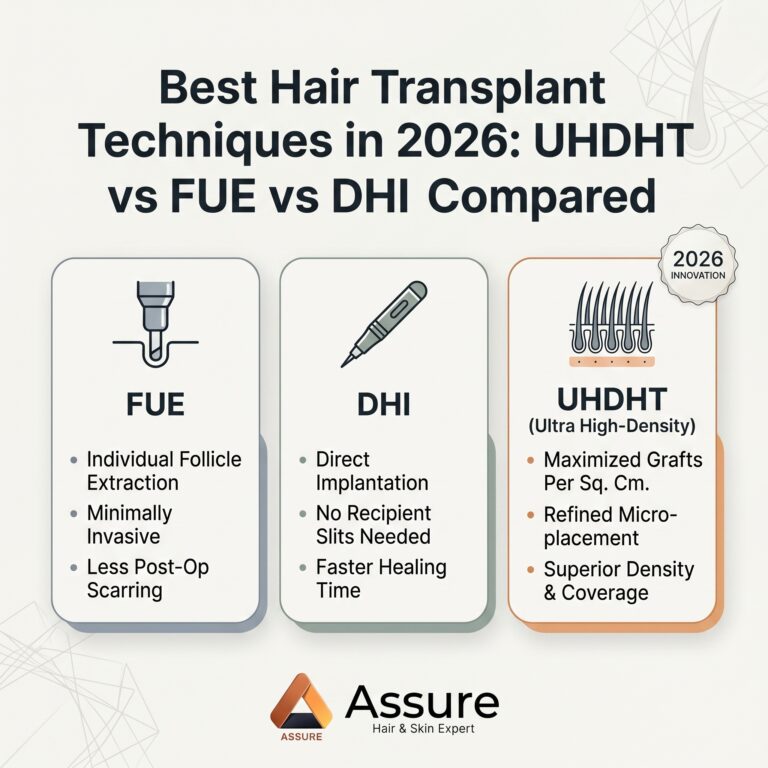
For patients where hair loss has progressed beyond what medical therapy can reverse, Assure Clinic offers advanced hair transplant solutions using the UHDHT method with exclusive UFME and DSHI techniques, achieving 60-80 grafts per square centimetre for natural-looking density.
Expert Opinion
“Dry scalp is one of the most overlooked contributors to hair quality issues that I see in clinical practice. Patients often focus on the hair itself, buying expensive serums and supplements, while ignoring the skin from which that hair grows. The scalp is skin. It needs hydration, barrier protection, and a balanced microbiome just like the skin on your face. When we restore scalp health at Assure Clinic, patients consistently report not just less flaking and itching, but stronger, shinier hair growth within 3-6 months. The key is accurate diagnosis first. Dry scalp, dandruff, and psoriasis each require fundamentally different treatment approaches, and what helps one can worsen another.”
— Dr. Abhishek Pilani, MBBS MD Dermatology (Gold Medalist, Pramukhswami Medical College), ISHRS Member, DHA Licensed | Founder, Assure Clinic (20,000+ procedures, 60+ qualified doctors)
Frequently Asked Questions (FAQs)
What is the fastest way to fix dry scalp?
The fastest approach combines a sulphate-free shampoo with an overnight coconut oil or jojoba oil treatment. Apply the oil before bed, wash with a gentle shampoo in the morning, and follow with a leave-in scalp serum containing hyaluronic acid. Most people notice improvement within 3-7 days. For severe dryness, a dermatologist can prescribe a topical emollient or short course of mild corticosteroids for rapid relief.
Is dry scalp the same as dandruff?
No. Dry scalp is caused by insufficient moisture (the scalp is too dry), while dandruff is caused by the Malassezia fungus thriving on excess oil (the scalp is too oily). Dry scalp produces small, white, powdery flakes; dandruff produces larger, yellowish, greasy flakes. The treatments are opposite: dry scalp needs moisturising, while dandruff needs antifungal treatment.
Can dry scalp cause permanent hair loss?
Dry scalp alone does not cause permanent hair loss. However, chronic dry scalp can lead to inflammation, scratching damage, and follicle weakening that causes temporary hair thinning. Once the dry scalp is treated, hair growth typically normalises within 3-6 months. If hair loss persists after scalp health is restored, androgenetic alopecia or another underlying condition may be responsible.
How often should I wash my hair if I have dry scalp?
Wash 2-3 times per week using a sulphate-free, pH-balanced shampoo and lukewarm water. Daily washing strips the scalp’s natural oils before they can rebuild the moisture barrier. On non-wash days, you can rinse with water only or use a co-wash (conditioner-only wash) to refresh without stripping.
Does drinking more water help dry scalp?
Yes, but it is only part of the solution. Systemic dehydration reduces skin hydration throughout the body, including the scalp. Drinking 2-2.5 litres of water daily supports overall skin hydration, but topical treatments are also necessary because water intake alone cannot fully address a compromised scalp barrier.
What is the best oil for dry scalp?
Coconut oil is the most evidence-backed option for dry scalp, with studies showing it reduces protein loss and has antimicrobial properties. Jojoba oil is the next best choice because its chemical structure closely mimics human sebum, making it well-tolerated even by sensitive scalps. For maximum benefit, warm the oil slightly before application and massage into the scalp for at least 5 minutes to stimulate blood flow.
Can dry scalp be a sign of a serious medical condition?
In some cases, yes. Persistent dry scalp that does not respond to moisturising treatments can indicate hypothyroidism, psoriasis, atopic dermatitis, or nutritional deficiencies (particularly zinc, vitamin D, and essential fatty acids). If your dry scalp is accompanied by fatigue, unexplained weight changes, or dry skin across your entire body, consult a doctor for blood work and a comprehensive evaluation.
Will anti-dandruff shampoo help dry scalp?
Usually not, and it can make things worse. Most anti-dandruff shampoos contain active ingredients like zinc pyrithione, ketoconazole, or selenium sulphide designed to combat fungal overgrowth. These ingredients can be drying and further strip moisture from an already dehydrated scalp. If you have dry scalp (not dandruff), switch to a sulphate-free moisturising shampoo instead.
How long does it take to treat dry scalp?
With consistent treatment (proper shampoo, scalp moisturising, and lifestyle adjustments), mild dry scalp typically resolves in 1-2 weeks. Moderate cases take 2-4 weeks. Severe or chronic dry scalp that has persisted for months may take 6-8 weeks of consistent treatment to fully resolve. If no improvement occurs within 4 weeks, seek a professional evaluation.
Can stress cause dry scalp?
Yes. Chronic stress elevates cortisol levels, which impairs skin barrier function, reduces sebum production, and increases inflammation throughout the body. A 2017 study in the Journal of Investigative Dermatology confirmed that psychological stress significantly increases trans-epidermal water loss, directly contributing to skin and scalp dryness. Managing stress through exercise, sleep hygiene, and relaxation techniques is an important component of comprehensive dry scalp treatment.
Conclusion
Dry scalp is a common, treatable condition that responds well to the right approach. The key is accurate diagnosis: confirm you are dealing with dry scalp (moisture deficiency) rather than dandruff (fungal overgrowth) or psoriasis (autoimmune), because each condition requires a different treatment pathway.
Start with the fundamentals: switch to a sulphate-free shampoo, wash 2-3 times per week with lukewarm water, incorporate a scalp oil or hyaluronic acid serum, and support your scalp from the inside with adequate hydration and omega-3 intake. For most people, these changes resolve dry scalp within 2-4 weeks.
If symptoms persist, if you notice hair thinning alongside scalp dryness, or if you want a professional assessment of your scalp and hair health, Assure Clinic’s team of 60+ qualified doctors across 13 locations provides comprehensive scalp analysis and personalised treatment plans.
Book your free consultation today. Call: +91 95861 22444
If dry scalp is causing shedding, layer hair fall control treatment alongside scalp care.