Hair Transplant After 1 Month: What to Expect (Month-by-Month)
You have just had your hair transplant. The first few weeks were a whirlwind of careful sleeping positions, gentle washing routines, and avoiding every urge to touch your scalp. Now you are one month in, and something unexpected is happening: your transplanted hair is falling out.
Before you panic, take a breath. This is completely normal.
At Assure Clinic, our team of 60+ qualified doctors across 13 clinics has guided more than 20,000 patients through this exact moment. This guide walks you through what really happens at the one-month mark and every month after, so you know exactly what to expect on your journey to full results.
—
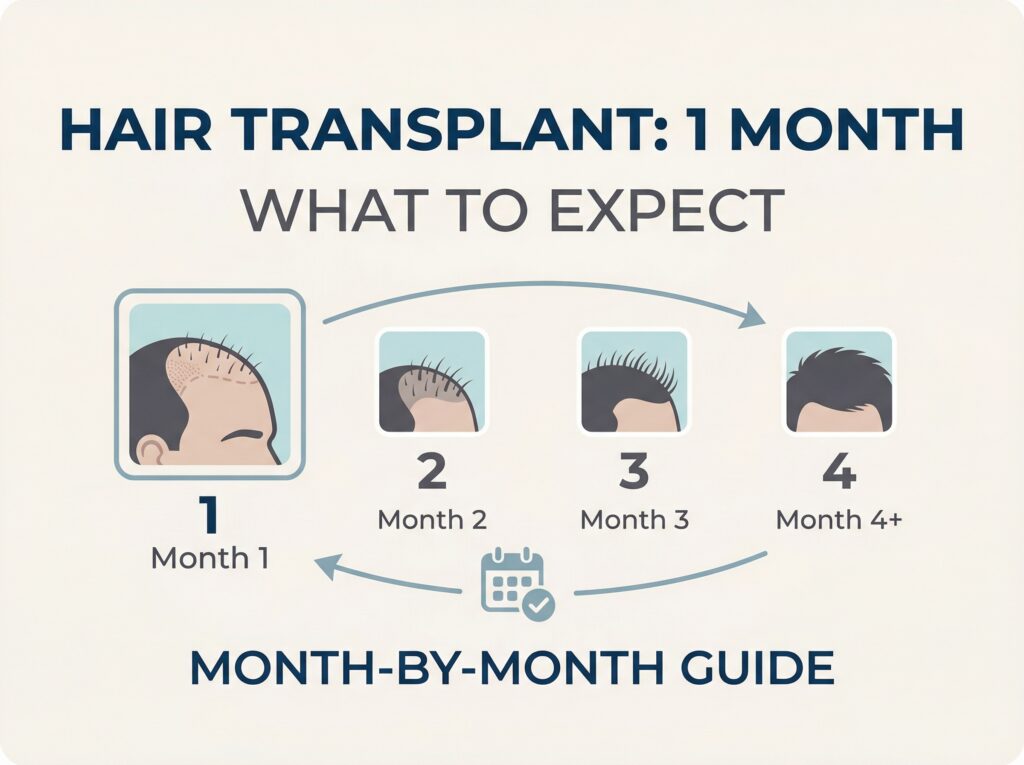
Month-by-Month Recovery Timeline
Here is the complete timeline from procedure day to final results:
| Timeline | What Happens | What You See |
|---|---|---|
| Day 1-3 | Redness, mild swelling, pinpoint scabs form | Recipient area looks pink/red, minor forehead swelling possible |
| Week 1 | Scabs solidify, donor area begins healing | Tiny dark scabs across transplanted zone |
| Week 2-3 | Scabs naturally fall off during gentle washing | Scalp looks cleaner, some redness remains |
| Month 1 | Transplanted hairs shed (shock loss — a normal post-transplant phenomenon documented in clinical literature (PubMed, 2025) begins) | Hair appears to fall out, scalp may look similar to pre-transplant |
| Month 2-3 | Follicles rest in dormant phase | Minimal visible change, patience required |
| Month 4-6 | New growth emerges, fine baby hairs appear | Thin, soft hairs become visible, gradual thickening |
| Month 7-9 | Significant growth and thickening | Noticeable improvement in density and coverage |
| Month 10-12 | Continued maturation, hair texture normalises | Strong growth, hair blends naturally with existing hair |
| Month 12-18 | Full results achieved | Maximum density, fully mature hair |
For a detailed day-by-day breakdown of the first two weeks, see our Day-by-Day Recovery Timeline.
—
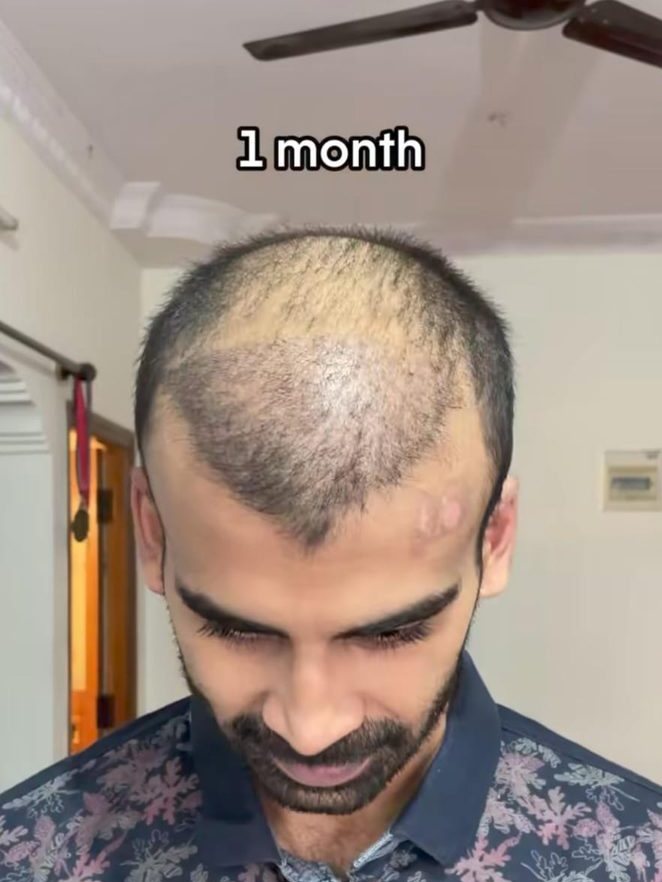
Hair Transplant After 1 Month: What It Looks Like
At the one-month mark, most patients experience a mix of emotions. The initial excitement of seeing transplanted hair in the recipient area gives way to concern as that hair begins to fall out. Here is what is actually happening:
The transplanted hairs are shedding, but the follicles remain alive beneath the skin. Think of it like a plant dropping its leaves in autumn. The roots are intact and healthy, preparing for new growth. The hair shaft that was visible above the scalp was always going to shed; it is the follicle underneath that matters.
At one month, your scalp may show:
- Small pinkish dots where grafts were placed, fading from the initial redness
- Transplanted hairs thinning or falling out (this is shock loss, covered below)
- The donor area at the back of the head looking mostly healed with minimal redness
- Slight residual tightness or numbness in the donor or recipient area, which is normal
The key thing to understand is that the appearance at one month is not an indicator of your final results. This is the very beginning of a 12 to 18-month journey.
—
Shock Loss: Why Hair Falls Out (It Is Normal!)
Shock loss is the single most anxiety-inducing part of hair transplant recovery, and it is completely expected. Here is what you need to know:
What it is: After transplantation, the trauma of being extracted and reimplanted causes the hair shaft to enter a resting phase (telogen). The visible hair falls out, typically between weeks 2 and 8 post-procedure.
Why it happens: The follicle prioritises re-establishing its blood supply in the new location. Growing a hair shaft takes energy the follicle cannot spare during this critical anchoring period, so it sheds the existing hair to focus on rooting itself firmly.
How much falls out: Most patients lose 80 to 100 percent of their transplanted hair shafts during shock loss. Some patients also experience temporary thinning of their existing native hair near the transplanted zone.
When it stops: Shock loss typically completes by the end of month 2 to 3. After that, the follicles begin their new growth cycle.
Expert Insight from Dr. Abhishek Pilani, MBBS, MD Dermatology (Gold Medalist), ISHRS Member:
“I tell every patient before their procedure: you will lose the transplanted hair in the first month or two, and it will feel discouraging. But with our UHDHT method achieving high graft survival, those follicles are alive and well. The new hair that grows from month 4 onward is the hair that will keep growing. Trust the process.”
—
After 2 Months: The Waiting Phase
Month 2 is often called the “ugly duckling” phase, and for good reason. Shock loss is complete or nearly complete, and new growth has not yet started. Your scalp may look very similar to how it appeared before the transplant.
This is the hardest part emotionally, but it is also entirely normal. During this phase:
- The transplanted follicles are establishing blood supply beneath the skin
- No visible growth is happening on the surface
- Your donor area should be fully healed by now
- Any numbness or tightness continues to resolve gradually
The best thing you can do during month 2 is follow your aftercare plan and be patient. Every one of the 20,000+ patients we have treated at Assure Clinic has gone through this same phase.
—
Month 3-6: New Growth Begins
This is when the excitement returns. Around month 3 to 4, you will notice fine, wispy baby hairs emerging from the transplanted follicles. These hairs will be thin and light-coloured initially, but they represent the beginning of your long-lasting results.
Month 3-4: Fine, soft hairs begin to appear. They may look thin and almost transparent. Growth is uneven across the transplanted area, which is normal since not all follicles restart at the same time.
Month 5-6: The early hairs begin to thicken and darken. You will start to notice a visible improvement in coverage. By month 6, most patients can see a meaningful difference compared to their pre-transplant appearance.
During this phase, you can typically resume all normal activities, including vigorous exercise, swimming, and regular hair styling. Your qualified doctor will confirm the specifics during your follow-up consultations.
—
Essential Aftercare Tips
Proper aftercare significantly impacts your results. Follow these guidelines, especially in the first three months:
First 2 weeks:
- Sleep with your head elevated at 45 degrees to reduce swelling
- Wash gently using the technique demonstrated by your medical consultant
- Avoid touching, scratching, or picking at the recipient area
- No exercise, heavy lifting, or activities that cause sweating
Weeks 2-4:
- Continue gentle washing, letting water run over the grafts rather than rubbing
- Avoid direct sunlight on the scalp; wear a loose-fitting hat if needed
- No swimming pools, saunas, or steam rooms
- Avoid smoking and alcohol, which impair blood circulation to the follicles
Month 1-3:
- Resume light exercise after your doctor approves (usually week 3-4)
- Continue protecting the scalp from direct sun exposure
- Use any prescribed medications (such as minoxidil or finasteride) as directed
- Attend all scheduled follow-up appointments
For the full aftercare guide, visit our detailed Post-Transplant Care Tips.
—
When to Contact Your Doctor
While most recovery symptoms are normal, contact your qualified doctor at Assure Clinic if you experience:
- Severe pain that does not respond to prescribed medication
- Excessive bleeding from the donor or recipient area after the first 48 hours
- Signs of infection: increasing redness, warmth, pus, or fever above 100.4 F (38 C)
- Significant swelling that worsens after day 4 or 5 (mild swelling on days 2-4 is normal)
- Large areas of graft loss due to physical trauma (if you accidentally bumped your head)
You can reach Assure Clinic at +91 95861 22444 for any post-procedure concerns. Our medical consultants are available to address your questions at any stage of recovery.
—
Full Results: Month 12-18
By month 12, the majority of your transplanted hair will have grown in. The hairs will be thicker, stronger, and behaving like your natural hair. You can cut, style, colour, and treat them exactly as you would your original hair because they are your original hair, just relocated.
Between month 12 and 18, you will see the final maturation:
- Maximum density is achieved
- Hair texture fully normalises
- Any remaining fine hairs thicken to their final calibre
- The overall result looks completely natural and permanent
Want to see what month 12 and beyond really looks like? Browse verified results from real Assure Clinic patients in our Results Gallery.
For a comprehensive look at the entire recovery journey, read our Hair Transplant Recovery Timeline.
—
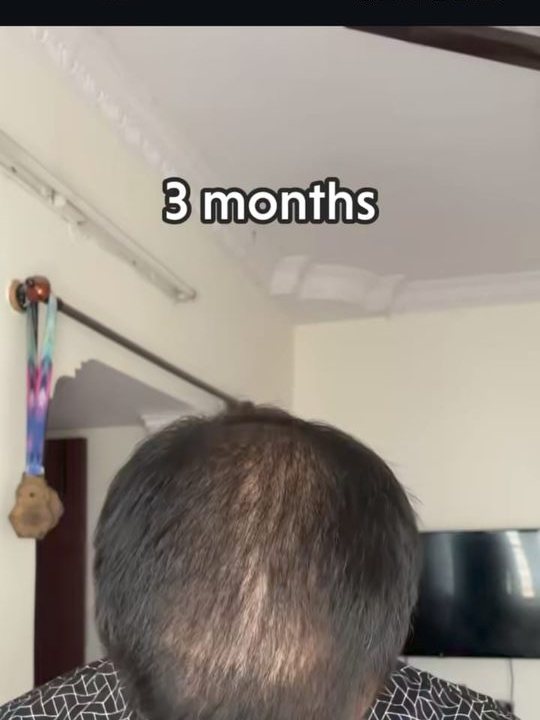
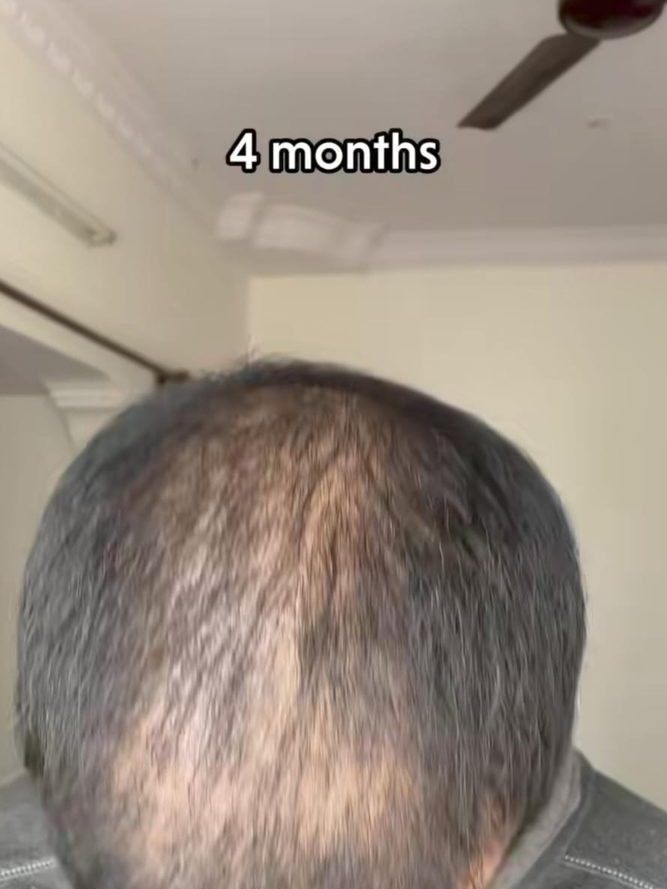
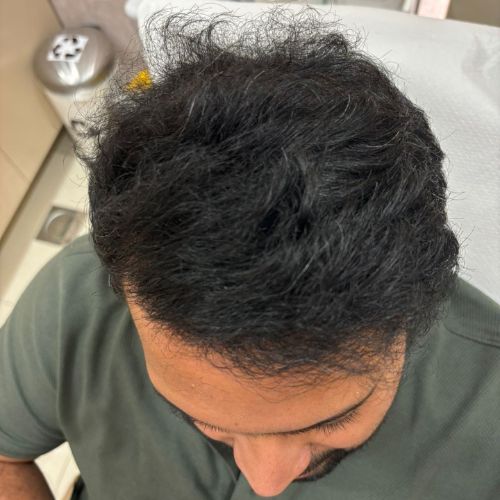
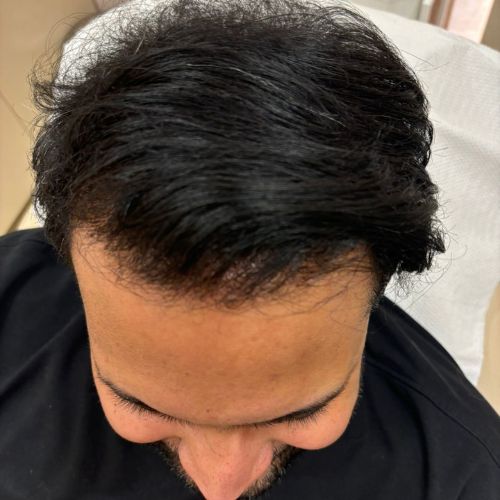
Worried it is not growing? This is what each month actually looks like
Real Assure Clinic patients, photographed through recovery and published with written consent. Tap any month to see that patient’s full timeline.

Frequently Asked Questions
Is it normal for hair to fall out 1 month after a hair transplant?
Yes, this is completely normal and expected. It is called shock loss, and it happens because the transplanted follicles shed their existing hair shaft to focus on re-establishing blood supply. The follicles remain alive and will produce new hair starting around month 3 to 4.
When will I see new hair growth after a transplant?
Most patients begin to see fine new hairs emerging between month 3 and 4. Noticeable improvement in density typically becomes visible around month 5 to 6, with full results by month 12 to 18.
Can I wear a cap 1 month after a hair transplant?
Yes, by one month post-procedure, you can wear a loose-fitting cap. Avoid tight-fitting hats that put pressure on the grafts. Your medical consultant at Assure Clinic will advise you on the specifics during your follow-up.
How long does shock loss last?
Shock loss typically begins around week 2 to 3 and is mostly complete by month 2 to 3. After that, the follicles enter a resting phase before beginning their new growth cycle around month 3 to 4.
What should I avoid at 1 month post-transplant?
At one month, avoid direct sun exposure on the scalp, swimming in chlorinated pools, heavy weightlifting, smoking, and alcohol. Continue gentle hair washing and follow your aftercare instructions from your qualified doctor.
When can I exercise after a hair transplant?
Light walking can resume after week 1. Moderate exercise like jogging is usually permitted after week 3 to 4. Heavy weightlifting and intense cardio can resume after 6 to 8 weeks. Always confirm with your qualified doctor based on your individual healing progress.