If you are losing hair at 25, you are not alone. One in four men experiences noticeable hair loss by age 25. The shock of seeing thinning at your temples, a receding hairline, or unexpected hair in the shower can feel isolating – especially when peers seem to have full, thick hair. But here is what matters: hair loss at 25 is not a life sentence. It is a medical condition with proven, actionable solutions.
The difference between stabilising your hair at 25 and losing significantly more by 35 often comes down to one thing: knowing what actually works and starting early. This guide covers everything you need to know about balding solutions for young men – why it is happening, how to assess your situation honestly, and the treatment options that deliver real results.
Every medical claim in this article is reviewed by Dr. Abhishek Pilani, ISHRS member and founder of Assure Clinic. His goal is to give you information that leads to action – not false hope, but genuine, evidence-based direction.
Take the Free 2-Minute Hair Loss Assessment
Answer 5 quick questions and get your personalized Norwood grade plus treatment recommendations from our doctors.
Start Free Assessment →Why Am I Balding at 25?
Hair loss at 25 feels early. It is. But early does not mean unusual. The causes are well-understood, and understanding them is the first step toward choosing the right solution.
Genetics: The Primary Driver
The single biggest factor determining whether you will go bald early is your family history. If your father, grandfather, or mother’s father experienced hair loss – particularly before age 40 – your risk is significantly higher.
Hair loss sensitivity is inherited not as a simple yes-or-no trait, but as a spectrum. You inherit the genetic predisposition to have hair follicles sensitive to DHT (dihydrotestosterone, the hormone behind male pattern baldness). Some men are highly sensitive and lose hair early; others carry the genes but express them slowly over decades.
The frustrating truth: you cannot change your genetics. But you absolutely can change how quickly the process advances through early intervention.
DHT – The Hormone Behind Early Balding
If genetics loads the gun, DHT pulls the trigger.
DHT is a byproduct of testosterone. Your body converts testosterone into DHT using an enzyme called 5-alpha reductase. In genetically sensitive follicles – typically at the hairline, temples, and crown – DHT binds to receptors and gradually shrinks the follicle. This process is called miniaturisation. Over time, the follicle produces thinner, shorter hair until it stops producing visible hair altogether.
This is precisely why DHT-blocking treatments work: they interrupt this process before it goes too far.
Stress and Cortisol
Chronic stress elevates cortisol, which can accelerate hair loss in genetically predisposed men. If you started losing hair around a stressful period (major exam, relationship changes, intense work pressure), stress may have accelerated an underlying genetic sensitivity.
The solution: stress management matters, but it is not a complete fix on its own. You need to address both the stress and the underlying DHT sensitivity.
Poor Nutrition and Deficiencies
Hair loss at 25 sometimes signals nutritional gaps. Zinc, iron, biotin, and selenium deficiencies can all worsen hair thinning. Young men with restrictive diets, irregular eating habits, or specific conditions affecting nutrient absorption are at higher risk.
A blood test can identify deficiencies. If you have them, supplementation can improve hair quality – though it is unlikely to be the complete solution if DHT sensitivity is the primary driver.
Hormonal Changes and Thyroid Issues
Thyroid dysfunction is less common in men than women, but when present, it can trigger early hair loss. Similarly, any significant hormonal shifts (anabolic steroid use, for example) can accelerate miniaturisation in genetically sensitive follicles.
“I see young men at 25 who panic because they think they are uniquely unlucky. The reality is that early hair loss runs in families, and genetics express themselves early in some men and late in others. The good news is that at 25, your follicles are still young and responsive to treatment. This is actually your advantage.” – Dr. Abhishek Pilani, Assure Clinic
How to Know If You’re Actually Balding (vs Just a Mature Hairline)
Not all hairline changes mean you are balding. This distinction is critical because it determines whether you need treatment or just patience.
The Mature Hairline vs Receding
A mature hairline is a natural shift that happens to most men between ages 17-30. The hairline recedes slightly at the temples – typically one centimetre or less – and then stabilises. This is normal, not pathological.
A genuinely receding hairline caused by hair loss continues to recede beyond the initial mature hairline shift. The recession accelerates, or spreads to other areas like the crown.
Warning Signs You’re Actually Losing Hair
- Progressive recession – your hairline is noticeably higher than it was one year ago
- Increased shedding – you are finding significantly more hair in the shower, on your pillow, or in your comb
- Thinning at the crown – hair is noticeably thinner when you look down or in photos
- Visibility of scalp – the scalp is visible through your hair where it previously was not
- Thinner hair texture – individual hairs feel finer, not just less dense
The Norwood Scale – Your Self-Assessment Tool
The Norwood Scale is the standard way dermatologists classify male pattern baldness. Understanding your current stage helps you choose the right treatment.
- Norwood 1-2: Mild recession at temples, full crown, most hair intact
- Norwood 3: Deeper temple recession, hairline forms an M-shape, generally good coverage elsewhere
- Norwood 4: Temple recession + crown thinning, noticeable loss pattern
- Norwood 5-6: Significant bald areas, only a band of hair remaining at the sides and back
- Norwood 7: Extensive baldness, minimal donor hair available
At 25, most men with early hair loss fall into Norwood 2-3. This is the critical intervention window – your follicles still have capacity to respond to treatment.
Uncertain about your stage? Use our Baldness Calculator for a quick assessment, or book a free consultation with Dr. Pilani’s team for a professional evaluation.
The Emotional Impact of Early Balding
Before discussing medical solutions, we need to acknowledge what you are actually experiencing.
Hair loss at 25 is not just a biological event – it is a psychological one. You are navigating an age where appearance and confidence feel intertwined. Dating, career advancement, social confidence – these all feel affected by sudden hair loss.
This is valid. Studies show that men experiencing early hair loss report measurable impacts on self-esteem, dating confidence, and even career confidence. Social media amplifies this by constantly showing men with thick, full hair.
The important reframe: early hair loss at 25 is also an opportunity. You are young enough that medical interventions have their best chance of working. You can make a decision now – either to treat it aggressively or to accept it – and then move forward with confidence. Many men find that simply taking action (rather than passively watching hair loss progress) restores a sense of control.
This is not dismissing your feelings. This is saying: your concern is legitimate, and it also has solutions.
Solution 1: DHT Blockers – Your First Line of Defence
If genetics loads the gun and DHT pulls the trigger, DHT blockers are the safety mechanism.
How DHT Blockers Work at 25
At Norwood 2-3, your follicles are miniaturised but not dead. They are still producing hair – just thinner, weaker hair. DHT blockers work by stopping or slowing the miniaturisation process, giving your follicles a chance to stabilise and sometimes recover.
The earlier you start, the better the results.
Finasteride (Propecia)
Finasteride is the most studied and proven DHT blocker. It is a prescription medication that blocks 70-73% of DHT production.
- Dosage: 1mg daily (oral tablet)
- Timeline: Hair loss stabilisation in 3-6 months; visible improvement by 12-24 months
- Efficacy: Stops hair loss progression in over 80% of men; promotes regrowth in a significant subset
- Side effects: Sexual side effects (decreased libido, erectile changes) reported in approximately 1.8-2.4% of users. These are typically mild and reversible upon discontinuation.
At 25, finasteride is often the right first step if you are at Norwood 2-3 or higher.
Natural DHT Blockers
Before prescription medication, many young men want to try dietary and natural approaches.
Effective natural options include:
- Pumpkin seed oil (zinc + phytosterols inhibit 5-alpha reductase)
- Green tea (EGCG polyphenol reduces DHT activity)
- Saw palmetto extract (320mg daily, roughly 40-50% as effective as finasteride)
- Rosemary oil (topical, comparable to minoxidil in some studies)
- Turmeric and dietary zinc
These are worth trying as Tier 1 interventions, particularly if you are at Norwood 1-2 and caught hair loss very early. But here is the honest assessment: if your family history is strong and you are already at Norwood 3 at age 25, natural options alone are likely insufficient.
“Natural DHT blockers are an excellent starting point. But I always tell young men this: if you have strong family history and your hair loss is progressing despite three months of diet and supplements, do not wait another year hoping natural options will work. The difference between starting finasteride at 25 and waiting until 27 can be substantial.” – Dr. Abhishek Pilani
For more detailed information on DHT blockers, see our complete DHT Blockers guide.
Solution 2: Minoxidil – Stimulating Regrowth
While DHT blockers stop the damage, minoxidil actively stimulates growth.
Minoxidil (marketed as Rogaine and generic versions) works by improving blood flow to hair follicles and extending the growth phase of the hair cycle. Unlike DHT blockers, which are preventive, minoxidil is stimulative.
How Minoxidil Works
- Application: Topical solution (2-5%) applied to scalp daily
- Timeline: 4-6 months to see noticeable improvement
- Efficacy: Stimulates regrowth in approximately 60-70% of men
- Best used with: DHT blockers (combination approach is more effective than either alone)
At 25 with early hair loss, minoxidil is particularly effective because your follicles are still responsive. Combined with a DHT blocker, minoxidil + finasteride is the standard dual-action approach that most dermatologists recommend for Norwood 2-4.
See our detailed Minoxidil guide for application protocols and what to expect.
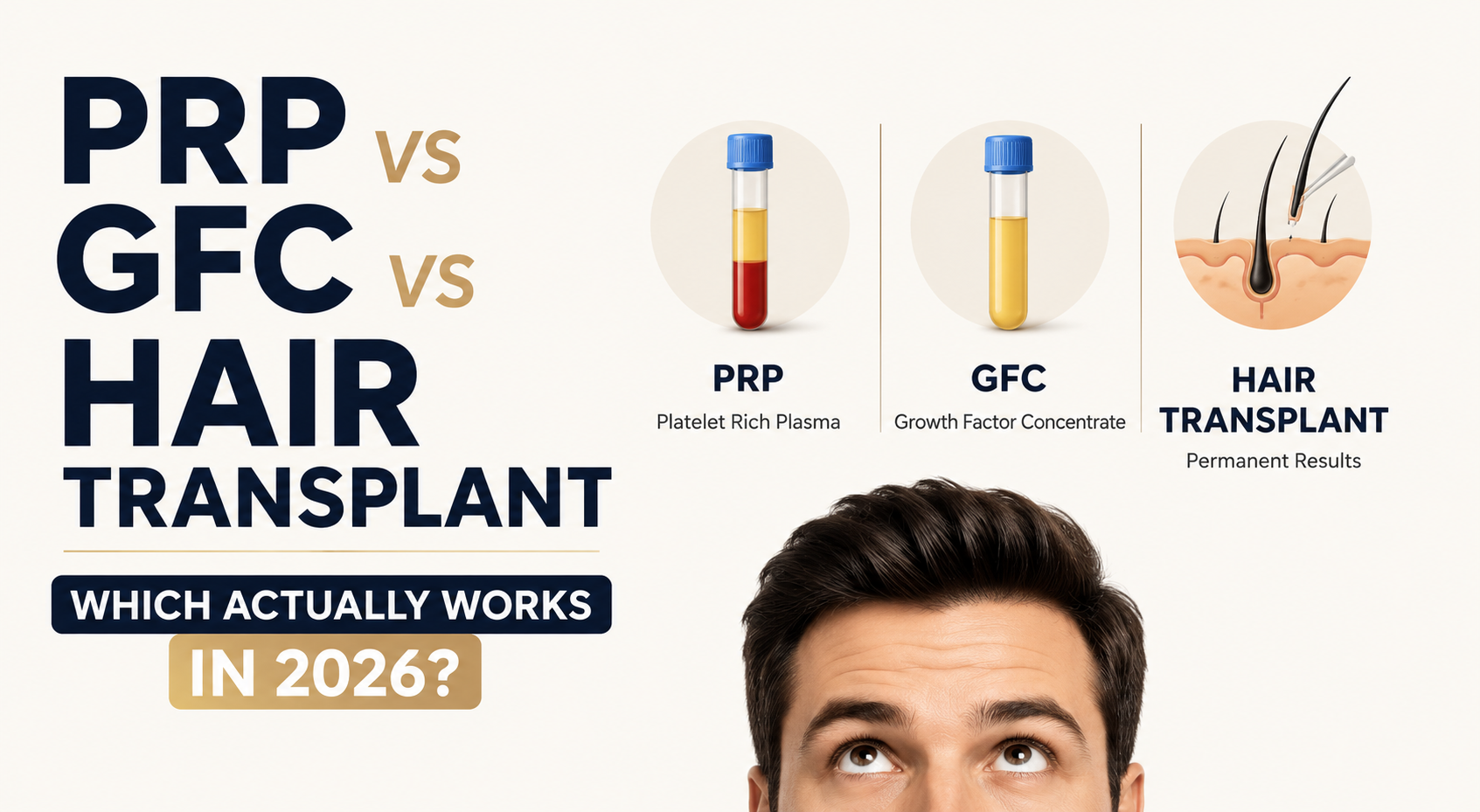
Solution 3: PRP and GFC – Boosting Growth at the Follicle Level
If DHT blockers protect and minoxidil stimulates, PRP (Platelet-Rich Plasma) and GFC (Growth Factor Concentrate) take things further by injecting growth-promoting compounds directly into thinning areas.
PRP Therapy
PRP uses your own blood’s concentrated platelets and growth factors to stimulate dormant follicles.
- Procedure: Blood drawn, centrifuged to concentrate platelets, then injected into scalp
- Sessions: Typically 3-4 sessions spaced 4-6 weeks apart
- Results timeline: Visible improvement by 4-6 months
- Cost: ₹5,000-15,000 per session
- Best for: Norwood 2-4, areas of thinning (not complete baldness)
GFC Treatment
GFC (Growth Factor Concentrate) is similar to PRP but may deliver a more concentrated growth factor profile. It is a newer option becoming increasingly available in 2026.
When to Use PRP/GFC at 25
These treatments work best as an accelerant when combined with DHT blockers and minoxidil. A young man at 25 with Norwood 2 hair loss might pursue:
- Finasteride + minoxidil as foundation
- Add PRP/GFC for 3-4 sessions to boost results
- Assess outcome at 12 months
This multi-layered approach gives you the best chance of significant improvement or even reversal if caught early enough.
Solution 4: Hair Transplant – Permanent Restoration
If your hair loss has progressed to Norwood 4 or higher, or if DHT blockers and minoxidil have plateau-ed after 12+ months, a hair transplant becomes a consideration.
Hair Transplant at 25: Special Considerations
There is a critical point when considering transplant at a young age: you must stabilise your hair first.
If you are still losing hair (because you are not yet on DHT blockers), transplanting now would be counterproductive. You would invest in restored hair at the front while losing more hair at the crown. The result would look unbalanced after five years.
The protocol: start finasteride + minoxidil now. Assess your stabilisation over 12 months. If you plateau at Norwood 3-4, then consider transplant as a way to restore what has already been lost.
Assure Clinic’s Approach to Young Transplant Patients
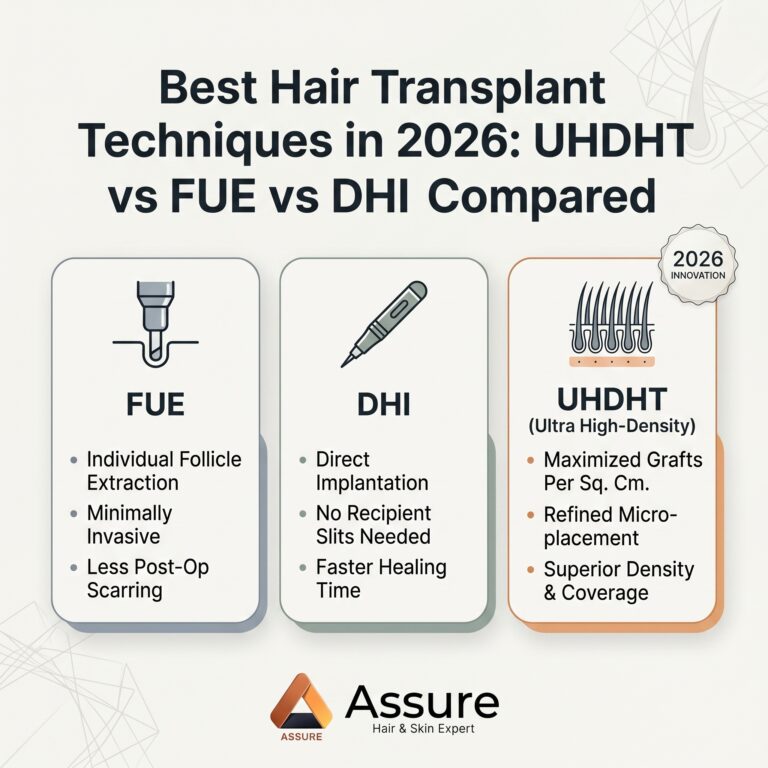
For young men who need transplant, Assure Clinic uses a phased approach:
- UFME (Ultra Fine Micro Extraction): Extracts individual grafts one by one, minimising donor area damage
- DSHI (Direct Simultaneous Hair Implantation): Implants grafts immediately, maximising graft survival
- Full Head Results Pricing: Per-session, not per-graft, ensuring you know the complete cost upfront
- 95% Graft Survival Rate: Validated across 20,000+ procedures since 2015
- Doctor-led, never technicians: All procedures overseen by 60+ Qualified Doctors
For a young man at Norwood 3-4, a phased approach with 2-3 sessions is often better than one massive session. This allows maximum density while protecting the donor area for potential future use.
The critical reminder: even after transplant, DHT blockers remain non-negotiable. They protect your remaining native hair from continued loss, ensuring your transplanted results blend naturally with your own growing hair.
What NOT to Do When You’re Going Bald at 25
Don’t Panic – But Don’t Ignore It Either
Panic leads to poor decision-making: impulsive purchases of unproven products, jumping between treatments without allowing time to work, or becoming so fixated on hair loss that it damages mental health.
But ignoring the problem is equally counterproductive. Hair loss progresses. Two years of untreated loss at 25 often means a Norwood 2 becomes Norwood 4.
Action, not panic: see a dermatologist, understand your situation, and make a deliberate plan.
Don’t Buy Random Hair Loss Products
The market is flooded with unproven serums, shampoos, and supplements claiming to regrow hair. Most have no clinical evidence.
If a product sounds too good to be true, it is. The only treatments with strong clinical evidence are: finasteride, minoxidil, PRP/GFC, and transplant.
Don’t Self-Medicate or Copy Dosing
You might find forums where men discuss finasteride or other medications. Do not self-prescribe based on what worked for someone online. Your situation is unique: your genetics, current hair loss stage, overall health, and other medications all matter.
See a doctor. Get prescribed the right dose. Get monitored.
Don’t Assume You Can Reverse Everything Without Treatment
Some men adopt the mindset: “I will just accept my hair loss and move on.” That is a valid choice. But then actually accept it – do not spend years wishing you had treated it earlier.
Conversely, if you choose to treat, commit to it. DHT blockers and minoxidil need 12 months to show full results. Quitting after 3-4 months because you don’t see change yet is not giving the treatment a fair chance.
“The men I see who have the best outcomes at 25 are those who take decisive action early. They see a dermatologist, start finasteride and minoxidil, and then give it 12-18 months. By 26 or 27, they have either stabilised their hair or significantly improved it. Compare that to men who wait and see, or who try every supplement under the sun – by the time they commit to real treatment, more damage is done.” – Dr. Abhishek Pilani
Creating Your Action Plan
Your situation is unique, but here is a general framework based on hair loss severity:
If You’re at Norwood 1-2 (Mild Recession, Early Thinning)
Month 1-3: Tier 1 – Foundation
– Book a dermatology consultation for official staging
– Start DHT blocker diet: pumpkin seeds, green tea, turmeric, spinach daily
– Add saw palmetto extract (320mg daily)
– Manage stress through exercise and sleep
– Get blood work to check for nutritional deficiencies
Month 3-6: Tier 2 – Escalation (if still progressing)
– Consider topical finasteride or oral finasteride (prescription from dermatologist)
– Add minoxidil 2% topical
– Continue dietary DHT blockers
Reassess at 12 months – If stabilised, continue maintenance. If still progressing, move to PRP/GFC consultation.
If You’re at Norwood 3-4 (Moderate Recession, Crown Thinning)
Month 1: Tier 3 – Medical Foundation
– Dermatology appointment with hair loss specialist
– Start finasteride 1mg daily (prescription)
– Start minoxidil 5% topical
– Get baseline photos for comparison
Month 1-6: Tier 3 – Dual Action
– Continue finasteride + minoxidil
– Consider PRP or GFC (3-4 sessions spaced 4-6 weeks apart) to accelerate results
Month 12: Reassess
– If significantly improved or stabilised: continue maintenance
– If plateau-ed: consult on transplant possibility with Dr. Pilani’s team
If You’re at Norwood 5+ (Extensive Loss)
Immediate step: Dermatology consultation
– Assess whether DHT blockers would help stabilise remaining native hair
– Discuss hair transplant feasibility
– Plan phased transplant approach if candidate
Ready to take action? You do not have to figure this out alone. Book a Free Consultation with Dr. Pilani’s team. You will get a professional Norwood staging, scalp analysis, and a personalised treatment roadmap – no obligation, no cost.
From Other Young Men Who Have Been Here
Hair loss at 25 can feel isolating, but it is surprisingly common. Young men who have addressed it early report:
- Relief at having a plan and taking action (rather than passively worrying)
- Visible stabilisation or improvement within 12 months
- Restored confidence once they understood their options
- Surprise at how manageable medical treatment is (a pill and a topical serum daily)
The isolation often dissolves once you realise: you are not uniquely cursed. You are dealing with a medical condition that millions of men your age face – and you are taking action to address it.
Frequently Asked Questions
Why am I balding at 25 when my friends aren’t?
Hair loss sensitivity is primarily genetic. If your father, grandfather, or maternal grandfather experienced early hair loss, you inherited genes that make your follicles sensitive to DHT. Timing and severity vary – some men show hair loss at 20, others at 40 or never. Family history is the strongest predictor.
Is hair loss at 25 permanent?
Hair loss progression at 25 is not permanently fixed – it can be slowed, stabilised, or partially reversed with treatment. However, the longer you wait to treat, the more permanent loss occurs. Starting treatment now (at 25) gives you significantly better outcomes than waiting until 30.
What is the fastest way to stop hair loss at 25?
The fastest approach is combination therapy: finasteride + minoxidil together. Finasteride stops DHT-driven miniaturisation; minoxidil stimulates regrowth. Combined, they work synergistically. Adding PRP/GFC accelerates results further. Results are typically visible by month 6-12.
Can I regrow lost hair at 25?
Partial regrowth is possible if the follicles are miniaturised but still alive. At Norwood 2-3, where you still have fine hair and some coverage, finasteride + minoxidil can produce meaningful regrowth in 40-50% of men. At Norwood 4+, medical treatments stabilise loss but are unlikely to fully restore density without transplant.
Should I get a hair transplant at 25?
Not immediately. Transplant is best reserved for men who have stabilised their hair loss on DHT blockers + minoxidil for 12+ months, and still want restoration. At 25, you are still potentially losing hair – transplanting before stabilisation creates an unbalanced result. Use medical treatments first; consider transplant in your late 20s if needed.
What if DHT blockers don’t work for me?
The majority of men (80%+) see stabilisation with finasteride. A smaller percentage see regrowth. If you are non-responder after 12 months, adding minoxidil, PRP, or considering other treatments with your dermatologist is the next step. Some men respond better to dutasteride (a stronger DHT blocker) off-label. A doctor can help you optimise.
Are there side effects I need to worry about?
Finasteride causes sexual side effects in approximately 1.8-2.4% of users – typically mild and reversible. Natural DHT blockers (foods, saw palmetto) have minimal side effects. Minoxidil can cause scalp irritation in some users. Any concerns should be discussed with your prescribing doctor.
How much will treatment cost?
Finasteride generics: ₹500-1,500/month
Minoxidil: ₹500-1,500/month
PRP/GFC: ₹5,000-15,000 per session (typically 3-4 sessions)
Hair Transplant: Full Head Results pricing (consult with clinic for quote)
Most young men start with finasteride + minoxidil (₹1,000-3,000/month combined) and assess after 12 months.
Is there any way to prevent hair loss if I haven’t started losing yet?
Yes. If you have strong family history but no current loss, preventive measures include: DHT blocker diet (pumpkin seeds, green tea, turmeric), stress management, adequate sleep, regular exercise, and nutritional optimization (zinc, iron, biotin). At this stage, you do not need medication – but building these habits now gives you a foundation.
How do I know if I’m a good candidate for a transplant?
You are a candidate for transplant if: you have stable hair loss (not actively worsening on medication), you are at Norwood 3 or above, you have sufficient donor hair at the back and sides of the scalp, and you have realistic expectations about results. A consultation with Dr. Pilani’s team will assess your specific candidacy.
Don’t wait another year wondering “what if.” Book a Free Consultation today. Get a professional assessment, understand your Norwood stage, and leave with a clear action plan. No cost, no obligation.