
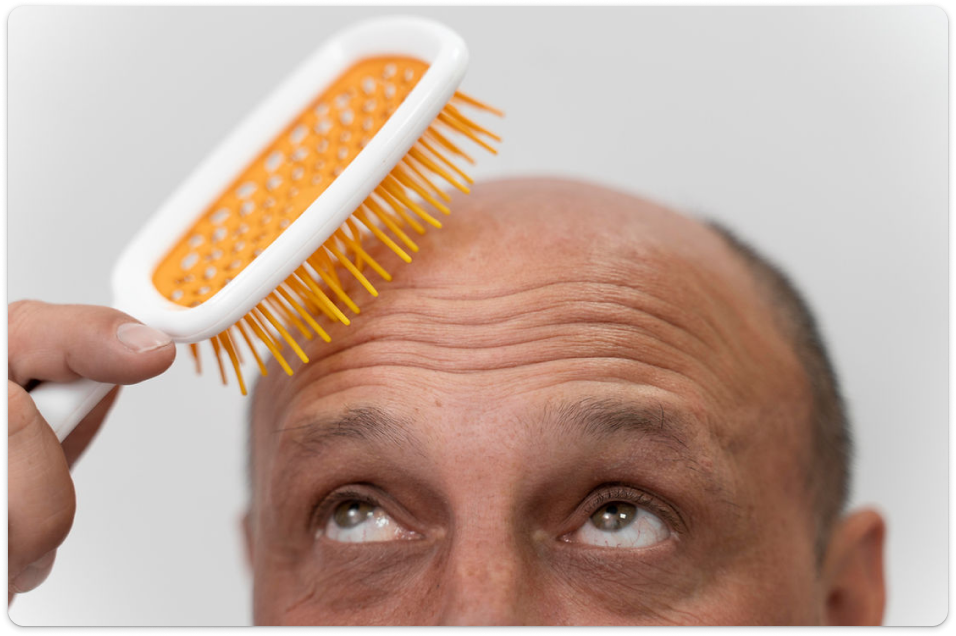
The Honest Answer: It Depends on Your Norwood Stage
The Norwood Scale classifies male pattern baldness into seven stages. Your stage determines whether a hair transplant is feasible and what kind of results you can realistically expect.
Norwood 5-6: Yes, Hair Transplant Works
At Norwood 5 and 6, you have lost significant hair across the front, top, and crown. The remaining hair forms a horseshoe pattern around the back and sides. This is what most people mean when they say “completely bald” — but critically, your donor area is still intact.
For these patients, hair transplant is absolutely viable. The key is managing expectations and planning strategically:
Most of our Norwood 5-6 patients are genuinely surprised by how much can be achieved. The difference between strategic placement by an experienced MD Dermatologist and basic coverage by a technician is enormous.
Norwood 7: Limited But Possible With the Right Approach
Norwood 7 represents the most advanced stage of male pattern baldness. Only a narrow band of hair remains around the sides and back. At this stage, a full-coverage transplant is typically not recommended — the math simply does not work. You would need 7,000-8,000 grafts for meaningful coverage, but the donor area can only safely provide 4,000-6,000 without visible thinning.
However, there are still options:
Strategic frontal restoration: Instead of attempting full coverage, transplanting 2,500-3,500 grafts into the frontal hairline and mid-scalp creates a natural frame for the face. This is the area people actually look at during conversation. Combined with a shorter hairstyle, this approach produces remarkable results.
Body hair transplant (BHT): Chest, beard, and leg hair can supplement scalp donor hair, potentially adding 1,000-2,000 additional grafts. Body hair differs in texture and growth cycle from scalp hair, so it is primarily used for adding density behind the transplanted hairline rather than creating the hairline itself. At Assure Clinic, our UFME extraction technology works effectively on body hair due to its ultra-fine punch size.
Combination approach: The most effective strategy for Norwood 7 patients combines a limited transplant for the frontal zone with scalp micropigmentation (SMP) for the crown and mid-scalp. This creates the appearance of a closely cropped full head of hair while the transplanted front provides real, growing hair where it matters most.
Truly Bald (No Donor Hair at All): Transplant Is Not Possible
If you have no hair remaining anywhere on the scalp — including the back and sides — a traditional hair transplant cannot be performed. There is simply no donor hair to work with. Any clinic that tells you otherwise is not being honest.
In this scenario, the options are:
At Assure Clinic, we will never recommend a procedure that cannot deliver meaningful results. If you are not a candidate for transplantation, we will tell you directly and recommend the alternative that best suits your situation.
—
How Assure Clinic Evaluates Patients With Advanced Baldness
When a patient with significant hair loss visits Assure Clinic, our MD Dermatologists conduct a thorough assessment that goes far beyond simply counting bald spots:
Donor density analysis: We measure the number of follicular units per square centimetre in your donor area using advanced magnification. A healthy donor area has 60-80 FU/cm2. Below 40 FU/cm2, extraction risks visible thinning in the donor area itself.
Scalp laxity assessment: How much flexibility your scalp has determines how many grafts can be safely extracted without creating tension or visible scarring.
Hair calibre measurement: Thicker individual hairs provide more visual coverage per graft. Indian men generally have excellent hair calibre, which works in their favour.
Progression analysis: Is your hair loss stable or still progressing? For patients under 35, we assess whether medical therapy (finasteride, minoxidil) should be started before or alongside transplantation to protect existing hair.
Expectation alignment: This is perhaps the most important step. We show patients realistic before-and-after photographs of cases similar to theirs — not cherry-picked best results, but honest outcomes that reflect what their specific donor area and hair loss pattern can achieve.
This assessment takes 30-45 minutes and is completely free at all Assure Clinic locations. We would rather turn away a patient who is not a good candidate than perform a procedure that delivers disappointing results.
—
Why the Surgeon Matters More Than the Graft Count
For patients with advanced baldness, the skill gap between an experienced hair restoration specialist and a general practitioner becomes enormous. Here is why:
Hairline design: An experienced surgeon creates a hairline that looks natural at every angle — slightly irregular, age-appropriate, and positioned to maximise the visual impact of limited grafts. A poorly designed hairline on a Norwood 6 patient looks obviously artificial and wastes precious grafts.
Graft distribution: With a limited donor supply, every graft must be placed strategically. Our MD Dermatologists use a density gradient approach — higher density at the hairline (35-40 FU/cm2), tapering to lower density further back (20-25 FU/cm2). This creates the illusion of fullness while making the most of available grafts.
Donor preservation: At Assure Clinic, our UFME technique uses 0.6-0.8mm micro-punches rather than the standard 0.9-1.2mm. This smaller punch size means less trauma to the donor area, which matters enormously when you may need a second session in the future. Over-harvesting the donor area in a single aggressive session is one of the most common mistakes clinics make with advanced baldness patients.
Honest counselling: The best surgeons are the ones who tell you what is NOT possible, not just what is. If a clinic promises you a full head of hair at Norwood 7, that is a red flag.
—
What Results Can You Realistically Expect?
Here is a straightforward guide based on what we see at Assure Clinic:
| Hair Loss Stage | Transplant Feasible? | Expected Grafts | Realistic Outcome |
|---|
| Norwood 5 | Yes | 3,000-4,500 (1-2 sessions) | Natural hairline + good frontal density + moderate crown coverage |
|---|
| Norwood 5V | Yes, with planning | 3,500-5,000 (2 sessions) | Natural hairline + frontal density. Crown may need SMP supplement |
|---|
| Norwood 6 | Yes, with realistic expectations | 4,000-6,000 (2 sessions) | Strong frontal frame. Mid-scalp coverage. Crown coverage limited |
|---|
| Norwood 7 | Limited | 2,500-3,500 + BHT option | Frontal hairline only. Combine with SMP for best overall result |
|---|
| No donor hair | No | N/A | SMP, hair systems, or BHT from body hair only |
|---|
These are honest numbers from 30,000+ procedures. Any clinic promising more is either over-harvesting the donor area or inflating expectations.
—
Alternatives to Hair Transplant for Complete Baldness
If a transplant is not right for your situation, these are the proven alternatives:
Scalp Micropigmentation (SMP)
SMP uses micro-needles to deposit pigment into the scalp, creating the appearance of a closely shaved head. It works for any level of baldness, requires no surgery, and results are visible immediately. The treatment typically requires 2-3 sessions over 2 weeks and lasts 4-6 years before requiring a touch-up.
SMP is particularly effective when combined with a limited hair transplant — the transplanted hair at the front provides real texture and depth, while SMP fills in the crown and mid-scalp.
Medical Therapy
For patients whose hair loss is still progressing, medications can stabilise the loss and sometimes promote regrowth:
At Assure Clinic, many of our advanced baldness patients start with medical therapy 3-6 months before transplantation to stabilise their remaining hair and optimise the surgical outcome.
Body Hair Transplant (BHT)
When scalp donor hair is insufficient, beard and chest hair can supplement the graft count. Body hair has different growth characteristics — shorter growth cycle, finer texture — so it is used to add density behind the hairline rather than create the hairline itself.
Our UFME technique is particularly well-suited for body hair extraction because the ultra-fine 0.6-0.8mm punch minimises scarring on visible areas like the chest and beard.
—
Book Your Free Assessment
The only way to know what is genuinely possible for your specific hair loss is a professional assessment. At Assure Clinic, our MD Dermatologists will evaluate your donor area, discuss your goals, and give you an honest answer — even if that answer is that a transplant is not the right option for you.
We offer free consultations at all 13 clinics across India and our Dubai centre. No pressure, no obligation — just an honest professional opinion from doctors who have seen every stage of hair loss across 30,000+ procedures.
—
Frequently Asked Questions
Can a completely bald person get a hair transplant?
It depends on the donor area. If you still have healthy hair around the back and sides of your head (the “horseshoe”), a transplant is possible even at Norwood 6-7. If there is no donor hair remaining anywhere, traditional transplantation is not feasible — but alternatives like scalp micropigmentation and body hair transplant may help.
How many grafts does a completely bald person need?
A Norwood 6 patient typically needs 4,000-6,000 grafts across two sessions for meaningful coverage. A Norwood 7 patient may need 2,500-3,500 grafts for frontal restoration plus body hair supplementation. Full scalp coverage from ear to ear would require 7,000-10,000 grafts, which exceeds what most donor areas can safely provide.
Is body hair transplant effective for bald patients?
Body hair from the beard and chest can supplement scalp donor hair, adding 1,000-2,000 grafts to the total available. However, body hair has a shorter growth cycle and different texture, so it works best for adding density behind the hairline rather than creating the hairline itself. Results vary based on body hair quality and quantity.
What is the best option for someone who is too bald for a transplant?
Scalp micropigmentation (SMP) is the most effective non-surgical solution for complete baldness. It creates the appearance of a closely shaved head and works for any degree of hair loss. Combining SMP with a limited transplant at the hairline provides the most natural overall result.
Am I too bald for a hair transplant?
The only way to know is a professional assessment of your donor area. Many men who believe they are “too bald” are surprised to learn they have 4,000-6,000 usable grafts available. At Assure Clinic, our free consultation includes donor density analysis, scalp laxity assessment, and honest guidance on what is achievable.
How much does a hair transplant cost for a bald person?
At Assure Clinic, we do not charge per graft. Our all-inclusive treatment packages cover the entire procedure, medications, PRP therapy, and 12 months of follow-up. The cost depends on your specific treatment plan, which our MD Dermatologists design after evaluating your hair loss pattern and goals. Book a free consultation for a transparent, fixed-price quote.
—
Disclaimer: Individual results vary based on hair loss stage, donor area quality, and overall health. This article is for educational purposes only. Consult a qualified dermatologist for personalised assessment.
Last Updated: March 2026
Find a Clinic Near You
Ready to Transform Your Appearance?
Book a free consultation with our expert dermatologists today
Call +91-9586122444The Complete Hair Loss Guide 2026
Expert guide by Dr. Abhishek Pilani covering causes, treatments, and when to consider a hair transplant. Trusted by 10,000+ readers.
